
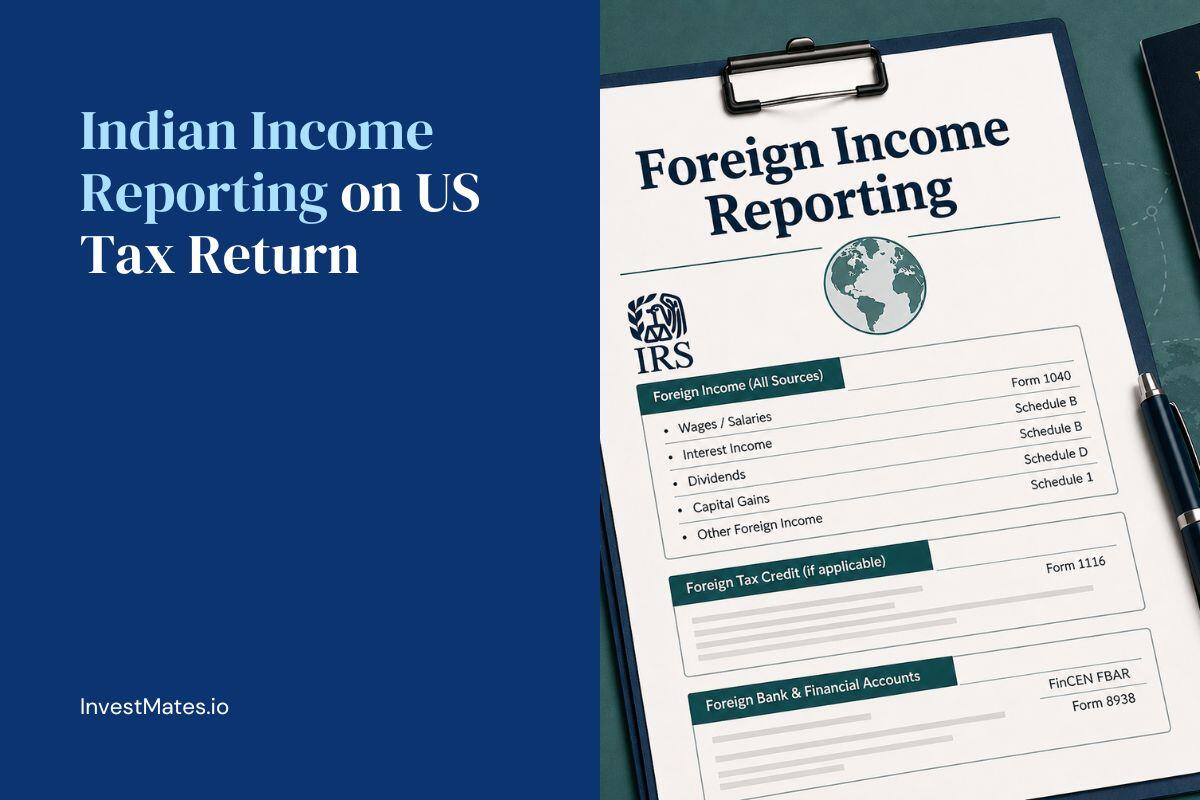
If you are an NRI living in the US, reporting foreign income from your Indian financial assets on your US tax return is not optional, not for your PPF account, your old NRE fixed deposit, or the mutual fund SIPs your parents set up years ago. Each one carries its own separate US reporting rule, and missing even one can leave the IRS statute of limitations open indefinitely on your entire return.
This checklist walks you through the process one asset type at a time, so you know exactly which form applies to what you actually own.
What you'll need before you start
Gather these before you try to match any asset to a form.
- Your PAN and Form 26AS or AIS statement from the Indian income tax portal
- Consolidated Account Statements (CAS) from NSDL or CDSL for demat holdings, and CAMS or KFintech statements for mutual funds
- Bank statements for every NRE, NRO, and FD account, including closed accounts that were open at any point in the year
- Your EPFO passbook and any NPS or ULIP statements
- Fair market values in INR as of December 31, converted using the Treasury Department's year end spot rate for asset reporting and the IRS yearly average rate for income
Step 1: Make a complete inventory of every Indian asset you hold
Start by listing everything, not just what you remember filing last year. Include savings and NRE or NRO accounts, fixed and recurring deposits, demat accounts holding stocks or ETFs, mutual funds bought directly or through SIPs, PPF, EPF, NPS, ULIPs, any life insurance policy with cash value, gratuity or superannuation funds, inherited or gifted property, gold, and any Indian crypto holdings.
This step matters because most US reporting thresholds are based on the combined value of everything you hold, not any single account. Priya, a software engineer in Seattle, assumed her FBAR obligation did not apply because no single Indian account of hers held more than $6,000. Once she added her NRE savings, her father's joint FD, and her demat cash balance together, she crossed $10,000 and needed to file.
Write the inventory down asset by asset, with an approximate value for each, before you move to the next step. A spreadsheet with columns for asset type, institution, and year end value in both INR and USD takes fifteen minutes to build and saves hours of back and forth with a preparer later.
Step 2: Check whether you must file the FBAR
The FBAR, or FinCEN Form 114, is required if the aggregate value of your foreign financial accounts exceeded $10,000 at any point during the calendar year, even for a single day. This covers your NRE, NRO, savings, FD, and RD accounts, plus the cash balance in your demat account.
It does not cover stocks or mutual fund units held directly, real estate, or gold. It is filed separately from your tax return, directly with FinCEN, by April 15 with an automatic extension to October 15.
Penalties matter here. A non-willful violation currently runs up to roughly $16,500 per violation, and a willful one runs to the greater of about $165,000 or half the account balance. Filing correctly is a lot cheaper than fixing it later. For the full filing walkthrough, InvestMates has a complete FBAR guide for NRIs covering deadlines and the filing process step by step.
Step 3: Check whether you must file Form 8938
Form 8938, the FATCA reporting form, catches more than the FBAR does. It applies to specified foreign financial assets, which includes your accounts but also stocks, mutual fund units, and insurance contracts with cash value held directly, not just through an account.
The threshold depends on your filing status and whether you live in the US or abroad. A single filer living in the US files if assets exceed $50,000 at year end or $75,000 at any point in the year. Married filing jointly, that becomes $100,000 at year end or $150,000 at any point. These thresholds roughly double or triple for NRIs living outside the US.
Form 8938 attaches to your Form 1040 and is due with your return. Assets you already report on Form 3520, 5471, or 8621 do not need to be listed again here, though you still need to file the form itself. Ravi, an NRI on an H-1B in New Jersey, files jointly with his wife. Between their NRE deposits, a demat account, and two mutual fund folios, they cleared $100,000 well before December 31, so Form 8938 was mandatory even though no single holding looked large on its own. InvestMates covers the overlap between FATCA and India's own CRS reporting in more detail in this FATCA and CRS guide.
Step 4: Identify PFIC assets and file Form 8621
This is the step most NRIs get wrong, and it is the most expensive one to get wrong. Indian equity mutual funds, debt mutual funds, ELSS funds, and India-listed ETFs are all classified as Passive Foreign Investment Companies, or PFICs, under US tax law. Most tax professionals treat ULIPs the same way for the investment portion, since the IRS looks through the insurance wrapper to the underlying fund.
Without a protective election, PFIC income defaults to the excess distribution method under Section 1291, which taxes gains at the highest rate for each year you held the fund, plus an interest charge on top. There is a narrow exemption: if your total PFIC holdings are $25,000 or less as a single filer, or $50,000 or less filing jointly, and you had no distributions, sales, or elections during the year, you are not required to file Form 8621 for that year.
Miss a required Form 8621 and the statute of limitations on your entire tax return stays open indefinitely under Section 6501(c)(8), not just on the PFIC. That is a real risk, not a technicality. InvestMates has a step-by-step Form 8621 filing guide that walks through each method in detail.
Step 5: Report interest, dividends, capital gains, and claim your foreign tax credit
Interest from your NRE, NRO, and FD accounts is fully taxable on your US return, even when it is tax exempt in India, as NRE interest generally is. The TDS withheld in India is usually creditable against your US tax through Form 1116, so you are not typically paying tax twice.
PPF is the trap here. Its interest is exempt under Section 10(11) of India's Income Tax Act, which means there is no Indian tax paid and therefore nothing to credit on your US return. You end up owing US tax on PPF interest with no offset at all, a detail that catches a lot of first time filers by surprise. InvestMates breaks down exactly how PPF, EPF, and NPS are taxed in the US, and how fixed deposit interest is treated is covered in this Indian FD tax reporting guide.
Step 6: Handle gifts and inherited assets from India
Money your parents send you is generally not taxable income in the US, but it can trigger Form 3520 if the aggregate gifts you receive from all foreign individuals exceed $100,000 in a calendar year. The form is informational, not a tax bill, but skipping it when required can bring a penalty of up to 25% of the amount involved, assessed at 5% per month it's late.
Inheriting property or investments from India works similarly. There is no US tax at the moment of inheritance, but you file Form 3520 Part IV if the value exceeds $100,000, and you need to track the stepped up basis carefully since India and the US calculate cost basis differently after death. InvestMates has a dedicated guide on filing Form 3520 for an inheritance from India that covers this in full.
Step 7: Catch up through streamlined filing if you have unreported past years
If you have gone through this checklist and realized you should have been filing FBAR, Form 8938, or Form 8621 in prior years, do not simply start filing going forward and hope nobody notices the gap. The Streamlined Filing Compliance Procedures exist for exactly this situation, provided your prior non-compliance was non-willful.
NRIs living outside the US generally qualify for the Streamlined Foreign Offshore Procedures, which waive the FBAR and accuracy penalties entirely. Those living in the US typically use the Domestic version, which carries a one time penalty of 5% of the highest account balance in the covered years. Both require three years of amended or delinquent returns and six years of FBARs, plus a signed certification that the failure was not willful. The IRS publishes the full eligibility rules and the exact certification language on its Streamlined Filing Compliance Procedures page, and it is worth reading before you certify anything.
Returns filed this way are still open to audit. There is no closing agreement, so keep your workpapers organized in case the IRS asks follow-up questions later.

| Asset | FBAR | Form 8938 | Form 8621 (PFIC) | Foreign tax credit |
|---|---|---|---|---|
| NRE / NRO savings account | Yes | Yes | No | Limited |
| Fixed or recurring deposit | Yes | Yes | No | Yes, on TDS |
| Indian mutual funds and ELSS | Yes | Yes | Yes | Limited |
| Indian ETFs | Yes | Yes | Yes, MTM may apply | Limited |
| Stocks in a demat account | Yes | Yes | Only if fund-like | Yes |
| PPF | Yes | Yes | No | No credit available |
| EPF | Contested, generally yes | Yes | No | Limited |
| NPS | Yes | Yes | No | Limited |
| ULIP | Yes | Yes | Likely yes | Limited |
| Real estate held directly | No | No | No | Yes, on gains |
| Physical gold | No | No | No | On sale gains |
Common mistakes to avoid
A few mistakes show up again and again. Filing the FBAR and assuming it covers Form 8938 too, when they are entirely separate filings with different thresholds. Assuming PPF is automatically exempt from US reporting because it is exempt in India, when the opposite is often true for the interest income. Checking each account against the FBAR threshold individually instead of adding them together. Treating a jointly held account with a parent in India as somehow outside FBAR scope, when signature authority alone can be enough to require reporting. And waiting years after discovering a gap to do anything about it, when Streamlined Filing gets harder to qualify for the longer the IRS has already been asking questions.
Conclusion
Reporting Indian financial assets on your US tax return comes down to matching what you hold to the right form: FBAR for accounts over $10,000, Form 8938 for broader assets above your filing threshold, Form 8621 for PFIC investments like mutual funds, and Form 3520 for large gifts or inheritances. Work through this checklist asset by asset rather than guessing, and if anything is unclear, talk to an advisor before you file rather than after the IRS asks.
Frequently asked questions
Do I need to report my Indian bank account to the IRS?
Yes, if the combined value of all your foreign financial accounts, including Indian savings, NRE, NRO, and FD accounts, exceeded $10,000 at any point in the year. This is the FBAR threshold, filed with FinCEN, and it applies even if the balance was only over $10,000 for a single day.
How do I report Indian mutual funds on my US tax return?
Indian mutual funds are generally classified as PFICs, which means they need Form 8621 in addition to FBAR and Form 8938 if you clear those thresholds. There is a narrow exemption if your total PFIC holdings are $25,000 or less as a single filer, or $50,000 or less filing jointly, with no distributions or sales in the year. Read more about what a PFIC actually is and why it matters for Indian funds specifically.
What is the most commonly missed form for NRIs?
Form 8621 for PFIC holdings is the one most often missed, largely because most NRIs have never heard the term PFIC until a CPA raises it. Missing a required Form 8621 keeps the statute of limitations open on your entire return indefinitely, not just on that asset.
Does the IRS actually find out about my Indian bank accounts and investments?
Generally, yes. The US and India share financial account information under a FATCA intergovernmental agreement, and Indian banks and mutual fund houses report US person account holders directly to their regulators, who pass that data to the IRS.
I never filed FBAR for my Indian accounts even though I should have. What do I do now?
If the omission was non-willful, look into the Streamlined Filing Compliance Procedures before you do anything else. Filing going forward without addressing the past creates its own risk, while Streamlined Filing can resolve prior years with reduced or no penalty if you qualify. InvestMates has more detail on fixing late FBAR filings and the options available.