
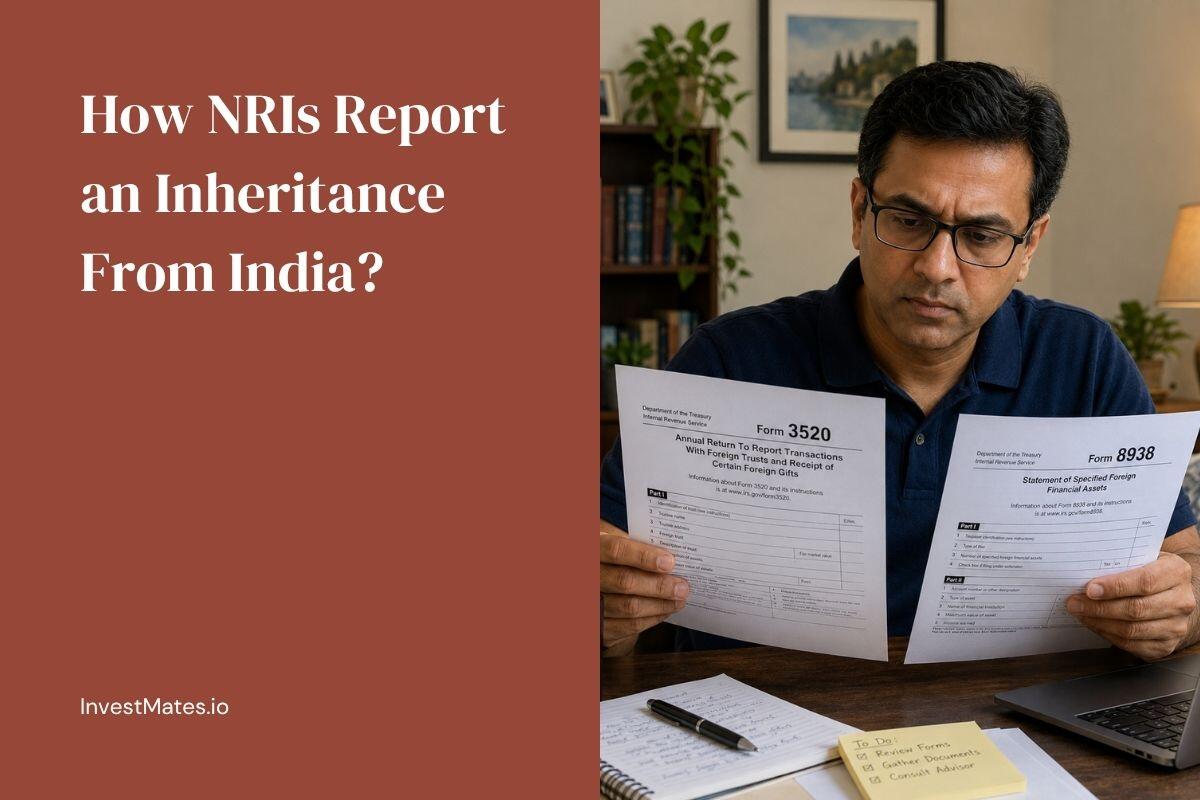
A large deposit lands in your NRO account after your father's estate in India settles, and two IRS forms with similar-sounding names are suddenly staring back at you.
If you're a US taxpayer who inherited money, property, or investments from India, you likely need to file Form 3520, Form 8938, or both, even though the inheritance itself isn't taxed.
I'll explain both forms step by step: who has to file, what counts toward the threshold, and what happens if you miss the deadline.
Step 1: Check whether Form 3520 applies to you
Start by adding up everything you received this tax year from the estate, or from any foreign person related to the deceased. You must file Form 3520 if the total gifts and bequests from a nonresident alien individual or a foreign estate exceed $100,000 in the year.
This threshold applies per source, not per transfer. If your father's estate sent money in two installments and your uncle in India separately gifted you cash, and the IRS treats them as related parties, you add both amounts together against the $100,000 mark.
Once you cross $100,000, you list every individual gift or bequest over $5,000 separately on Part IV of the form. You don't owe income tax on the inheritance itself. The US doesn't tax its taxpayers on money or property they inherit from abroad, this filing is purely informational.
Take Priya, a software engineer in Austin. Her father passed away in Pune, and his estate transferred ₹1.2 crore, about $145,000, into her NRO account in March. Because that's over $100,000, she has to file Form 3520 for the year she received it, even though she won't pay a cent of tax on the money.
Step 2: Check whether Form 8938 applies to you
Next, look at all your specified foreign financial assets, not just the inheritance, and value them as of December 31 and at any point during the year. This includes the inherited money once it sits in an Indian bank account, inherited mutual fund units, and any brokerage-style holdings you hold abroad. Real estate you hold directly in your own name doesn't count toward this, but an interest in an entity that holds real estate does.
Whether you must file Form 8938 depends on your filing status and where you live on the last day of the year:
- Unmarried and living in the US: more than $50,000 on December 31, or more than $75,000 at any point in the year
- Married filing jointly and living in the US: more than $100,000 on December 31, or more than $150,000 at any point in the year
- Unmarried and living abroad: more than $200,000 on December 31, or more than $300,000 at any point in the year
- Married filing jointly and living abroad: more than $400,000 on December 31, or more than $600,000 at any point in the year
You count as living abroad if you're a US citizen or resident who was physically present outside the US for at least 330 days during any 12 consecutive months, according to the IRS.
Form 8938 falls under FATCA, the same law that requires foreign banks to report their US account holders back to the IRS. If you want the fuller picture of how FATCA and CRS reporting work for NRIs, FATCA and CRS reporting covers that separately.
Form 3520 and Form 8938 test two different things, and that's where most people get confused. The table below lays out how they compare against each other and against FBAR, the third form that often gets mixed up with these two.
| Form | What it reports | Threshold | Where it's filed | Maximum penalty |
|---|---|---|---|---|
| Form 3520 | Gifts or bequests received from a foreign person or estate | Over $100,000 in the year, aggregated | Mailed separately to the IRS in Ogden, UT | 25% of the unreported gift |
| Form 8938 | Value of specified foreign financial assets you hold | $50,000 to $600,000, depending on filing status and residency | Attached to Form 1040, e-filed | $60,000 ($10,000 initial, up to $50,000 continuing) |
| FBAR (FinCEN 114) | Foreign bank and financial account balances | Aggregate over $10,000 at any time in the year | Filed directly with FinCEN, separate from the IRS | Varies by whether the failure was willful |
You can owe one of these forms, both, or neither, depending on the numbers. Priya's $145,000 inheritance triggers Form 3520 on its own. Whether it also triggers Form 8938 depends on what else she holds abroad and whether she lives in the US or overseas.
Step 3: Gather your India-side documentation
Before any Indian bank releases inherited funds, get the legal heir certificate or succession certificate from the relevant authority. Without one of these, banks generally won't transfer the deceased's balance into your name.
Collect the death certificate, a copy of the will if one exists, and a bank letter confirming the exact amount and date transferred to your account. Ask for a fair market valuation of any inherited property or investments as of the date of death, you'll need this figure later.
Tip: the cost basis of inherited assets for US tax purposes is generally the fair market value on the date of death, not what your parent originally paid for the asset, according to IRS Publication 551. This matters if you eventually sell inherited property or mutual fund units, since it determines your capital gain or loss.
Step 4: Complete and mail Form 3520
Fill out Part IV of Form 3520 with the amount received and the date it landed in your account. You don't need to itemize the underlying assets in detail, just identify each gift or bequest over $5,000 once your total crosses the $100,000 mark.
Form 3520 is not attached to your Form 1040. You mail it separately to the Internal Revenue Service Center in Ogden, UT, even in a year when you e-file your regular tax return.
Continuing Priya's example, she completes Part IV listing the ₹1.2 crore transfer, converts it to US dollars using the exchange rate on the date received, and mails the form to Ogden by her filing deadline. Her regular Form 1040 goes in separately, most likely e-filed through her usual tax software.
Form 3520 isn't hard to fill out once you know these three things. The most common mistakes are mailing it to the wrong address, forgetting it's separate from the 1040 and skipping it entirely, and using the wrong exchange rate to convert the rupee amount. Double-check all three before you send it.
Step 5: Complete and attach Form 8938 to your tax return
If your specified foreign financial assets cross your applicable threshold from Step 2, complete Form 8938 and attach it directly to your Form 1040. Unlike Form 3520, this one travels with your return and gets e-filed along with it.
List each specified foreign financial asset: the account or fund name, the maximum value during the year, and where it's held. This includes the inherited money once it's sitting in your NRO account, plus anything else you already held abroad before the inheritance.
Both forms can apply to the same inheritance in the same year. Form 3520 reports the act of receiving the money, and Form 8938 reports the fact that you're now holding foreign financial assets above your threshold.
Step 6: Know your deadlines
Both forms are generally due on the same date as your income tax return, April 15 for calendar-year filers. If you're a US citizen or resident living outside the US and Puerto Rico on the due date, Form 3520 gets an automatic extension to June 15.
If you request an extension for your income tax return, Form 3520 is due no later than the 15th day of the 10th month after your tax year ends, around October 15 for calendar-year filers. Form 8938, since it's attached to your 1040, follows your return's own extended deadline.
Once you know which forms apply and by when, mark both dates separately. Missing the Ogden mailing deadline for Form 3520 is easy to do when you're focused on e-filing your main return.
Step 7: Understand the penalties for getting it wrong
For Form 3520, the penalty for failing to report a foreign gift or bequest is 5% of its value for each month the failure continues, capped at 25% of the total. The IRS won't apply this penalty if you can show reasonable cause for the late or missing filing.
For Form 8938, the initial penalty for failing to file is $10,000. If you still haven't filed 90 days after the IRS mails you a notice, an additional $10,000 applies for each 30-day period that follows, up to $50,000 more, for a maximum combined penalty of $60,000. A separate 40% accuracy-related penalty can apply on top of that if you understate your tax because of undisclosed foreign assets.
Both penalties come with a reasonable cause exception, but the IRS decides that on a case-by-case basis, and it isn't guaranteed. If you've already received a notice about a missing filing, respond to it directly rather than waiting, since the penalty clock keeps running until you do.
What happens after you report the inheritance
Reporting the inheritance is the first step, not the last one. If the money went into Indian mutual funds, those funds are typically treated as PFICs under US tax law, which brings its own separate reporting on Form 8621 in future years.
If you eventually sell the inherited property or funds and the proceeds sit in an NRO account, you may also need to file an FBAR once your combined foreign account balances cross $10,000 at any point in the year. FBAR for NRIs covers those mechanics in full, this article only flags that it can apply.
If you want to move part of the inherited amount to the US, Indian banks will typically require Form 15CA and, above certain thresholds, Form 15CB from a chartered accountant before releasing the transfer. Form 15CA and 15CB explains that certification process.
And if this inheritance has you thinking about your own estate, whether your heirs will face a similar filing burden someday, estate planning for NRIs is a reasonable next read. If you'd rather have someone walk through the filings and the bigger estate picture together, InvestMates' NRI estate and inheritance planning service covers both in one engagement.
Conclusion
An inheritance from India can trigger two separate IRS filings that test different things: Form 3520 for the act of receiving it, Form 8938 for the value of what you now hold abroad.
Neither form means you owe tax on the inheritance itself, but skipping either one risks a real penalty. Work out your numbers against both thresholds as soon as the funds land, mark the Ogden mailing deadline separately from your regular filing date, and talk to a cross-border preparer before the filing season gets busy.
Frequently asked questions
Is an inheritance from India taxable in the US?
No. The US doesn't tax you on the value of money or property you inherit from a foreign person or estate. What you owe instead is an information filing, Form 3520 if the amount is over $100,000, so the IRS knows the source of the funds. Any future income the inherited assets generate, such as interest or dividends, is taxable in the year you earn it.
What is the difference between Form 8938 and Form 3520?
Form 3520 reports the one-time event of receiving a gift or bequest over $100,000 from a foreign person or estate, and it's mailed separately to Ogden, UT. Form 8938 reports the ongoing value of everything you hold abroad, inheritance included, once it crosses your filing-status threshold, and it's attached to your Form 1040. You can owe either one on its own or both together.
Do NRIs have to declare foreign assets in India?
If you're asking about the India side, you'll typically need a legal heir certificate or succession certificate before a bank releases inherited funds, but there's no separate FEMA filing required just to receive an inheritance from a relative. The reporting obligations discussed in this article are all on the US side, tied to your US tax residency.
Does foreign real estate need to be reported on Form 8938?
Real estate you hold directly in your own name generally doesn't count as a specified foreign financial asset. If you inherit property through a foreign entity, such as a company or trust that holds the real estate, your interest in that entity can count toward your Form 8938 threshold.
Does foreign real estate need to be reported on Form 8938?
Real estate you hold directly in your own name generally doesn't count as a specified foreign financial asset. If you inherit property through a foreign entity, such as a company or trust that holds the real estate, your interest in that entity can count toward your Form 8938 threshold.
What happens if I miss the Form 3520 deadline?
You may face a penalty of 5% of the unreported gift's value per month, capped at 25%, unless you can show reasonable cause for the delay. Filing late is still better than not filing at all, since the penalty calculation stops accruing once you file. If you've already received an IRS notice about it, handling an IRS notice explains your next steps.