
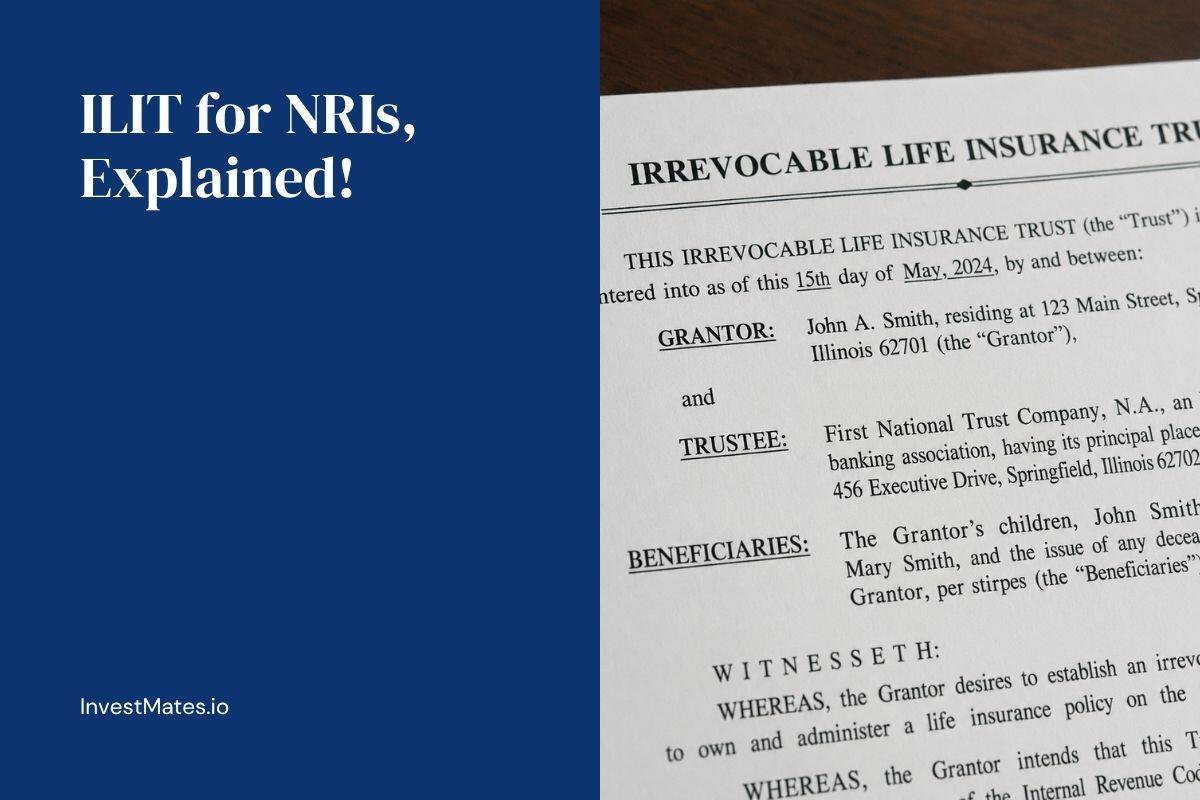
An ILIT, or irrevocable life insurance trust, is a trust that owns a life insurance policy on your life so the payout stays out of your taxable estate when you die.
Not every NRI needs one. If you are a genuine non-resident alien, your life insurance is already excluded from US estate tax under IRC Section 2105(a), no trust required.
Below, I will show you exactly when that protection holds, when it disappears once your domicile status shifts toward the US, and how to fund an ILIT correctly if you turn out to need one.
What is an ILIT and how does it actually work
An ILIT is an irrevocable trust that owns a life insurance policy on your life. You are the grantor. A trustee, usually not you and usually not your spouse either, manages the trust and hands the payout to your chosen beneficiaries when you die.
Irrevocable means what it says. Once you fund it, you cannot change the beneficiaries, cancel the policy, or pull the cash value back out.
That loss of control is the entire point, not a flaw. Because you hold none of the rights a policy owner normally holds, the death benefit can sit outside the reach of estate tax rules that would otherwise apply to you directly.
The NRA exception: why some NRIs may not need one at all
Before you set up a trust, check whether you need one.
Under Section 2105(a) of the tax code, the amount payable as life insurance on the life of a nonresident who is not a US citizen is not treated as US property for estate tax purposes. This applies regardless of who owns the policy. You could hold a US term policy in your own name, and the payout to your family would still sit outside your US-situs estate.
This exception applies specifically to non-resident aliens (NRAs), meaning you are neither a US citizen nor domiciled in the US at death. Domicile is about intent, not your visa. Most NRIs on H-1B visas who plan to eventually return to India meet this test. If that describes you, life insurance is already one asset you do not need to worry about.
Take Amit, an H-1B software architect with a $500,000 term policy and a firm plan to move back to Pune in five years. If he dies while still classified as a non-resident alien, his family collects the full payout with no US estate tax on it at all, no ILIT needed. The IRS page on nonresident estate tax filing confirms this treatment directly.
This is a different question from the $60,000 exemption trap that applies to your other US assets. If you are still working through what counts as a US-situs asset and how the NRA exemption works more broadly, InvestMates has already covered that ground in detail in its guide on US estate tax for non-citizens with India assets. I am picking up specifically where that guide leaves off, on life insurance and trusts.
When your domicile status flips the entire answer
The NRA exception only protects you while you remain a non-resident alien. Two common situations change that.
Green card holders and long-term stayers
Holding a green card, or simply forming a clear intent to remain in the US permanently, generally makes you a US domiciliary for estate tax purposes. Once that happens, you are taxed more like a citizen. Your worldwide estate is in scope, though you also get the much larger citizen-level exemption, $15 million for a person who dies in 2026, under the One Big Beautiful Bill Act.
The catch is that life insurance no longer gets the automatic pass. As a domiciliary, your policy is included in your gross estate unless it is structured correctly, which is exactly the gap an ILIT closes.
Consider Priya, who converted her H-1B to a green card two years ago and plans to stay in the US long-term. She owns a $1 million policy in her own name. Because she is now a US domiciliary, that full payout would sit inside her taxable estate on top of her other assets unless she moves the policy into a properly funded ILIT.
Incidents of ownership under IRC Section 2042
Section 2042 pulls life insurance proceeds into your taxable estate if you held any "incidents of ownership" at death. That includes the right to change your beneficiary, borrow against the policy, cancel it, or assign it to someone else. It does not matter whether you ever exercised those rights. Holding them is enough.
An ILIT works by making sure you, the insured, never hold any of these rights in the first place. The trust owns the policy from day one. You are not the trustee, and you cannot act as one.
The three-year rule under IRC Section 2035
If you already own a policy personally and transfer it into a new ILIT, Section 2035 pulls the proceeds back into your estate if you die within three years of the transfer. This is the most common ILIT mistake, and it is entirely avoidable.
The fix is straightforward. Have the trust apply for and own a brand-new policy from the start. Because you never held any incidents of ownership over that policy, the three-year rule never comes into play. For anyone weighing whether they can keep US ties like a green card while planning a return to India, this timing question matters just as much as the green card and domicile decision itself.
| Feature | Non-resident alien (no US domicile intent) | US domiciliary (green card or long-term stay) |
|---|---|---|
| US estate tax exemption (2026) | $60,000, unchanged since 1976 | $15,000,000 per person |
| Life insurance automatically excluded? | Yes, under Section 2105(a) | No |
| Is an ILIT required for the policy? | Generally not | Yes, if you want it outside your estate |
| Incidents-of-ownership rule (Section 2042) applies? | No | Yes |
| Three-year rule (Section 2035) applies? | No | Yes, if transferring an existing policy |
| Gift tax on funding the trust | Cash generally taxable, US stock generally exempt | Same annual exclusion rules as any US person |
Data reflects 2026 figures under Revenue Procedure 2025-32. Rules change, so verify current numbers with a cross-border advisor before acting.
The practical takeaway is this. If you are confident you will return to India and have no intent to stay permanently, spending money on an ILIT for life insurance alone is often unnecessary. If a green card or a long US stay is on the table, the calculus flips completely.
Funding your ILIT: the NRI gift tax wrinkle
Setting up the trust is the easy part. Funding it correctly as an NRI has a wrinkle most generic ILIT guides never mention.
Under Section 2501(a)(2), a non-resident alien's gift of US-situated intangible property, such as US stock, is generally exempt from US gift tax. Cash is treated differently. It is generally treated as tangible property, and gifting it can trigger gift tax exposure depending on where the funds originate. This is a genuinely fact-specific area, so get advice before assuming either way.
Most ILITs are funded with annual cash contributions that the trustee uses to pay premiums. To make those contributions qualify for the annual gift tax exclusion, the trust typically includes Crummey withdrawal rights. After each contribution, the trustee sends beneficiaries a short notice giving them a limited window, usually 30 days, to withdraw their share. Beneficiaries almost never exercise it, but the right itself is what converts the gift into a present interest eligible for the exclusion.
For 2026, that annual exclusion is $19,000 per recipient, or $194,000 if you are gifting to a spouse who is not a US citizen. Structuring contributions to fit inside these limits, and choosing whether to fund with cash or appreciated US stock, is where a cross-border tax advisor earns their fee.
Why the liquidity strategy fails without a trust
InvestMates has already made the general case elsewhere for life insurance as a liquidity tool: buy a policy so your family has cash instead of being forced to sell assets under time pressure. That advice holds for a genuine non-resident alien, since a personally-owned policy already sits outside the estate under Section 2105(a).
The moment you become a US domiciliary, that same personally-owned policy stops being free money. It gets pulled into your own gross estate under Section 2042 alongside everything else, which can shrink or wipe out the liquidity it was meant to provide. Take the US estate tax on RSUs example: $400,000 in vested shares, an estimated $108,800 estate tax bill as a non-resident alien, computed on the IRS Table A unified rate schedule less the $13,000 NRA unified credit, due in cash within nine months. A domiciliary facing a similar bill cannot count on a personal policy to cover it without adding to the problem. An ILIT-owned policy sidesteps this entirely. Because the trust, not you, owns it, the payout never enters your estate, so it arrives at full value exactly when your family needs it.
Conclusion
An irrevocable life insurance trust is not something every NRI needs. It solves one specific problem: keeping life insurance out of your taxable estate once your domicile status shifts toward the US, whether through a green card or years of intent to stay.
Before you buy a policy, transfer one, or skip an ILIT entirely, get a clear read on your current domicile status from a cross-border estate attorney, ideally as part of the same broader NRI estate plan covering your wills and power of attorney. That conversation decides whether this trust is worth building at all.
Frequently asked questions
What is the three-year rule for an ILIT?
The three-year rule, under IRC Section 2035, pulls life insurance proceeds back into your taxable estate if you transfer an existing personally-owned policy into a trust and then die within three years.
It does not apply if the trust buys a new policy directly and you never held any ownership rights over it. This is why estate attorneys almost always recommend starting fresh inside the trust rather than moving an old policy in.
What are the biggest mistakes NRIs make with an ILIT?
The most common mistake is transferring an existing policy into the trust and getting caught by the three-year rule. Close behind is naming yourself or your spouse as trustee, which can undo the separation the trust is meant to create.
A third mistake is funding the trust with cash without checking the gift tax treatment first, since cash and US stock are not treated the same way for a non-resident alien.
Is an ILIT worth it if I might already qualify as a non-resident alien?
Often not, at least for the life insurance piece. If you are confident you will remain a genuine non-resident alien with no intent to stay in the US permanently, Section 2105(a) already keeps your life insurance proceeds outside your US estate.
The calculation changes the moment a green card, a long-term US career, or family circumstances point toward permanent US residency.
Can I still buy a new US life insurance policy after moving back to India?
It gets harder. Most US insurers want an active US address, US income, or another meaningful US tie to underwrite a new policy, so a US-issued policy is usually off the table once you have fully relocated. Indian insurers offer NRI-friendly term plans instead, and buying one is straightforward, but remember it is an Indian asset and does not slot into a US ILIT the way a US-issued policy would. If a US ILIT is part of your plan, buy the policy while you still qualify rather than waiting until after you move.
Do green card holders need an ILIT even though the 2026 exemption is $15 million?
Often yes, even with the larger exemption available. A $15 million exemption covers your overall taxable estate, but life insurance held in your own name still counts as part of that estate under the incidents-of-ownership rule.
An ILIT keeps the death benefit separate, which matters most if your estate is close to or expected to exceed the exemption over time, or if you simply want the payout to reach your family without becoming part of a probate or estate tax calculation.