

The foreign tax credit does not automatically protect you from the alternative minimum tax. You refigure it on a separate AMT Form 1116, using AMT income instead of regular taxable income, and the two numbers rarely match.
Your 2026 return raises the stakes: the AMT exemption now phases out twice as fast, pulling more foreign-tax-credit filers back into AMT territory than in 2025.
Why the foreign tax credit and AMT don't automatically line up
The foreign tax credit lets you offset US tax with income tax you've already paid to India, dollar for dollar up to a limit. That limit is your foreign-source income divided by your total income, times your US tax bill.
It's the mechanism that keeps DTAA relief real instead of theoretical. If you've read what Form 1116 actually requires, you already know the basic shape of it.
The alternative minimum tax runs on a separate track. Instead of your regular taxable income, it starts from AMTI, alternative minimum taxable income, built by adding back a list of deductions and preference items the regular system allows but the AMT doesn't.
You compare a 26 percent (or 28 percent above a threshold) tax on that AMTI against your regular tax, and you pay whichever is higher.
Nothing about your foreign tax credit carries over into that comparison automatically. You have to build it again.
The classic trigger: the state tax add-back
This is where the credit and the deduction collide. Priya works in California, earns $340,000, and deducts close to $28,000 in state income tax on her Schedule A.
She also sold an apartment in Mumbai this year and paid roughly $19,000 in India capital gains tax on the sale, which she claims in full against her US tax through Form 1116.
Priya's numbers Regular tax liability: fully offset by her $19,000 India foreign tax credit. AMTI without the $28,000 state tax deduction: roughly $28,000 higher than her regular taxable income. Tentative minimum tax on that higher base, at 26 percent: climbs past what her AMT foreign tax credit, recalculated on the AMT version of Form 1116, can offset. Result: she owes AMT on a return where her regular tax was fully covered.
The credit isn't broken, and neither is the math. The two systems are simply comparing different bases, and a foreign tax credit built for one base doesn't fully transfer to the other.
How the AMT version of Form 1116 actually works
If your total foreign tax exceeds the Schedule 3 election limit, you complete a second Form 1116, marked "AMT" in the top margin. You need one for each separate income category, passive, general, and so on, where you're claiming a credit.
Part I uses only income and deductions "allowed for the AMT and attributable to sources outside the United States," per the IRS instructions for Form 6251, not your regular-tax figures. That AMT foreign source income becomes the numerator in a new limitation formula, run against your tentative minimum tax instead of your regular tax.
The result, your AMTFTC, lands on Form 6251, and it's often close to but not identical to your regular credit. TDS on Indian rental income, capital gains tax on a property sale, and tax withheld on Indian dividends all get refigured this way if you're above the de minimis threshold.
What changed to your AMT exemption for 2026
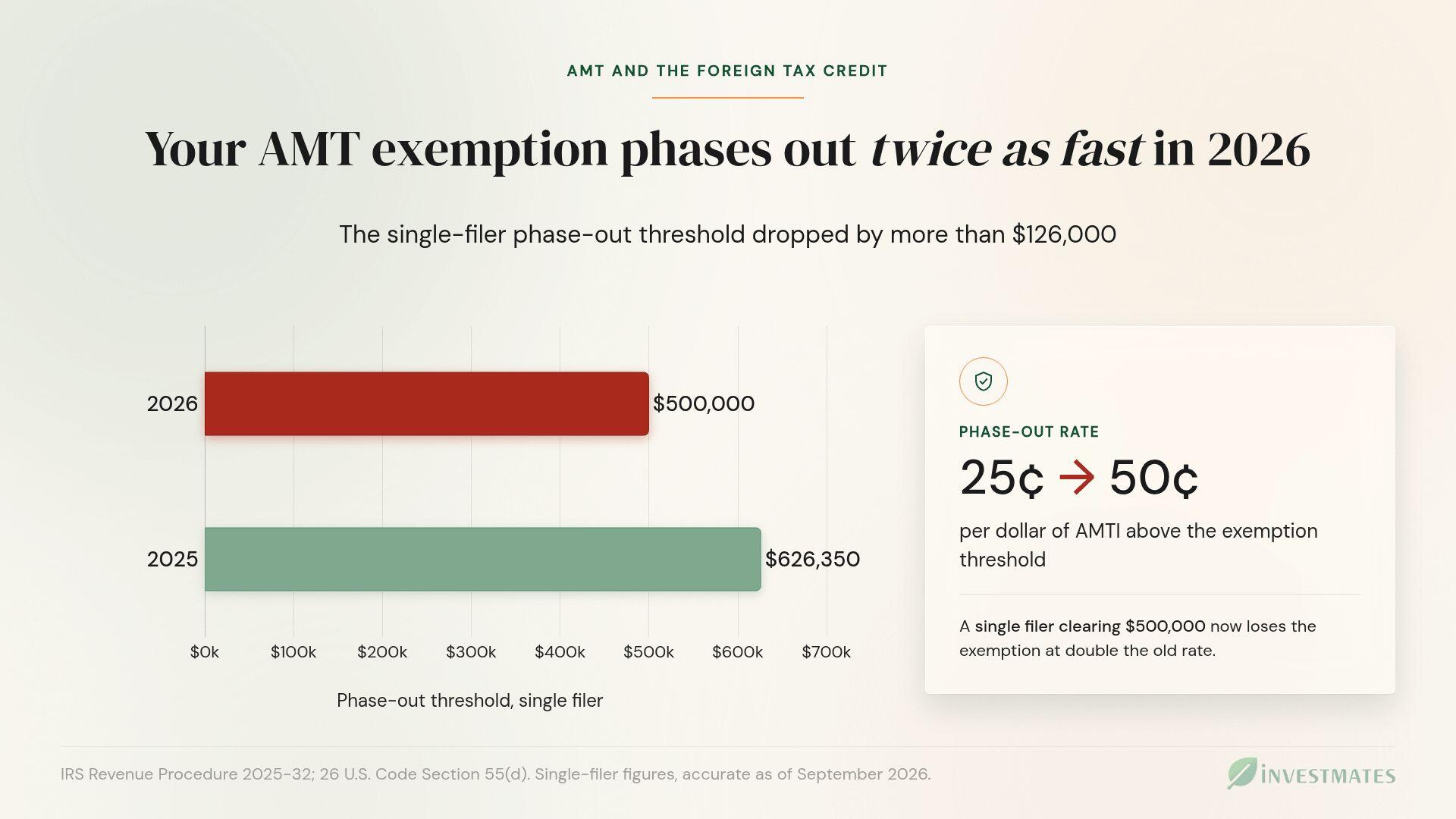
The 2026 exemption amounts went up slightly from 2025, as they do most years for inflation. What actually changed is how fast that exemption disappears once you cross the phase-out threshold, and the thresholds themselves dropped hard.

| 2025 | 2026 | |
|---|---|---|
| Exemption, single | $88,100 | $90,100 |
| Exemption, married filing jointly | $137,000 | $140,200 |
| Phase-out starts at, single | $626,350 | $500,000 |
| Phase-out starts at, married filing jointly | $1,252,700 | $1,000,000 |
| Phase-out rate | 25 cents per dollar | 50 cents per dollar |
The phase-out threshold for a single filer dropped by more than $126,000, and the rate at which the exemption disappears above it doubled. If you're a high-earning NRI clearing $500,000 (or $1,000,000 filing jointly), you'll lose your AMT exemption roughly twice as fast in 2026 as you did the year before.
That leaves a bigger AMTI base, and a bigger gap for your foreign tax credit to cover. The 28 percent AMT rate kicks in once your AMTI exceeds your exemption by more than $244,500.
Who actually gets caught between the two
This isn't every NRI who claims a foreign tax credit. It tends to be a specific overlap:
- You itemize with a large state and local tax deduction, the kind California or New York filers carry, and
- You're claiming a meaningful foreign tax credit, often from India capital gains tax on a property or stock sale, or
- Your income sits near or above the new $500,000 or $1,000,000 phase-out threshold, sometimes pushed there by RSU or stock compensation vesting or an ISO exercise in the same year.
If none of that applies to you, the interaction still exists on paper but rarely produces a bill. A filer taking the standard deduction with a modest India-source foreign tax credit almost never sees AMTI diverge enough from regular taxable income to matter.
What to do about it
- File your regular Form 1116 first and confirm your foreign tax credit fully offsets your regular tax.
- Check whether you qualify for the Schedule 3 de minimis election. If your total foreign tax is under $300 (single) or $600 (joint) and it's all passive income, you don't need a second Form 1116 for AMT at all.
- If you don't qualify, complete the AMT Form 1116 for each category, using AMT-basis income and deductions, and carry the result to Form 6251, Part III.
- If AMT still applies, don't assume next year's Form 8801 will hand the money back. The minimum tax credit only exists for AMT caused by deferral items like ISO exercise, not exclusion items like the state tax add-back. AMT you paid because of a disallowed state deduction doesn't come back as a future credit.
- If your case involves a large India property sale, an ISO exercise, and a state tax deduction landing in the same year, that's a genuine judgment call on sequencing. I'd run the AMT version of Form 1116 before you file, not after, rather than trust software to flag the gap on its own.
Where this leaves you
If you claim a sizable foreign tax credit and also carry a large state tax deduction, don't assume your credit protects you from AMT until you've actually run the AMT version of Form 1116. Pull last year's Form 6251, or run this year's numbers, before you file.
If the SALT add-back and your India-sourced credit are both large, that's worth a real conversation with someone who handles both sides of your return, not just a projection from tax software. I can walk through your specific numbers if you want a second read before you file.
Frequently asked questions
How do I know if I'm subject to AMT?
You're subject to AMT if your tentative minimum tax, calculated on Form 6251 using AMTI, exceeds your regular tax liability after credits. High state tax deductions, a large India-sourced foreign tax credit, and income near the $500,000 or $1,000,000 phase-out threshold are the most common reasons an NRI ends up there.
If you and your spouse are weighing joint versus separate returns, know that your filing status changes both the exemption and the threshold.
How is the AMT foreign tax credit calculated?
You complete a separate Form 1116 marked "AMT" for each income category, using only income and deductions allowed under AMT rules and sourced outside the US. That AMT foreign source income runs through the same limitation formula as your regular credit, but measured against your tentative minimum tax instead of your regular tax liability.
Does claiming the foreign tax credit fully protect me from owing AMT?
No. Your foreign tax credit can fully offset your regular US tax, and you can still owe AMT. That's most often because AMT disallows deductions, like state and local taxes, that lowered your regular taxable income but never touch your AMTI.
What is the AMT exemption amount for 2026?
For 2026, the AMT exemption is $90,100 for single filers and $140,200 for married couples filing jointly, phasing out at 50 cents per dollar of AMTI above $500,000 single or $1,000,000 joint.
Is India's alternative minimum tax under Section 115JC the same as the US AMT?
No. Section 115JC applies to non-corporate Indian taxpayers claiming specific deductions, like those under Chapter VI-A Part C or Section 10AA, and it has nothing to do with your US return. If you're an NRI without Indian business income claiming those deductions, this article's AMT is the US version on Form 6251, and Section 115JC almost certainly doesn't apply to you.
Whatever you decide here, filing Form 67 for the India side of this same income runs on its own separate track.