
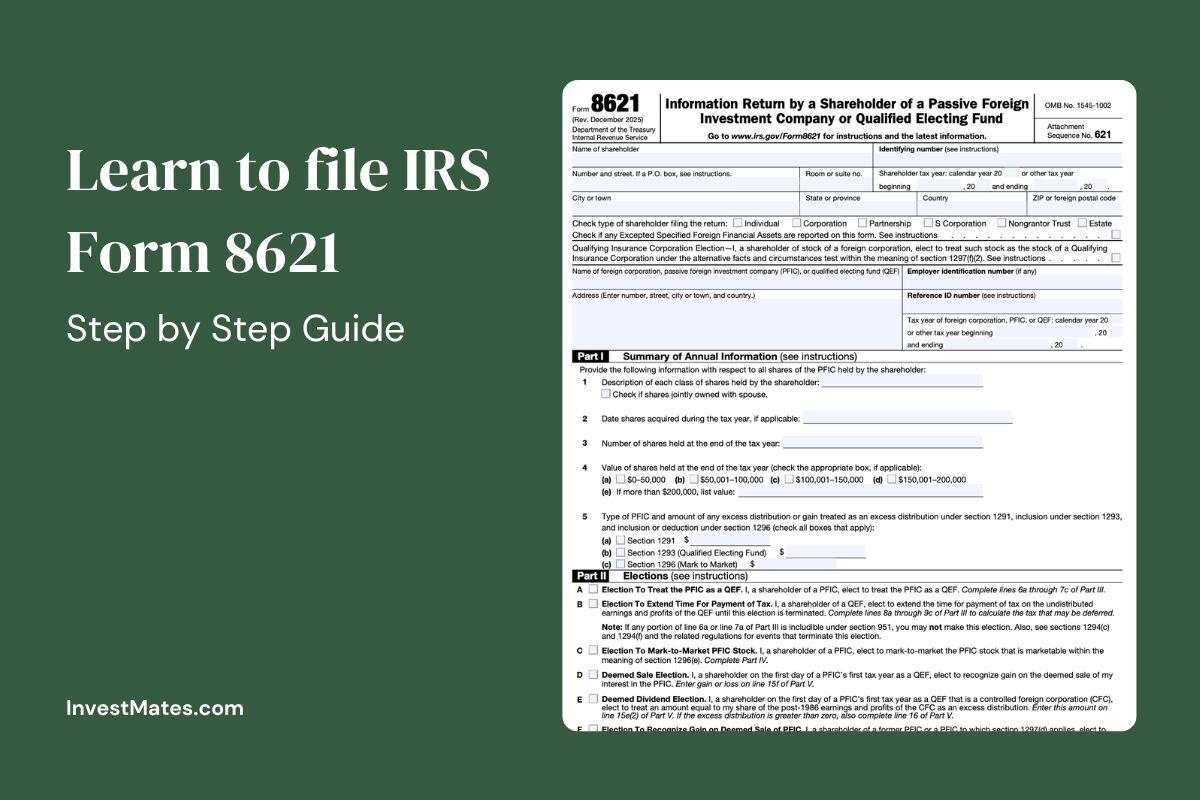
If you hold Indian mutual funds, ELSS, ULIPs, or any other Indian investment that qualifies as a PFIC, you almost certainly need to file Form 8621 with your US tax return every year. Form 8621 is the IRS information return for shareholders of a Passive Foreign Investment Company.
I will walk you through each part of the form, which tax method applies to your holdings, and the filing mistakes that keep your tax return open to IRS audit indefinitely.
Step 1: Determine whether you need to file
Start with two questions.
Do you hold a PFIC? If you hold any Indian mutual fund, the answer is almost always yes. Indian mutual funds meet the PFIC definition under IRC Section 1297 because they earn passive income (dividends, interest, and capital gains) on passive assets. For a full explanation of why Indian funds are PFICs, see the PFIC rules for Indian mutual funds guide on this site.
Who must file Form 8621, per the IRS
The IRS's own About Form 8621 page lists five triggers. You must file if you: receive a direct or indirect distribution from a PFIC, recognize a gain on a direct or indirect disposition of PFIC stock, are reporting a QEF or Section 1296 mark-to-market election, are making an election reportable in Part II of the form, or are required to file an annual report under Section 1298(f). For Indian mutual fund holders with no distributions or sales in a given year, that last trigger, the Section 1298(f) annual report, is the one that applies, unless the de minimis exception below lets you skip filing. You can download the current Form 8621 PDF and the Instructions for Form 8621 PDF directly from irs.gov.
Do you meet the de minimis exception? Under Section 1298(f) and Treasury Regulation 1.1298-1(c)(2), you do not need to file Form 8621 for a given year if all three of the following are true:
- The total fair market value of all your PFICs combined was $25,000 or less at December 31 ($50,000 or less if married filing jointly)
- You did not receive any excess distributions from any PFIC during the year
- You did not sell, redeem, or otherwise dispose of any PFIC during the year
All three conditions must hold. If any one fails, you must file.
Example: Rahul moved to the US on an H1B visa in September 2024. At December 31, 2024, he held ₹7 lakh (~$8,300) in Axis Bluechip Fund and made no withdrawals or redemptions. His total PFIC value is below $25,000 and he had no distributions or disposals. He does not need to file Form 8621 for tax year 2024.
Step 2: List every PFIC you hold and gather the data
Form 8621 must be filed separately for each PFIC. If you hold three Indian mutual funds, you file three forms, each attached to your Form 1040.
For each fund, record:
- Full legal name of the fund (e.g., "HDFC Flexi Cap Fund, Regular Growth")
- Country of incorporation: India
- Total units held as of December 31
- NAV per unit on December 31 in INR
- Total fair market value: units × NAV, in INR
- USD equivalent at the December 31 Treasury rate
Example: Priya holds 2,200 units of Mirae Asset Large Cap Fund, Growth. The December 31 NAV is ₹920 per unit, giving a total FMV of ₹20,24,000. At a December 31 USD/INR rate of 84.20, her FMV in USD is approximately $24,037. Her single-fund PFIC total is below $25,000, so she would meet the de minimis threshold if she also made no distributions or disposals.
Track the same data for every fund before moving to the next step.
Step 3: Determine which tax regime applies
Form 8621 has multiple parts, each for a different PFIC tax method. Before filling in the form, you need to know which regime governs each fund.
Section 1291 (the default) applies to most NRIs with Indian mutual funds. If you have never made a formal election, Section 1291 is where you land. Under this method, gains and excess distributions are spread over your entire holding period and taxed at the highest ordinary income rate (37% as of 2025 per IRC Section 1291(c)(2)), with an interest charge on top under IRC Section 6621. This is by far the most common situation for NRIs who held funds before they became US tax residents.
Mark-to-Market (MTM, Section 1296) allows you to treat the fund as if you sold it on December 31 each year and pay ordinary income tax on the paper gain. The interest charge disappears. Indian open-ended mutual funds may qualify under Section 1.1296-2(d) as NAV-redeemable securities, but only if the fund meets specific conditions: at least 100 shareholders, NAV published weekly via an independent source (AMFI or newspapers), SEBI regulation, and an annual independent audit. You can make the election for any tax year, by attaching a timely Form 8621 for that year (by the return's due date, including extensions). If you elect in a later year rather than your first year holding the fund, Section 1296(j) treats the stock as sold at fair market value on the last day of that first election year, so the resulting gain is still taxed as a Section 1291 excess distribution before MTM treatment takes over going forward. If you have never elected MTM, you are in Section 1291.
Qualified Electing Fund (QEF, Section 1295) requires the fund to issue a PFIC Annual Information Statement under Treas. Reg. Section 1.1295-1(g). No Indian AMC currently issues this statement, so QEF is unavailable in practice for Indian mutual funds.
In your first year of US tax residency, you may also be able to use a PFIC first-year cost basis reset to reduce your future PFIC tax exposure. This election is separate from the Section 1291/MTM/QEF choice and is available only in the year you first become a US tax resident.
For a deeper walkthrough of all three regimes, including the Section 1296(j) mechanism to exit Section 1291 if you missed the Year 1 MTM election, see our full PFIC elections guide.
Step 4: Complete Form 8621 part by part
The December 2025 revision of Form 8621 has six parts. Here is what goes in each part for the typical NRI filing under Section 1291.
Part I: Identifying information
Enter your name, address, SSN or ITIN, and the tax year you are filing for. Then identify the PFIC: enter the fund's full legal name and country (India). Indian mutual funds follow the Indian financial year ending March 31, so enter March 31 in the PFIC's tax year end field. The form itself covers your US tax year, which runs January 1 through December 31 for calendar-year taxpayers. Enter the total fair market value of your shares as of December 31. Leave the election checkboxes unchecked if you are using the Section 1291 default.
Part II: Elections
Part II contains eight elections (A through H). Most NRIs with Indian mutual funds who are under Section 1291 leave Part II blank. If you are making a Mark-to-Market election under Section 1296, check box C in Part II, then complete Part IV to calculate your annual gain or loss. The QEF election goes in box A, but QEF is unavailable for Indian mutual funds because no Indian AMC issues a PFIC Annual Information Statement. If you have made no elections, skip Part II entirely.
Part III: Income from a QEF
Part III is where you report ordinary income and net capital gains from a fund on which you have made a QEF election. Since QEF is unavailable for Indian mutual funds, leave Part III blank.
Part IV: Mark-to-Market gain or loss
Complete Part IV only if you have made an MTM election (box C in Part II). Enter the fair market value of your shares on December 31 of the tax year (line 10a), your adjusted basis in those shares (line 10b), and calculate the resulting gain or loss. This is the central calculation for anyone using the MTM method. Most NRIs with Indian mutual funds do not complete Part IV because they are under Section 1291 and have made no MTM election.
Part V: Section 1291 excess distributions and dispositions
This is the section most NRIs complete. Report here:
- Any distributions the fund paid you during the year (dividends or deemed distributions)
- Any gain from selling or redeeming units during the year
- The pro-rata allocation of those amounts across each year of your holding period, with the applicable tax rate and interest charge for each year
New requirement as of December 2025: When entering any Indian rupee amount in Part V, you must include the three-letter ISO currency code INR in the designated currency field before the rupee amount. Then translate each distribution into USD at the spot exchange rate on the date that distribution was made, and report the USD figure on new line 15e(2) (Instructions for Form 8621, Dec. 2025 revision). Leaving the currency field blank or using a symbol like ₹ instead of the three-letter code may result in an IRS error notice.
Example: Amit has held 1,000 units of SBI Bluechip Fund since before he moved to the US in 2021. He redeems all units in 2025 at a gain of ₹3,40,000 (~$4,000 USD). In Part V, he enters "INR 340000" in the currency fields, then follows the IRS worksheet to spread the gain across his four-year holding period (2021 through 2025) and calculate the 37% tax plus interest for each year before 2025.
If you received no distributions and did not sell any units during the year, Part V will have minimal entries, but you still attach the form if the de minimis exception does not apply.
Part VI: Status of prior year Section 1294 elections
Part VI applies only to shareholders who have previously elected to defer payment of QEF tax under Section 1294. Since QEF is unavailable for Indian mutual funds, Part VI does not apply to NRIs holding Indian mutual funds. Leave it blank.
Step 5: Attach Form 8621 to your 1040 and file
Form 8621 is not submitted separately. Attach it to your Form 1040 as part of your annual tax filing.
Deadline: The Form 8621 deadline is the same as your Form 1040. For most taxpayers, that is April 15. If you file a Form 4868 extension, your deadline becomes October 15. Form 8621 moves with your extension automatically because it is attached to your 1040.
Electronic filers: Most professional tax software supports Form 8621 as a PDF attachment within the e-file package. TurboTax Deluxe handles basic Form 8621 situations. For multiple PFICs, MTM elections, or prior-year corrections, specialist software or a CPA with international tax experience is the safer choice.
Paper filers: Attach completed Form 8621 pages behind your 1040.
One form per PFIC: If you hold four Indian mutual funds, you attach four Form 8621 copies to the same 1040.
Also check whether you have an FBAR obligation. If any Indian mutual fund account, including any NRI demat account or folio held at an Indian AMC or broker, had a value exceeding $10,000 at any point during the year, you must file FinCEN Form 114 (FBAR) by April 15 as well. Read the FBAR and PFIC compliance guide for a side-by-side explanation of both obligations.

Common mistakes to avoid
Filing one form for all funds. Each fund is a separate PFIC and gets its own Form 8621. A single form covering multiple Indian mutual funds is incorrect.
Misapplying the de minimis exception. All three conditions must hold. Exchange rate moves and fund growth can push you over the $25,000 threshold in a year when you did not in previous years. Apply the three-part check for every tax year.
Skipping the currency code. The December 2025 revision added the three-letter ISO currency code requirement in Part V. Write "INR" in the currency field whenever you enter Indian rupee amounts. Omitting it can trigger an IRS correspondence notice.
Assuming the India-US tax treaty protects you. The DTAA does not override US PFIC anti-deferral rules. PFIC taxation applies regardless of treaty positions.
Missing prior years. Under IRC Section 6501(c)(8), failing to file Form 8621 keeps the statute of limitations open on PFIC-related items in your return for the years in which you held the PFIC. The clock does not start until 3 years after you file Form 8621, so an unfiled form leaves those years exposed indefinitely.
The IRS can assess additional tax and penalties for those open years at any time. If you have missed Form 8621 filings, review what happens when Form 8621 goes unfiled and the IRS options for correcting late filings before you receive an IRS inquiry.
Conclusion
Form 8621 is mandatory for most NRIs who hold Indian mutual funds. The filing comes down to five steps: check the de minimis exception, list every PFIC with its rupee and dollar values, identify which tax regime applies, complete the relevant parts of the form, and attach it to your 1040 by April 15. If prior years were missed, act now, the statute of limitations stays open until you file.
Frequently asked questions
Does Form 8621 need to be filed every year?
Yes, for every tax year in which you hold a PFIC and do not meet all three conditions of the de minimis exception.
If your fund grows past $25,000 in a year, or if you receive any distribution or make any disposition, the exception no longer applies for that year and you must file.
Can I file Form 8621 separately from my 1040?
No. Form 8621 is not a standalone filing. It is attached to your Form 1040 and shares the same deadline, including any extension. There is no separate submission address or independent due date for Form 8621.
Who needs to file Form 8621?
Any US person, citizen, green card holder, or visa holder who meets the Substantial Presence Test under IRC Section 7701(b), who holds a PFIC must file Form 8621 for each PFIC in each tax year they hold it, unless the de minimis exception applies.
This includes NRIs on H1B, L1, and other non-immigrant visas who have become US tax residents.
Can I e-file Form 8621, or does it have to be paper filed?
Form 8621 attaches to your Form 1040 and can be included in an electronic filing. Most major tax software, including TurboTax Deluxe and above, can generate the form for straightforward cases involving a single fund with no elections.
For multiple PFICs, an MTM election, or prior-year corrections through the Streamlined Procedures, a CPA with international experience will produce more accurate results than DIY software. If you paper file, attach Form 8621 to the back of your 1040 package and send it to the same IRS address as your return.