

A charitable remainder trust can move appreciated US stock out of your taxable estate while you still draw income from it, even as a nonresident alien.
The benefit only survives if the charity that eventually receives what's left is organized in the United States. Skip that detail, and the estate tax saving vanishes at the exact moment your family needs it.
Here's how the trust actually gets the stock out, the two ways to structure the payout, and the compliance point that decides whether the deduction holds.
How a charitable remainder trust works for NRIs
Once you give up a green card and become a nonresident alien, any US stock you still hold turns into a US situs asset.
The $60,000 exemption is small enough that a meaningfully appreciated position can push the estate tax bill into six figures, at rates running up to 40%.
A charitable remainder trust, or CRT for the rest of this piece, is an irrevocable trust you fund with cash or appreciated property.
The trustee sells what you contributed, reinvests the proceeds, and pays you an income stream for a set term or for life. When the term ends, whatever's left goes to the charity you named.
It's tax-exempt under Section 664 of the tax code, so the trust pays no capital gains tax when it sells what you contributed.
The full value keeps working instead of shrinking by whatever state and federal capital gains rates would have taken first.
The part I'd flag first is that funding the trust with US stock doesn't cost you any gift tax, even though you're a nonresident alien handing over a US situs asset.
Publicly traded US stock counts as intangible property, and an NRA's gift of US intangible property is exempt from gift tax outright under 26 U.S.C. Section 2501(a)(2), with no dollar cap.
That's the same rule that lets an NRA fund any irrevocable trust with US shares tax-free.
Once the transfer is complete, the stock is out of your estate for good, assuming you don't retain any control that would pull it back in under the retained-interest rules.
The strategic value of a CRT for NRIs
This fits an NRI who already holds meaningfully appreciated US stock, whether from RSUs, a legacy brokerage account, or a business sale.
It also fits someone who is either already a nonresident alien or planning to become one by giving up a green card.
It fits someone who's charitably inclined regardless of the estate tax angle too, since the income tax deferral and tax-free growth inside the trust work the same way for a US citizen.
Either way, this belongs alongside a broader estate plan, not as a replacement for one.
It doesn't help much if your total US situs exposure sits comfortably under $60,000, since there's no estate tax problem to solve yet.
It also doesn't help if the charity you actually want to benefit is based in India.
In that case, look at an Irish-domiciled ETF instead, or life insurance through an ILIT. Either one usually gets you further than forcing a charitable structure to do a job it isn't built for.
Key structuring choices
Once the trust is funded, you choose how it pays you. Two structures exist, and the choice mostly comes down to whether you want a fixed number or one that moves with the market.
Charitable remainder annuity trust (CRAT)
A charitable remainder annuity trust pays a fixed dollar amount, set once when you fund it and never revisited. You can't add more money to it later.
If you want a predictable, fixed amount every year, a CRAT delivers that regardless of how the market does. Inflation will quietly erode its value over a long trust term, though.
Charitable remainder unitrust (CRUT)
A charitable remainder unitrust pays a fixed percentage of the trust's value, revalued every year. Contribute more later and the payout adjusts.
If the trust doubles in a strong decade, the income doubles with it, and it shrinks if the market has a bad stretch.
For a younger NRI decades from needing the income, a CRUT usually makes more sense than locking in today's dollar figure for the next forty years.

Compliance considerations for NRIs
None of this works automatically. Three rules decide whether the structure actually holds up, and the most expensive one to miss is the last.
The 10% remainder rule
Both trust types have to pay out between 5% and 50% of the trust's value each year, and the charity's share has to be worth at least 10% of what you originally put in.
Fall outside either band when you set the trust up, and it doesn't qualify as a CRT at all, regardless of how it's titled.
The domestic-charity requirement
This is the part of the rule that decides whether the structure actually works for a nonresident alien, and it runs differently than it does for a US citizen.
Because you keep an income interest in the trust, the full value gets pulled back into your gross estate if you die before the trust term ends.
That's the retained-interest rule, and it already governs any trust where the grantor keeps a string attached.
What rescues you from an estate tax bill on that amount is a matching estate tax charitable deduction for the value of what's left for charity.
For a US citizen, that deduction is straightforward under Section 2055. For a nonresident alien, the equivalent provision is Section 2106(a)(2).
It comes with a restriction Section 2055 doesn't carry: the deduction is allowed only for transfers to organizations created in the United States, or to a trustee for use within the United States.
Name an Indian nonprofit as your remainder beneficiary, and as far as I can tell from the regulation, you likely lose the deduction that makes the estate tax math work. The trust itself stays perfectly valid regardless.
Fund the trust the day you set it up, live past the term, and this concern never comes up at all, since the trust will have already finished paying out to charity while you're alive.
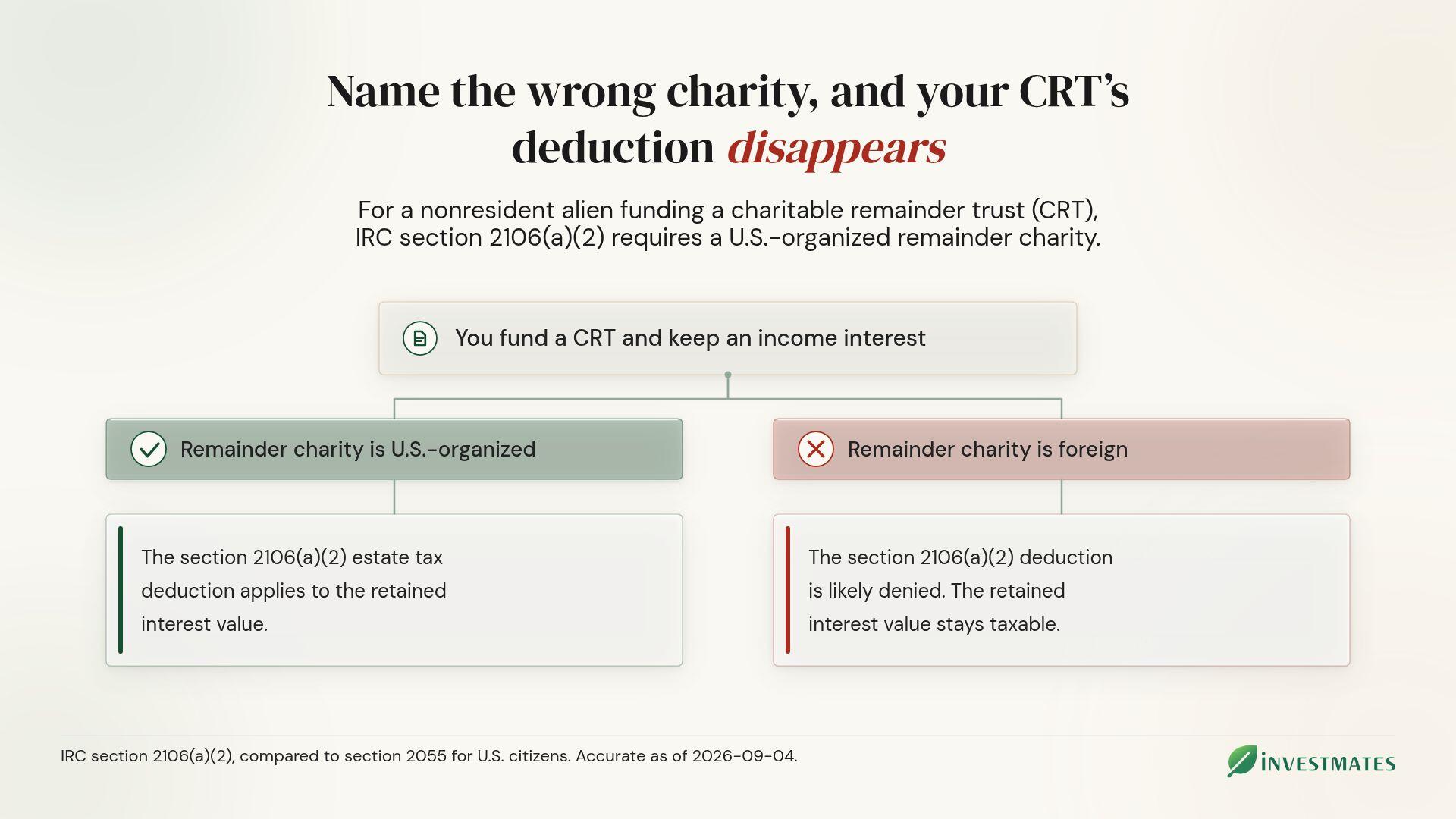
The deduction that makes a CRT work against the $60,000 nonresident exemption only applies if the charity that eventually gets the remainder is organized in the United States. Name a foreign charity instead, and the deduction likely disappears, even though the trust itself stays perfectly valid.
I'd treat that domestic-charity requirement as the single fact that decides whether a CRT is worth building for an NRI client, ahead of even the CRAT-versus-CRUT choice.
A trust with the wrong remainder beneficiary is technically a valid CRT and a failed estate plan at the same time.
Dual-tax and withholding complexities
One more thing worth flagging honestly: I haven't found a clear IRS ruling on how the trust's annual income payments get withheld for a nonresident alien beneficiary. That matters once you're living in India and actually drawing them.
The character of each payment (ordinary income, capital gain, or return of principal, in that order) follows the same four-tier rules as for a US beneficiary.
The withholding mechanics on a foreign address are different, though, and need a CPA's sign-off before you rely on a specific number.
This piece doesn't cover how India taxes what you eventually receive from the trust. That's a separate question with its own answer, and it hasn't been checked here, so don't assume either way before asking a CPA who handles both sides.
What to do about it
Start by listing your most appreciated US stock, the positions where the capital gains tax you'd otherwise owe on a sale is large enough to justify giving up outright ownership.
Decide between a CRAT and a CRUT based on whether you want a fixed payout or one that tracks the trust's value.
Pick a US-organized 501(c)(3) as the remainder beneficiary, not a foreign one, if the estate tax deduction matters to your plan.
From there, an estate attorney drafts and funds the trust, and your CPA coordinates the reporting on both the US and India sides before you sign anything irrevocable.
Before you sign anything
If you're holding appreciated US stock and already thinking about giving some of it away, run the numbers on a CRT before you assume a simple gift is your only option.
I'd rather see a client walk in with the wrong structure than not ask the question at all.
Talk to an estate attorney who has actually structured one of these for a nonresident alien, and confirm the remainder beneficiary's US status before you sign anything. That single detail is what makes or breaks the estate tax benefit.
Frequently asked questions
Does funding a CRT trigger US gift tax for a nonresident alien?
No. Publicly traded US stock is intangible property, and an NRA's gift of US intangible property is exempt from US gift tax under 26 U.S.C. Section 2501(a)(2), with no per-donee dollar limit.
That exemption applies whether the recipient is a person or an irrevocable trust.
Can I name an Indian charity as the remainder beneficiary of my CRT?
You can, but you'll likely give up the US estate tax charitable deduction that makes the structure work against the $60,000 nonresident exemption.
Section 2106(a)(2) limits that deduction to organizations created in the United States or trustee transfers used within the United States, unlike the broader rule that applies to US citizens.
What's the difference between a charitable remainder annuity trust and a charitable remainder unitrust for an NRI?
A CRAT pays a fixed dollar amount set once at funding and accepts no further contributions. A CRUT pays a percentage of the trust's value, recalculated every year, and can accept additional contributions later.
Neither choice depends on your citizenship status, only on whether you want payout certainty or growth potential.
Does a CRT still make sense if I later become a US citizen?
The estate tax argument gets weaker, since a citizen's exemption sits at $15 million rather than $60,000. The income tax deferral and tax-free growth inside the trust still work the same way.
It can remain worthwhile for the giving strategy alone, separate from the estate tax question that usually brings an NRI to this structure in the first place.
Do I need an estate attorney to set up a CRT as an NRI?
Yes. This isn't a form you fill out online. The trust document has to meet the payout and remainder-value tests under the tax code precisely.
Getting the remainder beneficiary's organization status wrong is exactly the mistake that costs an NRI donor the estate tax benefit they set the trust up for.