
If you're a US person who owns or controls an Indian family trust, IRS Form 3520-A is due every year, whether or not it paid you. Miss it: the penalty runs to the greater of $10,000 or 5% of the trust's US-owned assets, landing on you, not the trustee.
Here's what decides whether your trust is on the hook, and where the deadline catches people who filed everything else correctly.
What Form 3520-A actually reports, and why it isn't Form 3520
It's the trust's own annual information return, not yours. The IRS describes it as the way a foreign trust with a US owner reports its assets, its beneficiaries, and anyone treated as owning a piece of it.
The filing obligation sits with the trustee first. The trustee often won't cooperate, especially when they're a relative in India who has never heard of the IRS. When that happens, the US owner has to file a substitute version instead.
You become a US owner under the grantor trust rules (IRC Sections 671 through 679) when you funded the trust, control its assets, or hold specific powers over how it's run. If you've ever transferred property into a foreign trust, it's very likely a grantor trust, and that makes you the one the IRS treats as the owner.
This is a different form from Form 3520, and mixing them up is where a lot of families lose track. Form 3520 reports a foreign gift or inheritance over $100,000, filed alongside your personal return. Form 3520-A is different in kind: an ongoing annual return for a trust you own, not a one-time disclosure of money you received.
Take Meera, a green card holder in New Jersey. Her father set up a family trust in Chennai in 2019 to hold ancestral property and a mutual fund portfolio, and named Meera and her brother as trustees with full authority over the assets.
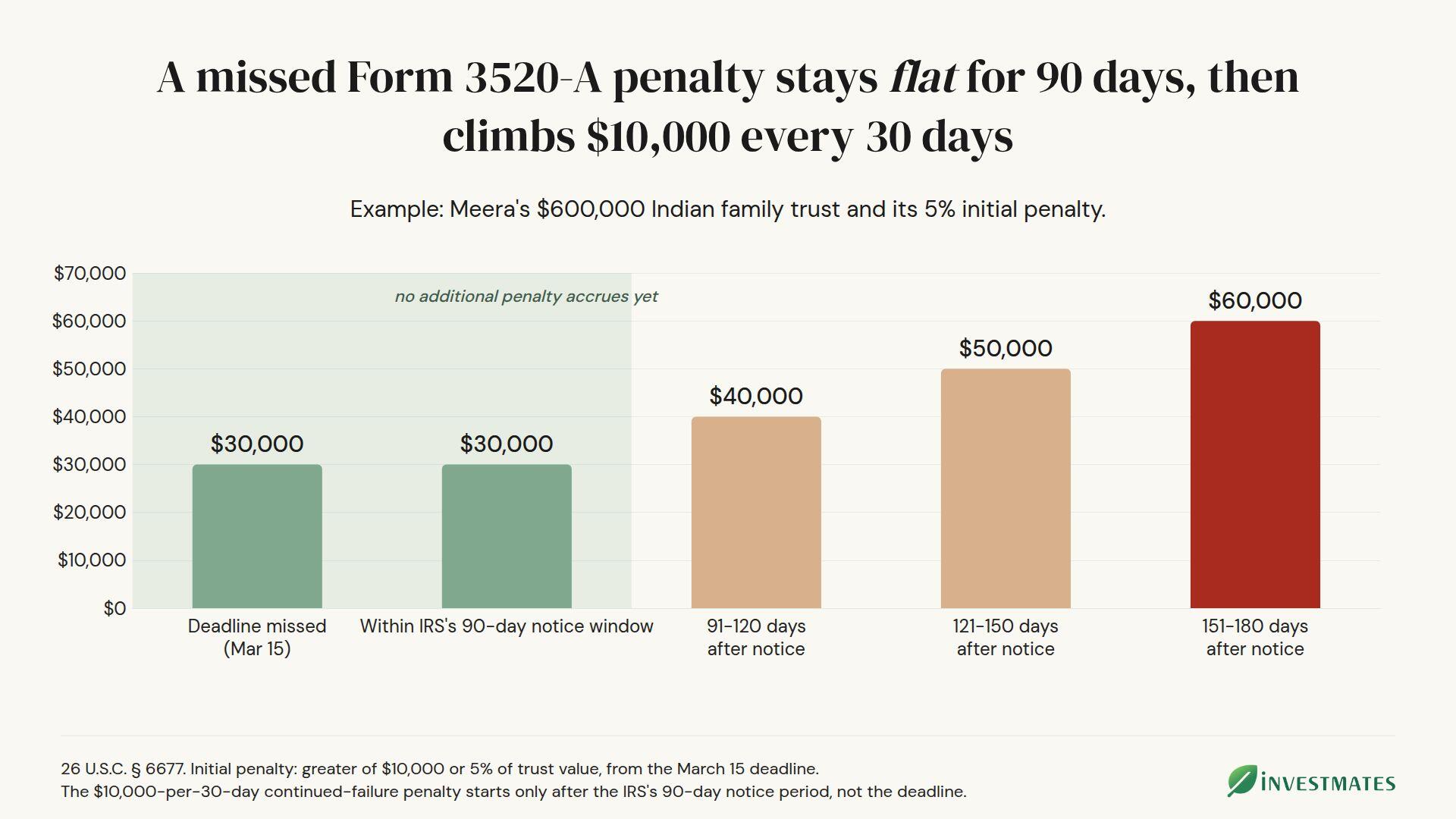
Because Meera has effective control, she's a US owner, and the trust owes that return every year she holds that control. Its assets run close to $600,000, and 5% of that is $30,000, well past the $10,000 floor, the number that actually applies if the return goes unfiled.
A formal trust deed isn't the only trigger
A Hindu Undivided Family, the structure many Indian families use to hold ancestral property across generations, raises the same question. The IRS has never issued a direct ruling on how an HUF is classified, but an HUF's lack of individual beneficial ownership pushes the analysis toward foreign trust treatment rather than partnership treatment. I wouldn't assume either way without a professional read of the specific deed or family arrangement.
What I see in practice
The classification question doesn't only come up with a formally drafted trust deed. In the compliance reviews I've run this year, it's surfaced twice, and both times the family didn't have a trust at all: it was an EPF or NPS retirement account. The question was the same either way: does the account's structure make it a foreign grantor trust on top of, or instead of, a PFIC? If your family holds a provident fund or NPS account, it's worth asking that same question.
The deadline runs on the trust's calendar, not yours
Form 3520-A is due the 15th day of the third month after the trust's tax year ends. For a calendar-year trust, that's March 15, a full month before your personal return is due. This mismatch is the single most common trap with this form.
An extension works the same way. Filing Form 4868 to push your personal return to October doesn't touch the trust's deadline at all. The trust needs its own extension, Form 7004, filed under the trust's EIN, and it buys an automatic six months.
Two separate deadlines run side by side here, not one:
- Your personal return: due April 15, or June 15 if you're abroad, extendable to October with Form 4868.
- The trust's return: due March 15 for a calendar-year trust, extendable six months with Form 7004, filed under the trust's own EIN.
If nobody in the family knows this form exists, the March deadline passes quietly while everyone assumes the summer extension covers everything. It doesn't, and by then the trust is already late.
Families juggling a foreign trust are usually juggling other foreign-asset filings at the same time. If the trust's accounts also cross the FBAR reporting threshold, that's a separate deadline running in parallel, not a substitute for this one.
The penalty lands on the US owner, not the trustee
Miss the filing, or file it late or incomplete, and the penalty is the greater of $10,000 or 5% of the gross value of the US-owned portion of the trust. That penalty applies as soon as the deadline is missed, whether or not the IRS has said anything yet.
The IRS eventually mails a notice of the failure, and the clock changes at that point. If the failure still isn't fixed 90 days after that notice, an additional $10,000 applies for every 30-day period, or part of one, beyond that 90-day window. None of this falls on the trustee in India. It's assessed against you, the US owner, because you're the one inside the IRS's jurisdiction.
There's a small mercy buried in the mechanics. If an asset is already reported on Form 3520-A, you don't have to separately itemize it on Form 8938.
Its value still counts toward whether you cross the 8938 threshold, though, and you have to identify it in Part IV. It's one less line item, not one less form.
A trust holding Indian mutual funds carries its own layer on top of this. Those funds are almost always PFICs under US tax law, which means a separate Form 8621 for each fund the trust holds.

Who this applies to
This applies to you if you're a US citizen or green card holder who funded an Indian family trust or controls its assets. It also applies if you hold powers over distributions or trustee decisions that the grantor trust rules treat as ownership.
It doesn't apply if you're an NRI with no US tax residency and no green card, since this is a US filing obligation tied to being a US person. It also doesn't apply to a one-time gift or inheritance with no ongoing trust structure behind it: that's Form 3520 territory, covered separately above.
And it doesn't apply to a family trust where every owner and beneficiary is outside the US tax net. The trigger is a US person on the ownership side, not the trust's location or the family's nationality.
The broader estate planning question usually sits behind this one. Families set these trusts up to manage succession, not to create a US filing headache, and the two goals don't have to conflict once the reporting is handled correctly.
What to do about it
Work through this in order, not all at once:
- Find out whether the family structure is legally a trust, an HUF, or something else, and get a copy of the deed or the document that created it.
- Identify who the trustee is and confirm whether they know a US filing obligation exists. Most don't.
- Get a US preparer and the trustee talking well before March 15, not after the deadline has already passed.
- If the trustee won't file, prepare the substitute Form 3520-A and attach it to your own Form 3520 by your personal return's deadline.
- Check whether the trust holds anything that triggers its own separate filing, particularly Indian mutual funds under the PFIC rules.
Three things families get wrong about Form 3520-A
"My personal extension covers the trust too." It doesn't. Form 4868 extends your 1040. The trust needs its own Form 7004, filed under its own EIN, and nobody files that for you automatically.
"No distributions, no filing." The obligation runs on ownership and control, not on what the trust paid out that year. A trust that made zero distributions still owes that return if a US person owns it.
"This is the trustee's problem." It's the trustee's job first, but if they don't do it, the substitute filing and the penalty exposure both move to you. Silence from India doesn't transfer the risk away from the US owner.
Get the trustee and a US preparer talking before March 15
The single most useful thing you can do this year is get the trust's paperwork in front of a US preparer before the deadline. Don't wait until it's already passed and you're filing a substitute return under penalty pressure.
If your family holds a trust, an HUF, or a retirement account back home that might count as one, I'd rather look at the actual documents with you now than reconstruct the filing history later.
Frequently asked questions
What is the difference between Form 3520 and Form 3520-A?
Form 3520 reports a foreign gift or inheritance over $100,000, or a transaction with a foreign trust, and you file it with your own return. Form 3520-A is the trust's own annual return, due on the trust's calendar rather than yours, and it applies every year you're treated as an owner, not just the year money changed hands.
Who is responsible for filing Form 3520-A, the trustee or the US owner?
The trustee is responsible first, since it's the trust's own return. If the trustee doesn't file, usually because they're based in India and unaware of the requirement, the responsibility shifts to the US owner, who then has to file a substitute Form 3520-A alongside their personal Form 3520.
Is a Hindu Undivided Family treated as a foreign trust for Form 3520-A purposes?
It can be, though the IRS has never issued a direct ruling on HUFs specifically. An HUF's structure, where no single member holds a defined beneficial interest, leans toward foreign trust treatment rather than partnership treatment. It's worth a professional review rather than an assumption either way.
What happens if the Indian trustee refuses to file Form 3520-A?
The US owner's disclosure obligation doesn't go away. You file a substitute Form 3520-A yourself, attached to your own Form 3520, using whatever trust records you can get. It's not as complete as a trustee-prepared return, but it's the filing that protects you from the penalty for a trust return you don't control.