

The day you move back to India for good, two financial rule systems reset at once. The Income Tax Act changes how your global income and assets are treated. FEMA changes what you are legally allowed to hold. Most returning NRIs know they need to convert their bank accounts. Far fewer know about the returning NRI foreign asset disclosure India obligation that kicks in from the very first year you become a Resident. Miss it, and you are looking at some of the steepest penalties in Indian tax law.
This article covers which US assets must be reported in India, which forms to use, what FEMA expects you to do with your US accounts, and why your RNOR period does not give you a free pass on disclosure.
Why Your Reporting Obligations Change the Day You Return
You are an NRI while you spend fewer than 182 days in India during a financial year. The moment you cross that threshold, the Income Tax Act classifies you as a Resident. This is not a choice or a gradual shift. It happens automatically based on days spent in India.
FEMA has its own definition of residential status, and the two do not always align perfectly. But the practical effect is the same: once you are back in India as a Resident, both the IT Act and FEMA apply new rules to your foreign assets.
Many returning NRIs qualify for RNOR status in their first two or three years back. This is a transitional status between NRI and full Resident. It carries important tax benefits. But it comes with one commonly misunderstood condition: you are still a Resident for reporting purposes, which means Schedule FA applies to you.
Which US Assets Must You Report in India?
The short answer is: almost all of them. Once you are a Resident under the Income Tax Act, you must disclose every foreign asset you hold, regardless of whether you earned income from it during the year.
Here is a breakdown by asset type:
US savings and checking accounts: Yes, these must be reported in Schedule FA under Section A1 (Foreign Bank Accounts). You need to disclose the account number, the bank name, the country, the peak balance during the year, and the closing balance.
US brokerage accounts (stocks, ETFs, bonds): Yes. Custodial accounts go in Section A2, and equity interests in companies go in Section A3. If you hold US stocks in a brokerage account, those shares count as a foreign asset.
US mutual funds: If your mutual fund is structured as a foreign entity, it may qualify as a PFIC (Passive Foreign Investment Company) for US tax purposes and as a foreign asset for Indian disclosure. Report it in Schedule FA.
401(k) and IRA accounts: This is a grey area that Indian tax authorities have not resolved definitively. The conservative and widely recommended approach among tax advisors is to report them in Schedule FA as other assets (Section A5). Verify this with a qualified tax professional before filing.
US real estate: Must be declared in Schedule FA under immovable property.
Remittances from the US to India: These are not an asset by themselves. Whether they attract Indian income tax depends on what they represent. If you transferred savings you already earned and paid tax on in the US, they are generally not taxed again in India during your RNOR period. Once you become a full Resident (Resident and Ordinarily Resident, or ROR), all global income including US earnings becomes taxable in India, subject to DTAA credit.
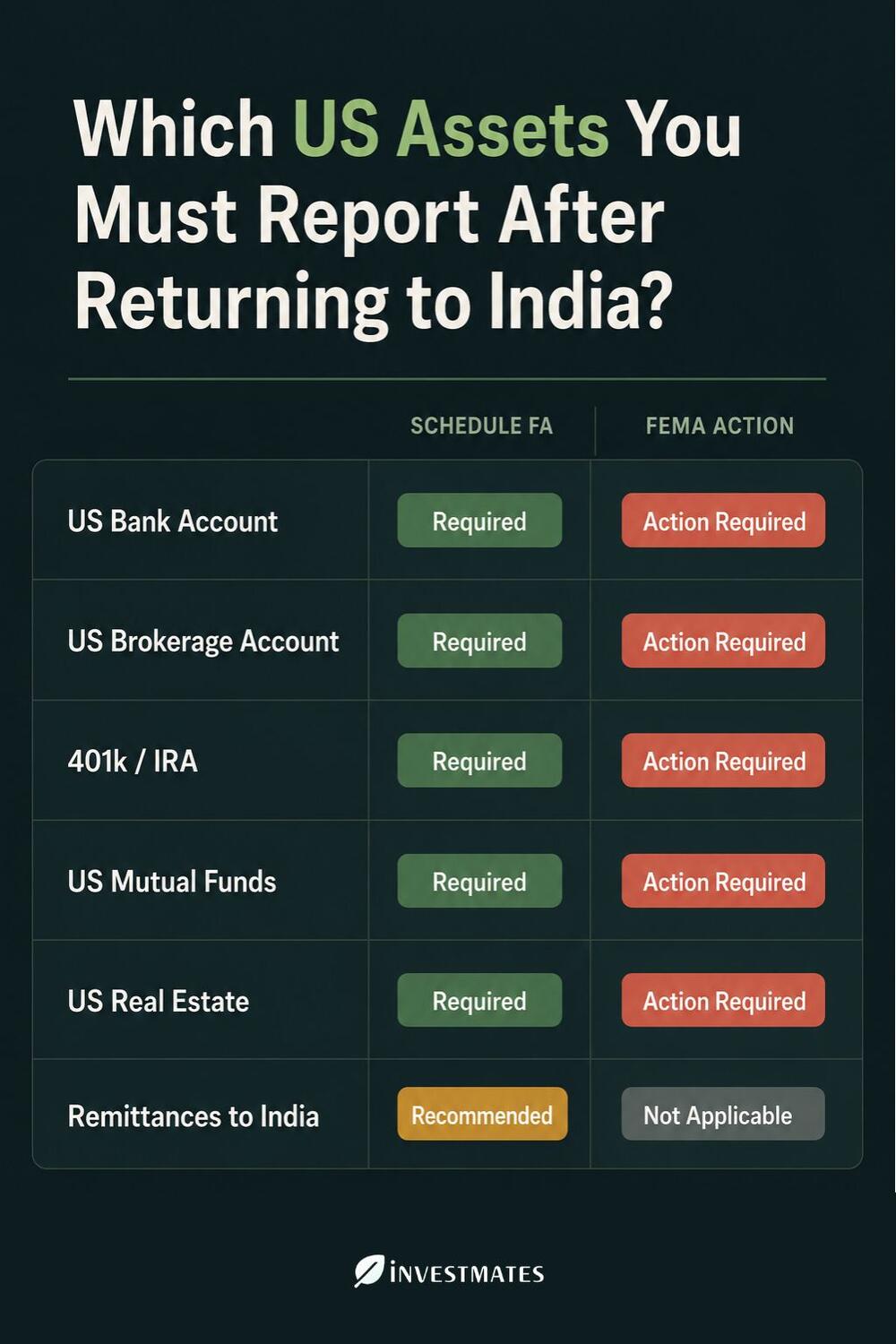

| US Asset Type | Disclose in Schedule FA? | FEMA Action Required | Timeline |
|---|---|---|---|
| US bank account | Yes (Section A1) | Close or convert to RFC | Within ~6 months of return |
| US brokerage account | Yes (Section A2/A3) | Hold up to 180 days, then sell or seek RBI permission | Within 180 days |
| US 401(k) / IRA | Recommended (Section A5) | No immediate action required under FEMA | Annual disclosure |
| US mutual funds (PFIC) | Yes (Section A3/A5) | Seek advice on FEMA compliance | Annual disclosure |
| US real estate | Yes (immovable property) | Permitted to retain; disclose and report rental income | Annual disclosure |
| Remittances to India | Not an asset; track income source | Not applicable | Track in year of transfer |
Schedule FA: Your Annual Income Tax Disclosure
Schedule FA is the mandatory foreign assets schedule that forms part of ITR-2 and ITR-3. You cannot file ITR-1 (Sahaj) if you hold any foreign assets. The moment you become a Resident with foreign holdings, ITR-2 or ITR-3 is the form you file.
Schedule FA is divided into sections that map to different asset types:
- A1: Foreign bank accounts (bank name, account number, country, peak and closing balance)
- A2: Foreign custodial accounts (brokerage accounts, held in a fiduciary capacity)
- A3: Equity and debt interests in foreign entities (shares, bonds, ownership stakes)
- A4: Interests in trusts outside India
- A5: Other foreign assets not covered above
You must disclose the asset even if it generated zero income during the year. Holding it is enough to trigger the reporting requirement.
The deadline for Schedule FA is the same as your ITR deadline: July 31 for most individual filers, October 31 if your accounts need an audit. This is an annual obligation. Every year you hold foreign assets as a Resident, you file Schedule FA.
One more reason not to skip this: India and the US exchange financial account information automatically under FATCA (Foreign Account Tax Compliance Act) and the CRS (Common Reporting Standard). The Income Tax Department already receives data on your US accounts. If you do not disclose and they already have the data, the mismatch triggers scrutiny.
If you are filing taxes in the year you return for the first time as a Resident, Schedule FA will feel like new territory. Plan for it before the ITR season begins.
FEMA Rules for Your US Accounts After Return
The Foreign Exchange Management Act (FEMA) governs what Indian Residents can hold in foreign currency and abroad. The rule is straightforward: once you are a Resident under FEMA, you generally cannot hold foreign bank accounts, foreign securities, or foreign currency without RBI permission.
That sounds alarming if you have a US bank account and a Schwab or Fidelity brokerage. Here is the practical picture.
Your NRE account must be converted to a regular resident savings account or closed. It cannot remain an NRE account once you are a Resident, because NRE accounts are only available to Non-Residents.
Your NRO account can stay open. It is designed to hold India-sourced income (like rental income) and remains valid for Residents too.
Your US bank account falls under FEMA's restrictions. The RBI allows you to retain it for a reasonable period while you wind down your US affairs. In practice, most advisors recommend completing the conversion or closure within six months of returning. The cleanest option is to transfer the balance to India and open an RFC (Resident Foreign Currency) account instead.
An RFC account is a special account available to returning NRIs. It lets you hold foreign currency in India legally. You can keep funds in USD, GBP, or EUR and use them freely, including for future travel or investments abroad. This is the right vehicle for your foreign savings rather than maintaining a US bank account indefinitely.
Your US brokerage account has a tighter window under FEMA. You are generally allowed to hold foreign securities for up to 180 days after becoming a Resident. After that, you need RBI permission to continue holding them. If you have a large stock portfolio in the US, speak to an advisor about your options before the 180-day window closes.
Understanding FEMA compliance rules in detail before you return will save you from scrambling to close accounts under time pressure.
Does RNOR Status Protect You From Reporting?
RNOR, or Resident but Not Ordinarily Resident, is a transitional status under Section 6 of the Income Tax Act. You qualify for it if you were an NRI for 9 of the 10 years immediately before returning, or if you spent fewer than 730 days in India over the 7 years before the current year.
The tax benefit of RNOR is real. Foreign income, meaning income from a source outside India that is also not connected to a business or profession controlled from India, is not taxable during your RNOR years. For a returning NRI with US salary continuing as consulting income, or with US investments generating dividends, RNOR can mean zero Indian tax on those earnings for two to three years.
What RNOR does not do is exempt you from Schedule FA.
RNOR individuals are classified as Residents for income tax purposes. The Schedule FA disclosure obligation applies to all Residents, whether Ordinarily Resident or Not Ordinarily Resident. The IT Act does not carve out RNOR as a category that skips foreign asset disclosure.
This is one of the most common and costly misconceptions among returning NRIs. They assume that because they are not paying Indian tax on foreign income during RNOR, they do not need to report foreign assets either. That is wrong. You must disclose. The Schedule FA requirement and the taxability of income are two separate things.
Build this into your return to India tax plan from day one, not as an afterthought in March.
Penalties If You Don't Report
The Black Money (Undisclosed Foreign Income and Assets) and Imposition of Tax Act, 2015 sets the penalty framework for failing to disclose foreign assets. The numbers are not forgiving.
If you do not disclose a foreign asset and the IT Department discovers it, the tax is levied at a flat 30% on the total value of the undisclosed asset, not just the income it generated. On top of that, a penalty equal to 90% of the tax amount applies. Combined, that works out to roughly 57% to 60% of the asset value, gone.
Beyond the financial penalty, the Act allows for prosecution and imprisonment of up to seven years for willful non-disclosure.
FEMA penalties are separate. A contravention under FEMA can attract a fine of up to three times the amount involved in the contravention, or Rs 2 lakh per day, whichever is higher, for continuing contraventions.
The reason this matters even more now: India receives financial account information from the US automatically under FATCA and CRS. The IT Department does not need to conduct an investigation to know your US account exists. If your return shows no foreign assets but their system shows a Chase Bank account with $50,000, that is a mismatch they will act on.
Conclusion
Returning NRI foreign asset disclosure in India is not optional, and RNOR status does not change that. Once you qualify as a Resident, you must file Schedule FA every year you hold foreign assets, whether those assets generated income or not. At the same time, FEMA requires you to convert or close your US bank accounts, ideally by opening an RFC account to keep your foreign savings within Indian law. The penalties for getting this wrong are among the highest in Indian tax law. Start an InvestMates consultation before you file your first ITR as a Resident so you know exactly what to declare and what to do with your US accounts.
Frequently asked questions
Do I need to close my US bank account after returning to India?
You are not required to close it immediately, but FEMA does not allow Residents to hold foreign bank accounts indefinitely without RBI permission.
The practical approach is to transfer the balance to India within six months of returning and open an RFC (Resident Foreign Currency) account if you want to retain funds in foreign currency.
Most advisors recommend completing this within six months of your return to avoid a FEMA contravention.
Which ITR form do I use to declare foreign assets?
You need ITR-2 or ITR-3. ITR-1 (Sahaj) does not include Schedule FA and is not available to individuals with foreign assets. If you are a salaried employee with no business income and hold foreign assets, ITR-2 is the right form. If you have business or professional income, use ITR-3. Download the official form at incometaxindia.gov.in.
Is money I transferred from the US to India after returning taxable?
It depends on what the money represents. If you are transferring savings that you already earned and paid tax on in the US, those funds are generally not taxed again in India during your RNOR period. Once you become a full Resident (ROR), your global income including any US earnings is taxable in India, but you can claim a tax credit for US taxes already paid under the DTAA. The source of the remittance and the year it was earned matter significantly.
Do I need to report my 401(k) and IRA in Schedule FA?
Indian tax law does not have explicit provisions for US retirement accounts like the Income Tax Act does for Indian accounts.
However, the widely recommended approach among cross-border tax advisors is to disclose them in Section A5 (Other Assets) of Schedule FA on a conservative basis.
The risk of not disclosing and later being found to have undisclosed foreign assets under the Black Money Act is far greater than the administrative effort of reporting.