
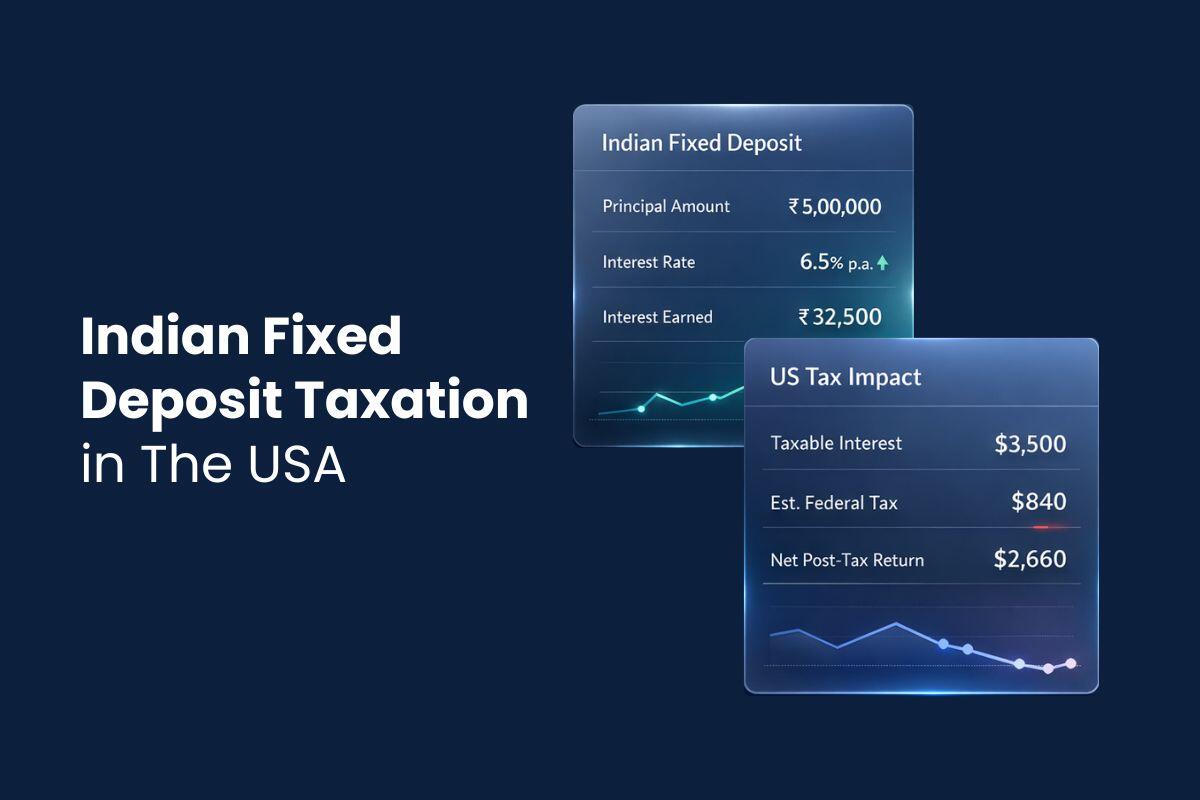
Tax on FD investments gets tricky if you're a US taxpayer with fixed deposits in India. The United States taxes individuals based on their US person status rather than residence. This means you must report worldwide income on your US tax return even if you've paid taxes in India already. The IRS takes an aggressive compliance approach. Failure to report your Indian FDs may result in heavy fines and penalties.
You must disclose your fixed deposits on international reporting forms, namely FBAR and FATCA. Understanding tax on FD in India versus tax on FD in USA helps you stay compliant and avoid expensive mistakes. This piece walks you through US tax treatment of Indian fixed deposits and the specific reporting requirements you need to meet.
Understanding Indian Fixed Deposits (FDs)
A Fixed Deposit locks your money with a financial institution for a predetermined period at a guaranteed interest rate. Banks and NBFCs in India offer FD tenures ranging from 7 days to 10 years. You deposit a lump sum amount. The institution pays you interest higher than regular savings accounts.
Interest calculation varies based on tenure. FDs shorter than 6 months use simple interest, while longer tenures apply compound interest. To cite an instance, see depositing Rs. 1,00,000 for 5 years at 10% that yields Rs. 1,50,000 with simple interest but Rs. 1,61,051 with compound interest.
As a US taxpayer, you access three specific FD types. NRE (Non-Resident External) Fixed Deposits accept foreign income converted to rupees and remain tax-free in India. Both principal and interest are repatriable. NRO (Non-Resident Ordinary) Fixed Deposits hold India-sourced income like rent or dividends. Interest faces 30% TDS plus surcharge and cess, with principal being non-repatriable. FCNR (Foreign Currency Non-Resident) deposits maintain your foreign currency exposure and offer tax-free returns in India.
Tax on FD in India depends on your account type. NRE and FCNR accounts escape Indian taxation, but NRO accounts attract standard resident tax rates. Your tax on FD in USA follows different rules, requiring you to report all three types on your US return whatever the Indian tax treatment.
Do NRIs Pay Tax on FD Interest in India?
NRE fixed deposit interest is exempt from Indian tax under Section 10(4)(ii) of the Income-tax Act for as long as you hold non-resident status, and FCNR interest is exempt under Section 10(15) on the same basis. NRO fixed deposit interest is fully taxable in India: banks withhold TDS at 30% plus applicable surcharge and cess under Section 195. You can usually cut that NRO TDS to the India-US treaty rate of 15% by filing a tax residency certificate and Form 41 (the DTAA self-declaration that replaced Form 10F under the 2026 Income-tax Rules) with your bank before interest is credited.
US Tax Treatment of Indian Fixed Deposits
US tax residents face taxation on worldwide income whatever their residence. The IRS taxes your Indian FD interest even if you never withdraw it or if India exempts it from taxation.
Tax on FD in India applies upon maturity or withdrawal. Tax on FD in USA follows accrual-based taxation instead. The IRS taxes your interest income as it accrues each year rather than waiting for distribution. You cannot defer taxation by rolling over FDs or reinvesting interest.
Fixed deposits with terms exceeding one year receive Original Issue Discount treatment. The IRS prevents artificial tax avoidance by requiring annual reporting of accrued interest instead of allowing gross-up taxation at maturity.
Your NRE account interest remains tax-free in India but becomes taxable on your US return. The same applies to NRO and FCNR deposits. Interest income faces ordinary income tax rates up to 37% rather than preferential capital gains rates.
You can offset double taxation through foreign tax credits, but only up to what the India-US tax treaty allows India to charge in the first place. Article 11 of the treaty caps India's tax on interest paid to a US resident at 15% (10% if paid to a bank), well below the standard 30% NRO TDS. If you filed Form 41 with your bank as described above, your NRO TDS is already withheld at that lower rate; either way, only tax up to the treaty rate is creditable on Form 1116, so any TDS withheld above 15% isn't a US credit and is instead reclaimed by filing an Indian income tax return. You choose between claiming foreign taxes as credits or itemized deductions. Credits reduce your US tax liability dollar-for-dollar and are more beneficial than deductions. Complete Form 1116 to claim the foreign tax credit and prevent paying tax twice on similar income.
Is FCNR Interest Taxable in the US?
Yes. The IRS treats FCNR interest the same as NRE and NRO interest: it is ordinary income, reportable on your US return as it accrues each year, regardless of India's tax treatment. Because FCNR interest is exempt from Indian tax (as covered above), there is no Indian TDS to credit on Form 1116 for this deposit type; the full accrued interest is taxed directly at your US ordinary rate.

US Reporting Requirements for Indian Fixed Deposits
You face mandatory disclosure obligations on top of tax on FD in USA. Two separate forms capture your Indian fixed deposits: FBAR and Form 8938.
File FBAR when combined foreign account values exceed $10,000 at any point during the calendar year. This threshold applies to combined balances across all foreign accounts including savings and checking, plus each FD. You must report every fixed deposit rather than consolidating them. FBAR requires the maximum account value during the year, account numbers and financial institution details. The form goes to FinCEN by April 15 with automatic extension to October 15.
Form 8938 attaches to your annual tax return with higher thresholds. Single filers living in the US must file if foreign assets exceed $50,000 on year-end or $75,000 anytime during the year. Married couples filing jointly face $100,000 and $150,000 thresholds. US persons abroad get much higher limits: $200,000 year-end or $300,000 peak for singles, and double that for joint filers.
Both forms may require reporting similar accounts. Non-willful FBAR violations can draw a penalty of up to $10,000 per violation, a ceiling that rises most years under mandatory inflation adjustments, while Form 8938 non-compliance can reach $60,000 total ($10,000 initially, plus up to $50,000 in continuing-failure penalties). Each fixed deposit counts as a separate reportable account that demands disclosure.
Conclusion
Your Indian fixed deposits create dual obligations as a US taxpayer. The IRS taxes all FD interest annually, whatever the Indian tax treatment. You must disclose each account on FBAR and Form 8938 when thresholds apply. Foreign tax credits help prevent double taxation on your NRO deposits. Stay compliant by reporting your FDs on your tax return and filing international forms before deadlines. This avoids substantial penalties.
Frequently asked questions
How is interest from fixed deposits taxed in the United States?
Fixed deposit interest is treated as ordinary income for U.S. federal tax purposes. It's taxed in the year it accrues, regardless of whether you withdraw it or not. This means you'll pay tax at your regular income tax rates, which can be as high as 37%, rather than at preferential capital gains rates.
Do I need to pay U.S. taxes on income earned in India?
Yes, if you're a U.S. citizen, green card holder, or resident alien, you must pay U.S. taxes on your worldwide income, including income earned in India. This applies regardless of where you live or whether you've already paid taxes in India on that income.
Are there different tax implications for NRE and NRO fixed deposits in the U.S.?
While NRE fixed deposits are tax-free in India and NRO deposits face 30% TDS in India, both types are fully taxable in the United States. The IRS requires you to report interest from all types of Indian fixed deposits on your U.S. tax return, regardless of their tax treatment in India.
Can I avoid double taxation on my Indian fixed deposits?
Yes, but only up to the India-US treaty rate of 15% on NRO interest, not the full 30% TDS. File a tax residency certificate and Form 41 with your bank to get the lower rate withheld directly, then use Form 1116 to credit that treaty-rate tax against your U.S. liability. Any TDS withheld above 15% isn't a US credit; reclaim it by filing an Indian tax return instead. Credits reduce your U.S. taxes dollar-for-dollar, which is more beneficial than claiming them as deductions.
What reporting requirements apply to Indian fixed deposits held by U.S. taxpayers?
You must file FBAR if your combined foreign account balances exceed $10,000 at any time during the year. Additionally, you may need to file Form 8938 with your tax return if you meet higher thresholds ($50,000 year-end or $75,000 anytime for single filers in the U.S.). Each fixed deposit must be reported separately on these forms.