

The Roth conversion deadline for 2026 is December 31: your pre-tax 401(k) or individual retirement account (IRA) money has to leave the account by then to count for this year. There's no April extension, and once it's done you can't undo it.
If you're on an H-1B or green card and might move back to India, this date matters more than usual. 2026 may be your last full year as a US tax resident, and that's usually the cleanest year to convert. I'll walk you through how the deadline works, what a move changes, and how much to convert before December 31.
How the Roth conversion deadline works
The distribution date decides the tax year
A Roth conversion moves pre-tax money, usually from a traditional IRA, into a Roth IRA. Under Internal Revenue Code (IRC) Section 408A(d)(3)(A), the converted amount is taxed as ordinary income. The year that counts is the year the money leaves the traditional IRA.
That makes December 31 a hard line. A Roth contribution for 2026 can still go in until April 15, 2027, but a conversion has no look-back window. One that settles on January 2 belongs to 2027, along with whatever income and residency you have then.
You can't take it back
Before 2018 you could reverse a conversion through recharacterization if markets fell or plans changed. The Tax Cuts and Jobs Act ended that, and the IRS now states that a conversion can't be recharacterized once made. The tax bill is final the day the money lands in the Roth.
So I'd never treat a December conversion as a placeholder. Decide the amount when your 2026 income is nearly final, then convert once.
Settlement, not the request, is what counts
The distribution has to be completed by December 31, not just requested. Brokerages work on their own timelines, so a late-December request can settle in January.
This year Christmas falls on Friday, December 25, and December 31 is a Thursday. Place your request by mid-December and check the distribution date.
401(k) money follows the same calendar
Pre-tax 401(k) money reaches a Roth through an in-plan Roth conversion, if offered, or a direct rollover from an old employer's plan into a Roth IRA. Either way, it's taxed in the year it leaves the pre-tax account. Your current employer's plan often won't release money while you still work there, so check first.
Why December 31 matters more if you may move back
The year you leave changes your US filing status
As a full-year US tax resident, a conversion is taxed like any other American's: normal brackets, the standard deduction, joint filing if you're married. In the year you move, you'll usually be a dual-status taxpayer, resident for part of the year and nonresident for the rest.
IRS Publication 519 restricts dual-status filers. Unless you elect resident treatment for the whole year, your standard deduction is zero and you generally can't file jointly. A half-year salary makes the exit year look cheap, but those limits often erase the gain.
After you leave, conversions get murky
Once you're a nonresident alien (NRA) for US tax, a conversion is harder to price. Retirement distributions to nonresidents face 30% withholding by default. There's also no published IRS guidance on how the US-India tax treaty treats a conversion by a nonresident.
That uncertainty is why I'd finish any planned conversion while you're still a full-year resident. The exit-year tax planning for H-1B holders already has enough moving parts without an open treaty question added to it.
What India does with the same conversion
India taxes by its own financial year, April to March, and by your residential status. Income from a US IRA that's received and kept outside India isn't taxed while you're a non-resident, or Resident but Not Ordinarily Resident (RNOR) after the move. Your RNOR window usually runs two to three financial years.
The bigger India question comes later, once you're Resident and Ordinarily Resident (ROR). India doesn't recognize a Roth's tax-free status. My position is the conservative one: report Roth withdrawals as income in India, with the growth taxed at slab rates and no US tax to credit against it.
If you leave the US, the Roth IRA itself stays open and keeps its US tax-free treatment. How your IRA is taxed after the move depends mostly on your Indian residency status in the year you withdraw.
Conversion timing compared: this year, the exit year, or after the move
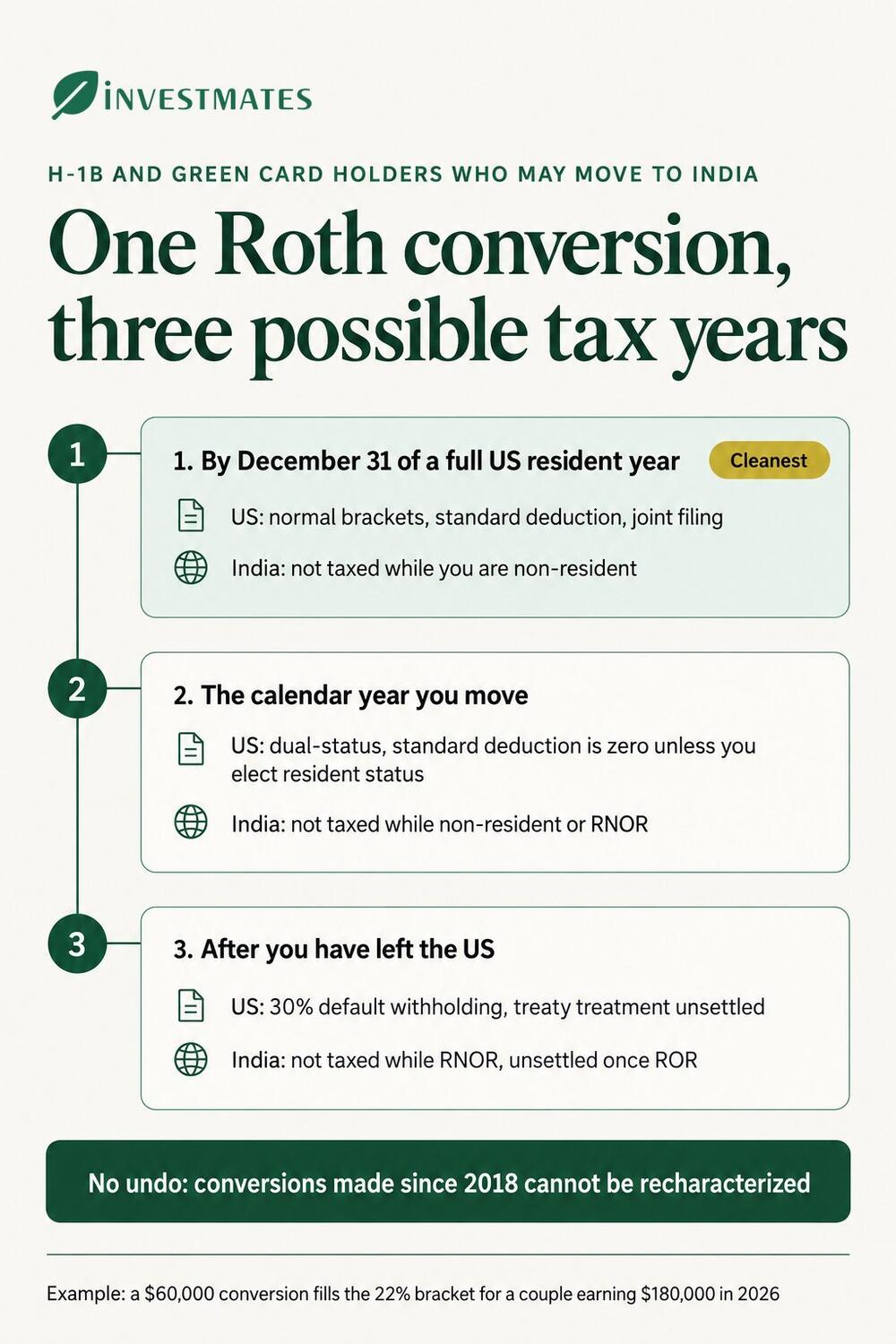

| When you convert | Your US status | US tax on the conversion | India tax on the conversion |
|---|---|---|---|
| By December 31 of a full US resident year | Resident | Normal brackets, standard deduction, joint filing | None while you're non-resident in India |
| In the calendar year you move | Dual-status | Resident rates, but generally no standard deduction or joint return | None while non-resident or RNOR |
| After you've left | Nonresident alien | 30% default withholding, treaty treatment unsettled | None while RNOR; unsettled once ROR |
A worked example: Arjun and Neha in Seattle
Arjun is on an H-1B and Neha on an H-4. They live in Seattle, file jointly and expect to move to Bangalore in mid-2027. Their 2026 wages are $180,000, and Arjun holds $95,000 in a traditional IRA rolled over from an old 401(k).
- Taxable income before any conversion: $180,000 minus the $32,200 joint standard deduction for 2026 is $147,800.
- The 22% bracket for joint filers in 2026 runs up to $211,400, leaving $63,600 of room.
- A $60,000 conversion stays inside 22% and adds about $13,200 of federal tax. Washington has no state income tax.
- Converting all $95,000 would push $31,400 into the 24% bracket.
If they wait until 2027, the same conversion lands in a dual-status year without the standard deduction, or after the move with 30% withholding and an open treaty question. 2026 is the year with known rules, and its Roth conversion deadline is December 31, 2026.
Who this timing question applies to
The December 31 date matters most if you hold pre-tax IRA or rolled-over 401(k) money and a move to India is a real possibility in the next year or two. That covers:
- H-1B and L-1 holders who could leave on short notice, including after a layoff.
- Green card holders weighing a return, who stay US residents until the card is formally abandoned.
- Couples where one spouse may move ahead and change the household's filing position.
- Families who aren't sure yet, or who might come back to the US in 15 to 20 years.
It matters less for US citizens. You're taxed by the US on worldwide income for life, so moving doesn't change your US conversion rules, only India's view of the Roth later. If you're staying in the US permanently, this is ordinary year-end planning with no India layer.
Green card holders have one more line to watch. Giving up a card held in at least 8 of the 15 tax years ending with that year can trigger the Section 877A exit tax. That tax generally pulls retirement balances into income in the expatriation year.
How much to convert: fill your Roth conversion tax bracket, not more
- Estimate your 2026 taxable income from your latest pay stub, including any December bonus or RSU vest.
- Find the room left in your current bracket. For joint filers in 2026, the 22% bracket tops out at $211,400 and the 24% bracket at $403,550.
- Check for after-tax basis. If you've ever made nondeductible IRA contributions, Form 8606 prorates the conversion using the value of all your traditional, SEP and SIMPLE IRAs on December 31.
- Pay the tax from cash, not from the IRA. Withholding from the conversion is a separate distribution, and under age 59½ it can carry the 10% additional tax.
- Cover the extra tax through higher withholding or the fourth-quarter estimated payment due January 15, 2027.
- Place the request by mid-December and keep the confirmation. You'll report the conversion on Form 8606 Part II using your custodian's Form 1099-R.
The same December 31 date governs other year-end moves, such as tax-loss harvesting, so run them together. A standard Roth conversion calculator will do the US bracket math in step 2. It won't know your India residency dates, so it can't tell you whether the Roth growth stays tax-free once you're in India.
The judgment call worth a professional is step 2 for a returner: how much Roth money you'll realistically withdraw during RNOR, against what India may tax once you're ROR. Converting more than you can use inside that window can mean paying US tax now on growth India taxes later.
Common misreadings about converting before a move
Planning a Roth conversion ladder after you land
A Roth conversion ladder spreads conversions over several years. Each conversion starts its own five-year clock, and withdrawing converted money within that period before age 59½ can trigger the 10% additional tax. An RNOR window runs two or three Indian financial years, so every rung's Roth conversion 5-year rule outlasts the shield.
I don't recommend ladders to returning clients for that reason. One well-sized conversion in a known US resident year, or an RNOR-window plan built around the 401(k) and IRA exit options, usually fits better.
Assuming RNOR is automatic
Your RNOR years depend on your day counts in India over earlier years, not simply on how long you were away. Of 461 InvestMates discovery calls from February to October 2026, 178 raised RNOR. In about 36, the caller learned their status or window differed from what they'd assumed.
Count your days before you size a conversion around the window.
Your next step before December 31
Pull your latest pay stub this week, work out the room left in your 2026 bracket, and fix the amount before mid-December. If a move is likely, I'd size it against your RNOR window and India's later view of the Roth. InvestMates can model both sides with you before the deadline.
Frequently asked questions
What is the biggest Roth conversion mistake?
The biggest Roth conversion mistake is converting more than your current bracket holds, so part is taxed at the next rate up. Paying the tax from the IRA is close behind, since before 59½ it can add the 10% additional tax. For a returner, converting money you'll withdraw as an ROR in India is the third.
What time of year should I do a Roth conversion?
For most H-1B and green card households, the best time of year for a Roth conversion is late November to mid-December. By then your bonus and RSU vests are mostly known, with time left to settle before December 31. If you may move, also check how your RNOR status applies afterwards.
Is it better to do a Roth conversion early or late in the year?
A late-year Roth conversion lets you size it against income you already know. An early one gives the money more months of tax-free growth inside the Roth. Because a conversion can't be undone, certainty usually wins for anyone whose income or residency may change.
Does a Roth rollover reset the 5 year rule?
No, moving money from one Roth IRA to another doesn't restart the Roth IRA's 5-year clock. Rolling a Roth 401(k) into a Roth IRA is different: the years in the 401(k) don't count toward the Roth IRA's clock. Each traditional-to-Roth conversion also starts its own 5-year period for the 10% additional tax before age 59½.
Can you move your 401k into a Roth IRA without penalties?
Yes, a direct rollover moves a pre-tax 401(k) into a Roth IRA without the 10% early withdrawal penalty, but the amount is taxed as income that year. Your current employer's plan may not allow it while you're employed. If you're leaving the US, compare it with other 401(k) withdrawal strategies first.