
A backdoor Roth IRA lets non-resident Indians (NRIs) on an H-1B or green card fund a Roth even when their income is above the Internal Revenue Service (IRS) limit, if they file as US tax residents. You contribute to a traditional individual retirement account (IRA) without a deduction, then convert it to a Roth.
The catch is an old 401(k) rolled into an IRA after a job change or layoff, which the pro-rata rule can turn into a tax bill. I'll walk you through the eligibility rules, the pro-rata math with a real client example, how to clear it before December 31, and how to file Form 8606.
How a backdoor Roth IRA works on an H-1B or green card
The IRS doesn't ask what visa you hold. It asks whether you're a resident alien for tax purposes. Green card holders are, and most H-1B workers become residents once they pass the substantial presence test, so they file Form 1040 like a citizen.
You also need US taxable compensation, which your W-2 salary covers. If you're still a nonresident filing Form 1040-NR in your first US year, get the IRA question checked before you contribute. Everything below assumes you file Form 1040.
The backdoor comes down to four actions, and neither the contribution nor the conversion has an income limit:
- Contribute up to $7,500 to a traditional IRA and claim no deduction for it.
- Leave the money in cash or a money market fund so it earns almost nothing.
- Convert the balance to your Roth IRA, the same week or a few weeks later.
- Report both steps on Form 8606 with your tax return.
You can make a 2026 contribution until April 15, 2027, and filing an extension doesn't move that date. The conversion counts in the calendar year you actually do it.
Why you need the backdoor: 2026 and 2027 Roth income limits
Above a certain modified adjusted gross income (MAGI), you can't contribute to a Roth IRA directly. The ranges below come from the IRS cost-of-living announcements for each year.

| Filing status | 2026 phase-out | 2027 phase-out | What it means for you |
|---|---|---|---|
| Single or head of household | $153,000 to $168,000 | $158,000 to $173,000 | Above the top, use the backdoor |
| Married filing jointly (MFJ) | $242,000 to $252,000 | $250,000 to $260,000 | Common for two-income tech households |
| Married filing separately (MFS) | $0 to $10,000 | $0 to $10,000 | Direct Roth is out at almost any salary |
The trap when your spouse lives in India
If your spouse is a nonresident alien in India, you usually file married filing separately unless you elect to treat them as a US resident and file jointly. That MFS range starts at $0 and isn't indexed, so even a modest salary blocks a direct Roth.
There's one relief. If you didn't live with your spouse at any time during the year, you use the single limits instead. Choosing between the two filing routes changes far more than your Roth, so read how filing jointly or separately plays out first.
The pro-rata trap and your old 401(k) rollover
The pro-rata rule in IRC Section 408(d)(2) treats every traditional, SEP (Simplified Employee Pension) and SIMPLE (Savings Incentive Match Plan for Employees) IRA you own as one pot. You can't convert only the after-tax dollars. Each dollar you convert carries the same mix of taxed and untaxed money as the whole pot.
The pot is measured on December 31 of the conversion year, not on conversion day. Your 401(k), Roth IRA and any inherited IRA stay outside it. So do Indian accounts like the Employees' Provident Fund (EPF), Public Provident Fund (PPF) and National Pension System (NPS), because none of them is a US IRA.
What the math looked like in one client file
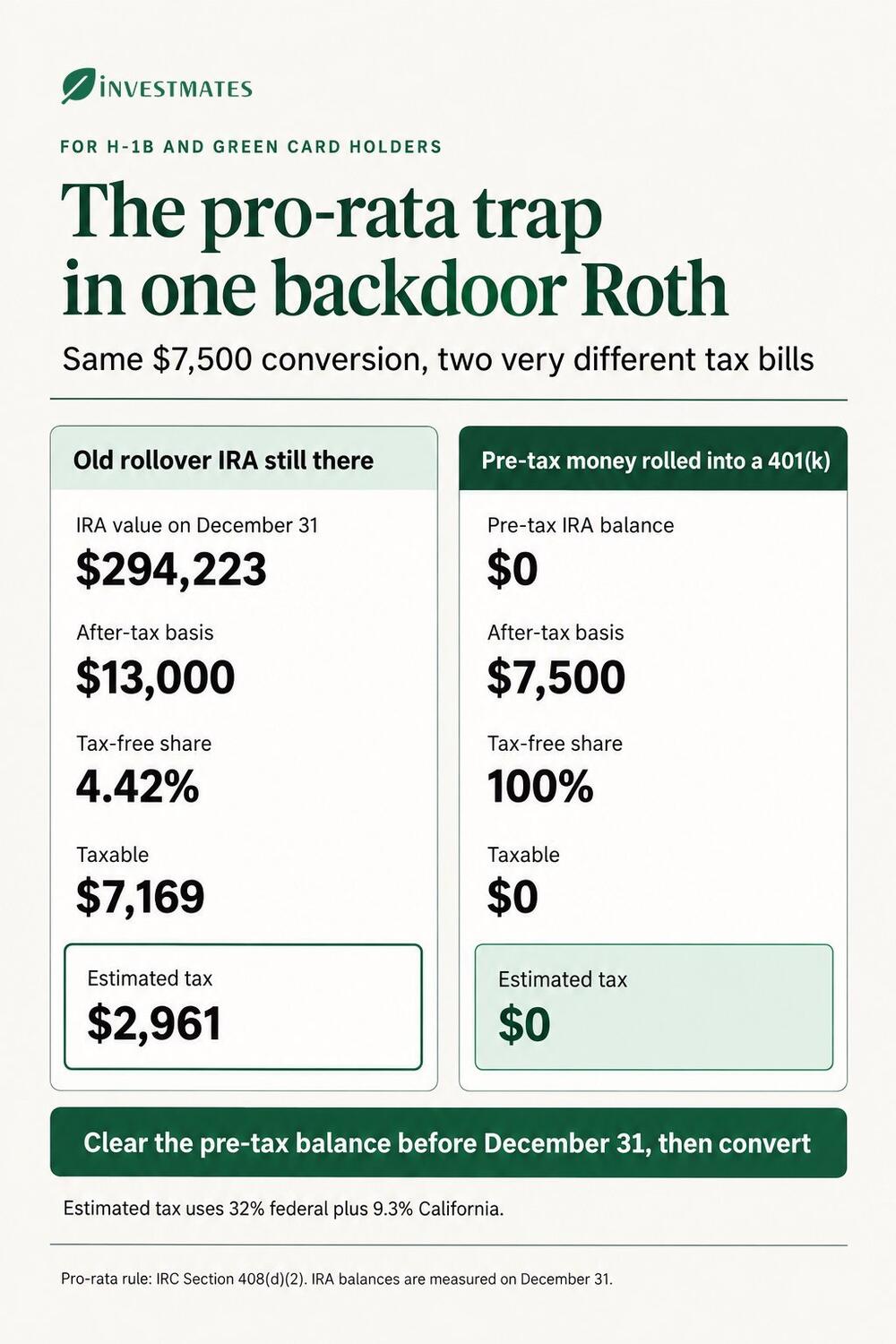
One client file I reviewed this year shows the cost clearly. The traditional IRA held about $287,000: $5,500 of after-tax basis from a 2015 nondeductible contribution, and roughly $281,000 of pre-tax money rolled from four old 401(k) plans.
A new $7,500 contribution would bring total basis to $13,000 against an IRA worth about $294,000. Only 4.42% of the conversion would be tax-free, so about $7,169 of the $7,500 becomes taxable income.
At the 32% federal bracket plus California's 9.3%, that's roughly $2,961 of tax on money already taxed once. The leftover basis then gets recovered slowly over decades, and the same bill comes back every year the old rollover sits there.
Three ways to clear the pre-tax balance
- Roll it into a 401(k). IRC Section 408(d)(3)(H) lets pre-tax IRA money roll into an employer plan while the after-tax basis stays behind. Your plan has to accept incoming IRA rollovers, which its summary plan description (SPD) states.
- Use a solo 401(k). Any self-employment or 1099 consulting income lets you open one, and many accept IRA roll-ins.
- Convert everything. You pay ordinary income tax on the pre-tax part once, and the problem is gone for good.
In that client's case, rolling the $281,000 pre-tax portion into a 401(k) would leave only the $5,500 basis in the IRA. Converting it costs $0 in tax, and every backdoor after that is clean. I'd pick the 401(k) roll-in over a big conversion whenever a plan will take the money.
The roll-in has to land before December 31 of the year you convert. If you're running short on time, contribute now, hold the cash in the IRA, and convert next year once the old balance is gone.
If your employer's 401(k) allows after-tax contributions, the mega backdoor Roth can move far more than $7,500 a year without touching the pro-rata rule. If you're moving back to India later, first check how a Roth fits a planned return.
Filing Form 8606 without paying tax twice
Form 8606 records your after-tax basis, so the IRS doesn't tax the same dollars again. Part I covers the nondeductible contribution. Part II covers the conversion, and line 6 asks for the December 31 value of every traditional, SEP and SIMPLE IRA you hold.
Your custodian sends Form 1099-R for the conversion, usually with code 2 in box 7 if you're under 59½. Box 2a often shows the whole conversion as taxable, and Form 8606 is what proves the real taxable amount is close to zero.
This is where avoidable mistakes show up. In one review of client 1099-Rs, I found three backdoor conversions of about $7,000 each, every one showing the full amount as taxable in box 2a. Each needed Form 8606, the prior basis and the December 31 IRA values before the real tax was known.
A few filing rules matter on a visa:
- Each spouse files their own Form 8606, even on a joint return.
- Skipping a required Form 8606 carries a $50 penalty, and overstating basis carries $100.
- Keep every Form 8606 permanently, because basis carries forward through line 14.
- Each conversion starts its own five-year clock for the 10% early-withdrawal penalty before 59½.
The IRS instructions for Form 8606 walk through each line if you prepare your own return.
What to do next
- Pull your latest statements for every traditional, rollover, SEP and SIMPLE IRA you own.
- Add up the pre-tax balance you'd carry into December 31.
- If it isn't zero, ask your 401(k) administrator whether the plan accepts IRA roll-ins.
- Complete the roll-in before December 31, then contribute and convert.
- Find your last Form 8606 so the basis carries forward correctly.
The bottom line
Before you send $7,500 to a traditional IRA this year, check one number: the December 31 balance of every pre-tax IRA in your name. If it's zero, the backdoor is close to free. If it isn't, I'd fix that first, and InvestMates can check the numbers with you.
Frequently asked questions
Can an H-4 spouse with no income do a backdoor Roth?
Yes, an H-4 spouse can do a backdoor Roth if you file jointly. A spousal IRA lets them contribute up to $7,500 based on your earned income, under the same IRA eligibility rules for NRIs. They file their own Form 8606, and only their own pre-tax IRAs count toward their pro-rata math.
Can I open a Roth IRA if I have a green card?
Yes. A green card holder is a US tax resident, so a Roth IRA follows exactly the same rules as for a citizen, including the backdoor route. That residency lasts until you formally give up the card, which matters if you later keep a green card from India.
Are backdoor Roth conversions still allowed in 2026?
Yes. Backdoor Roth conversions are still allowed in 2026, and the 2025 tax law didn't change Roth IRA conversions. Congress considered ending the strategy in 2021, but that proposal didn't pass.
Can you do a backdoor Roth with a solo 401k?
Yes, indirectly. A solo 401(k) that accepts IRA rollovers can absorb your pre-tax IRA money, which leaves your traditional IRA empty so the backdoor Roth conversion costs no tax. You need genuine self-employment income to open one.
Can I convert my existing IRA to a backdoor Roth IRA?
Yes, but converting an existing pre-tax IRA is a regular Roth conversion, and you'll pay income tax on the pre-tax part. It does clear the pro-rata problem permanently, so it can make sense in a lower-income year.