
You've spent years building a career in the US, contributing diligently to your retirement accounts. Now you're thinking about moving back to India in the next few years. The question that stops most NRIs cold: should you keep maxing out your 401(k) or Roth IRA, or is there a smarter way to use these accounts before you leave?
The answer changes completely when India is in the picture. A 401(k) and a Roth IRA were designed for US tax residents. Once you become a tax resident of India, both countries want a share of your withdrawals. How much each country takes, and which account gives you more control over that, is what this comparison covers.
This article breaks down every dimension that matters for a US-based NRI planning to return, so you can decide which account to prioritize, how much to contribute, and what to do with these accounts after you land in India. If you're not yet sure about your return timeline, the broader 401k vs IRA vs Roth IRA comparison covers the general decision framework for any US-based NRI.
What Is a 401(k)?
A 401(k) is an employer-sponsored retirement savings plan in the US. It comes in two forms: a Traditional 401(k), where contributions are made with pre-tax dollars, and a Roth 401(k), where contributions are made with after-tax dollars.
For 2026, the annual contribution limit is $24,500 for employees under 50. If you are between 50 and 59 or aged 64 and above, you can contribute up to $32,500 (an $8,000 catch-up). If you are between 60 and 63, the SECURE 2.0 Act allows a higher catch-up of $11,250, bringing your limit to $35,750. Many employers match a portion of your contributions, typically 3% to 6% of your salary. If you leave your job before your employer's vesting schedule is complete, you may forfeit part or all of this match.
For a full breakdown of 401(k) investment options and vesting rules as an NRI, that guide covers the details.
What Is a Roth IRA?
A Roth IRA is an individual retirement account you open yourself, funded with after-tax dollars. Because you pay tax upfront, qualified withdrawals in retirement are completely tax-free under US law.
For 2026, you can contribute up to $7,500 per year if you are under 50, and $8,600 if you are 50 or older. However, there are income limits. Your ability to contribute phases out starting at $153,000 of modified adjusted gross income for single filers and $242,000 for married couples filing jointly in 2026. Verify the exact phase-out range at irs.gov before contributing.
A key advantage of the Roth IRA is that there are no required minimum distributions (RMDs) during your lifetime, unlike a Traditional 401(k). To check your full Roth IRA eligibility as an NRI, including what happens when you stop earning US income, that article explains the rules in detail.

Is a Roth IRA Taxed in India?
This is the single most-searched question NRIs have about Roth IRAs, and the honest answer has two distinct parts.
The US side: qualified withdrawals are tax-free
Under US law, a qualified Roth IRA distribution (you're 59½ or older and have held the account at least five years) is completely tax-free, including all the growth. This holds true even for non-resident aliens living in India, since the US doesn't distinguish Roth taxation by residency for qualified distributions.
The India side: genuinely unsettled, not a clear no
India's tax authorities have not issued specific guidance on Roth IRA distributions, and this is a real gap, not a technicality. Some interpretations treat Roth withdrawals as tax-free income exempt under the India-US DTAA; others argue India can tax the growth portion since India's tax code has no equivalent concept of a "post-tax, grows tax-free" retirement account to map it against. Unlike Traditional 401(k)s and IRAs, where Section 89A gives RORs a clear mechanism to defer India tax on accrued growth until withdrawal, Roth IRAs sit in a genuine gray area. During your RNOR period (typically 2 to 3 years after returning), this uncertainty matters less: foreign income not remitted to India isn't taxable regardless of account type. The open question surfaces once you become a full Resident and Ordinarily Resident (ROR). If you're relying on Roth tax-free treatment as a cornerstone of your India retirement plan, get a current opinion from a cross-border tax advisor before you need the money, not after.
What Is the Indian Equivalent of a Roth IRA?
There isn't a true equivalent. India has no retirement account that combines post-tax contributions with genuinely tax-free growth and withdrawals the way a Roth IRA does. The closest comparisons are imperfect: ELSS mutual funds offer equity growth with a tax deduction on the way in (the opposite direction from a Roth) and are taxed on long-term capital gains above ₹1.25 lakh, unlike a Roth's tax-free withdrawals. PPF offers tax-free growth and withdrawal (EEE status) but caps contributions at ₹1.5 lakh per year and locks funds for 15 years, both far more restrictive than a Roth IRA. If you're looking for "the Indian Roth IRA," the short answer is that nothing matches it closely enough to treat as a substitute.
401(k) vs Roth IRA: Which Should You Choose When Returning to India?
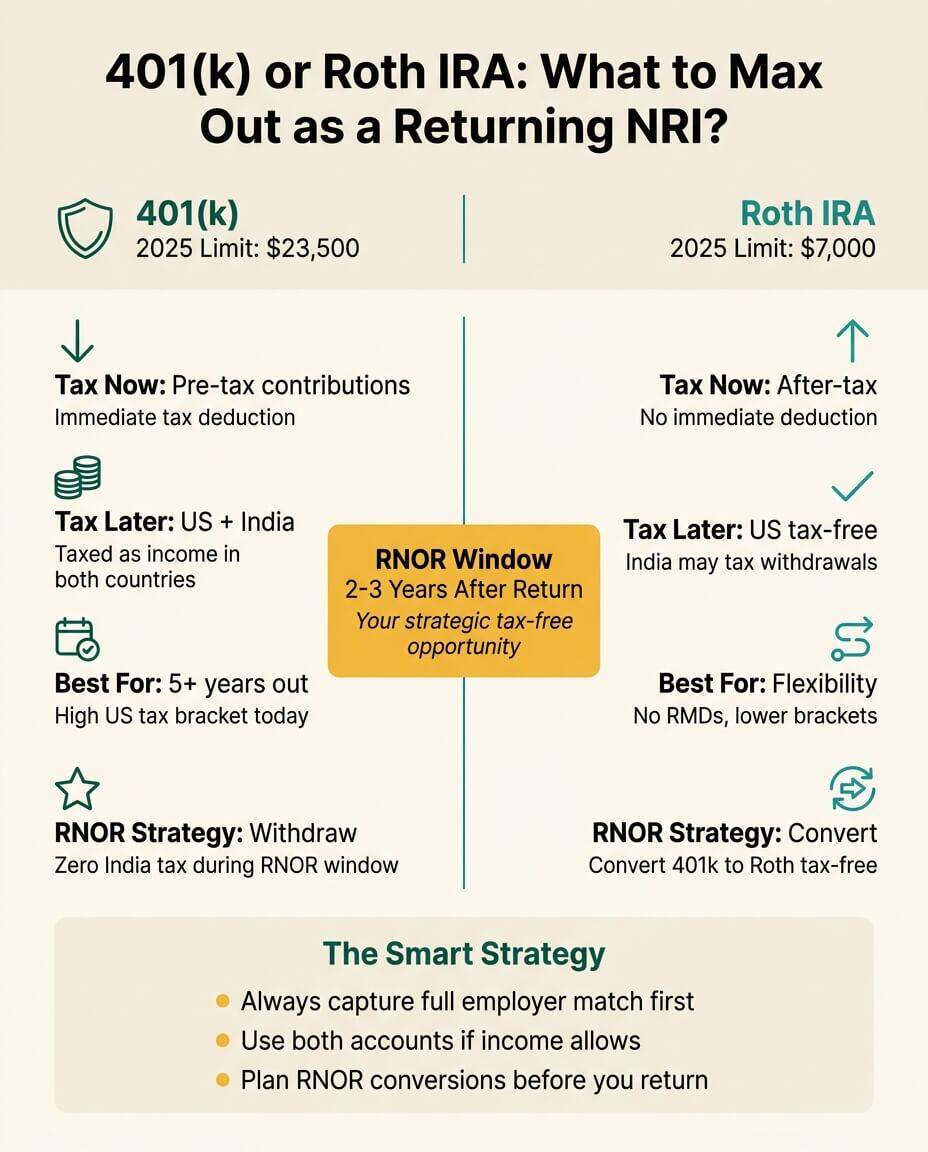
Neither account is universally better for returning NRIs. The right answer depends on three things: how many years until you return, your current US tax bracket versus your expected tax rate in India during retirement, and whether you will qualify for RNOR status.
Most NRIs who have lived abroad for 9 of the past 10 years qualify for RNOR status for 2 to 3 years after returning. During this period, foreign income that is not remitted to India is not taxable in India. This window is the most powerful tax planning tool available to returning NRIs, and your retirement account strategy should be built around it.
Choose 401(k) if:
- You are 5 or more years from returning and your current US marginal tax rate is 32% or higher. The pre-tax deduction saves you more money at higher brackets.
- Your employer offers a match and you are not currently contributing enough to claim all of it. The match is immediate, guaranteed return. Always take the full match before putting money anywhere else.
- You plan to use the RNOR window strategically. If you return at 55 and have RNOR status for 2 years, you could withdraw from your Traditional 401(k) during that period and owe zero India tax on those distributions (as long as the funds are not remitted to India).
- You are between 60 and 63 and want to use the SECURE 2.0 enhanced catch-up limit of $35,750 to rapidly build your balance before leaving.
- You expect to be in a lower tax bracket in India during retirement than you are in the US today. In that case, deferring tax now and paying at a lower rate later is a net positive.
Choose Roth IRA if:
- You are in the 22% or 24% US tax bracket and expect your India income in retirement to be modest. Paying tax now at 22-24% and then potentially paying India tax later on a smaller base may still beat paying a higher rate on a larger Traditional 401(k) balance.
- You value flexibility. Roth IRA contributions (not earnings) can be withdrawn at any time and any age, without penalty. This matters if you are not certain when you will return or what your cash needs will be.
- You dislike the idea of mandatory withdrawals. With no RMDs, your Roth IRA can continue to grow tax-free for as long as you choose not to touch it.
- You have already captured your full employer match in the 401(k) and want a separate bucket for post-tax retirement savings.
- You want to use the RNOR window to convert your Traditional 401(k) to a Roth IRA. You pay US income tax at the time of conversion, but owe zero India tax during RNOR. After that, your Roth IRA balance grows and is withdrawn tax-free in the US.
Can You Use Both?
Yes, you can contribute to both a 401(k) and a Roth IRA in the same calendar year. The limits are completely separate. In 2026, that means up to $24,500 in your 401(k) plus $7,500 in your Roth IRA, for a combined total of $32,000 per year (if you are under 50).
Take Priya, 36, a software engineer in Austin earning $145,000 a year. She contributes $24,500 to her Traditional 401(k), capturing her company's full 4% match, and also puts $7,500 into a Roth IRA. She is planning to return to India in 6 years and intends to use the RNOR window to convert a portion of her 401(k) to Roth at zero India cost. Using both accounts now gives her maximum flexibility later.
If your income exceeds the Roth IRA phase-out limit, a backdoor Roth IRA allows you to make a nondeductible Traditional IRA contribution and then convert it. Consult a tax advisor to confirm this is appropriate given your full financial picture.
Conclusion
For most US-based NRIs planning to return to India, the answer is not 401(k) or Roth IRA. It is both, used strategically. Max out your 401(k) at least to the employer match, and use a Roth IRA to build a separate post-tax bucket. Before you return, work with a cross border tax advisor to use your RNOR window to withdraw or convert at the lowest combined tax cost. How you treat your Roth IRA in India is not a question with a universal answer, but with the right timing and the right advisor, both accounts can work hard for you on both sides of the world.
Frequently asked questions
Does India recognize Roth IRA distributions as tax-free?
No. India does not have a concept of tax-exempt retirement savings accounts. The Indian Income Tax Act taxes worldwide income of tax residents. When you become a tax resident of India, Roth IRA distributions will likely be treated as income and taxed accordingly, even though they are tax-free in the US. The India-US DTAA may allow a credit for any US taxes withheld, but since qualified Roth IRA distributions are not taxed in the US, there may be no credit to claim. Consult a cross border tax advisor before making large withdrawals as a tax resident of India.
Is a Roth IRA tax-free?
In the US, yes, for qualified distributions (age 59½+, account held 5+ years). In India, it's genuinely unsettled: India hasn't issued clear guidance on Roth distributions specifically, and Section 89A's protections don't cleanly cover Roth accounts the way they do Traditional 401(k)s and IRAs. During your RNOR period this matters less; once you're a full Resident, get current professional advice before relying on Roth tax-free treatment for India purposes.
What is the Indian equivalent of a Roth IRA?
There isn't a true one. India has no account combining post-tax contributions with genuinely tax-free growth and withdrawal the way a Roth IRA does. ELSS funds and PPF are sometimes compared to it, but both work differently: ELSS gives a tax deduction going in (opposite of a Roth) and is taxed on long-term gains going out, while PPF is tax-free both ways but caps contributions at ₹1.5 lakh a year with a 15-year lock-in.
Are you allowed to max out both a 401(k) and a Roth IRA in the same year?
Yes, if you meet the income eligibility requirements for the Roth IRA. The 401(k) and Roth IRA have completely separate contribution limits. In 2026, you can contribute up to $24,500 to your 401(k) and up to $7,500 to your Roth IRA in the same calendar year, for a combined $32,000 if you are under 50. Note that you must have US earned income at least equal to your total IRA contributions to be eligible for the Roth IRA.
How does RNOR status protect my US retirement account withdrawals from India tax?
Under the Indian Income Tax Act, an individual with RNOR (Resident but Not Ordinarily Resident) status is taxable in India only on income sourced from India or income received in India. Foreign-source income, such as 401(k) or Roth IRA withdrawals, that is not remitted to India is not taxable during the RNOR period. For most NRIs who have lived abroad for 9 of the past 10 years, this status applies for 2 to 3 years after returning. Note that to qualify as an NRI in the first place, you generally need to spend fewer than 182 days in India in a financial year.
Once you return and cross that threshold, your RNOR window begins. This window is genuinely valuable: you can take 401(k) distributions or convert to a Roth IRA during RNOR at zero India tax cost, as long as those funds stay offshore and are not brought into India.