

You spent years building a 401(k) in the United States. Now you're moving back to India, and the big question is what to do with it. Cash it out? Leave it invested? Roll it into an IRA? The wrong move can cost you tens of thousands of dollars in unnecessary taxes and penalties.
This step-by-step guide walks you through the right 401k withdrawal strategy for NRIs, covering what the US and India tax rules actually say and how to use tools like the India-US DTAA, your RNOR window, and Section 89A to keep more of your money. Getting your withdrawal strategy right before you leave the US can save you tens of thousands of dollars.
Step 1: Understand Your Three 401(k) Options
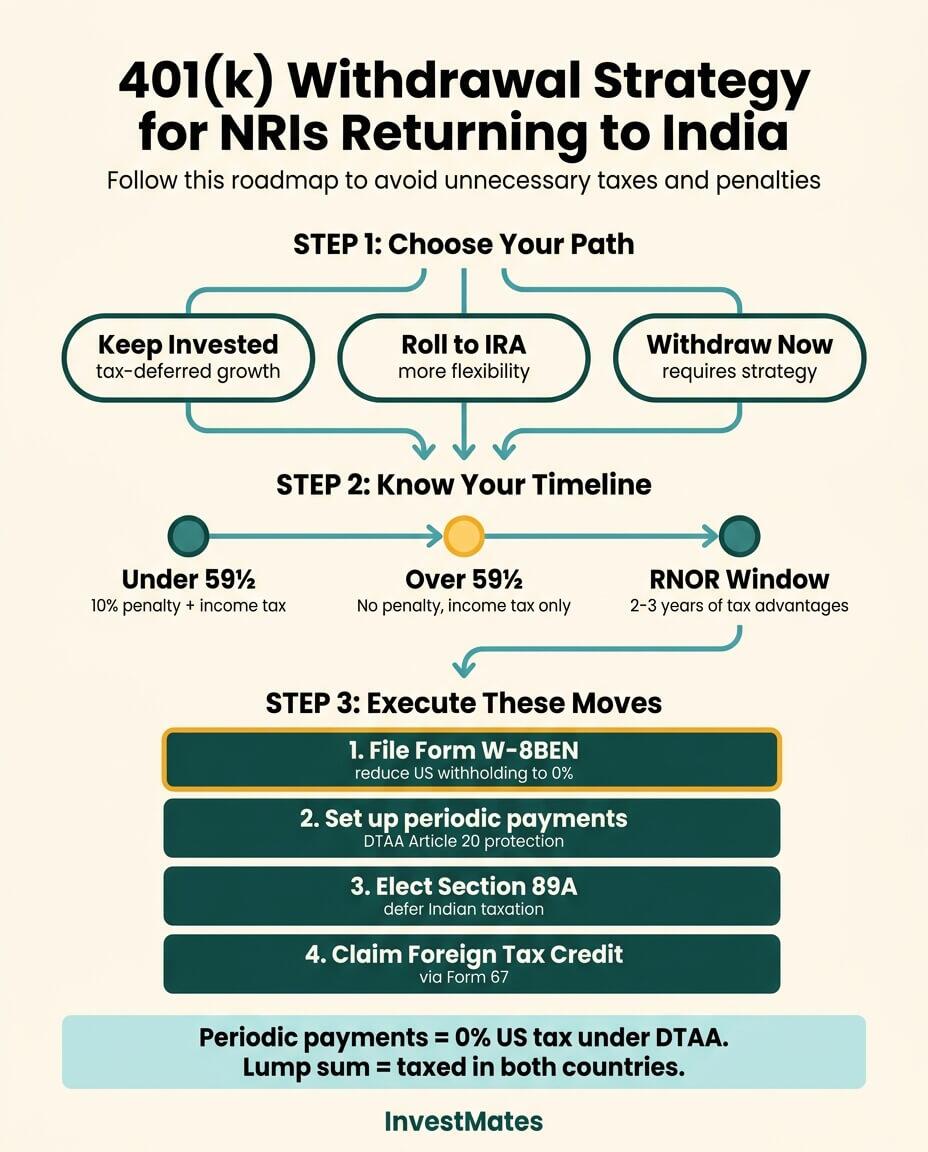
Before anything else, your 401k withdrawal strategy starts with choosing between three main paths. None of them is automatically right or wrong. The best choice depends on your age, how soon you need the money, and your India tax residency timeline.
Option 1: Keep the account invested in the US
Your 401(k) can stay exactly where it is. Your money continues to grow tax-deferred in the US, and you are not required to do anything until you need the funds or until Required Minimum Distributions (RMDs) begin. Under the SECURE 2.0 Act, RMDs now start at age 73. If you are years away from retirement and do not need the money right now, leaving the account invested is often the most tax-efficient starting point.
Option 2: Roll it over to a Traditional IRA or Roth IRA
If your employer does not allow you to keep the 401(k) after leaving, or if you want more investment flexibility, you can roll the funds into an IRA. The rollover must happen within 60 days to avoid immediate US taxation. A Traditional 401(k) rolls cleanly into a Traditional IRA. A Roth 401(k) rolls into a Roth IRA. This preserves your tax-deferred status and does not trigger any penalties.
Option 3: Withdraw all or part of the funds
You can cash out your 401(k), fully or partially. This is the most expensive option if done without planning. Withdrawals are taxed as ordinary US income, and if you are under 59½, you also pay a 10% early withdrawal penalty. But with the right strategy around DTAA and timing, older NRIs can execute this efficiently.
Here is how all three options compare:

| Feature | Keep Invested | Roll Over to IRA | Withdraw Now |
|---|---|---|---|
| US tax due immediately | No | No | Yes (ordinary income rate) |
| 10% early withdrawal penalty | No | No (if rolled within 60 days) | Yes (if under age 59½) |
| US withholding on distributions | 30% default when you draw | N/A during rollover | 30% default, reducible via DTAA |
| India tax treatment | Not taxable until withdrawal | Not taxable until withdrawal | Depends on residency status |
| DTAA Article 20 available | Yes, when you begin draws | Yes, when you begin draws | Only for periodic payments |
| Required Minimum Distribution | Age 73 | Age 73 (Traditional IRA) | N/A |
| Best for | Under 59½, no immediate need | Employer plan ending, flexibility needed | Over 59½ with tax strategy in place |
Step 2: Know Your US Tax Exposure as a Non-Resident
Once you leave the US and become a non-resident alien, your relationship with the IRS changes. Your 401(k) is still US-source income, and the US still wants a share.
If you are under age 59½
Withdrawing early is expensive. You pay ordinary federal income tax on the full amount withdrawn, plus a 10% early withdrawal penalty. For example, Rahul withdraws $50,000 at age 44. He is in the 22% federal tax bracket. He pays $11,000 in federal income tax and $5,000 as a penalty, leaving $34,000 before India even enters the picture. That is a 32% immediate loss.
The IRS has limited exceptions to the 10% penalty, such as permanent disability or substantially equal periodic payments under the 72(t) rule. These are complex and require guidance from a US tax professional before you proceed.
If you are over age 59½
No early withdrawal penalty applies. You pay only ordinary federal income tax on the amount you withdraw.
In both cases, as a non-resident, your plan administrator defaults to 30% US withholding on distributions, per IRS Publication 515. You can reduce or eliminate this withholding by filing Form W-8BEN with your plan administrator and invoking your rights under the India-US DTAA.
Step 3: Leverage DTAA Article 20 to Reduce US Tax to Zero
The India-US Double Taxation Avoidance Agreement (DTAA) is your most powerful tool for 401(k) withdrawals. But the way you take the money determines whether the DTAA protects you or not.
Periodic payments qualify under Article 20. Article 20 of the DTAA states that pensions and similar payments from past employment are taxed only in your country of residence. If you are a resident of India and receive regular monthly or quarterly payments from your 401(k), the US cannot tax them at all. File Form W-8BEN with your plan administrator and cite Article 20. Your US withholding drops to 0%.
Lump sum withdrawals fall under Article 23. Taking your full balance in one shot does not qualify as a periodic payment. It falls under "Other Income," where no DTAA protection applies. Both countries can tax the lump sum. This is the most common and most avoidable mistake returning NRIs make.
The practical solution: set up a Systematic Withdrawal Plan (SWP) or schedule regular monthly distributions before you leave the US. Even monthly payments of $1,000 or $2,000 qualify as periodic payments under Article 20.
To understand the full range of DTAA benefits across different income types, you can read this complete DTAA guide.
Step 4: Defer India Tax With Section 89A and Form 10-EE
Here is the provision most returning NRIs do not know about. Section 89A of the Income Tax Act, 1961 (introduced by the Finance Act 2021, effective from AY 2022-23) lets you defer Indian tax on the income building up inside your 401(k) until you actually withdraw it.
Without Section 89A, once you become a Resident and Ordinarily Resident (ROR) in India, the interest, dividends and gains accruing inside your 401(k) each year are technically taxable in India, even though the US taxes them only when you withdraw. Section 89A removes this mismatch by matching the Indian treatment to the US one: you pay tax in India only in the year of withdrawal. During your RNOR years this foreign income is generally outside India's tax net anyway, so the relief matters most once you become ROR.
To claim this relief:
- You must have opened the account while you were a non-resident of India and a resident of the country where the account is held
- File Form 10-EE on the Income Tax e-filing portal before you file your ITR for the relevant year
- The relief covers retirement accounts maintained in notified countries, currently the US, the UK and Canada
- The election is irrevocable once made, so discuss it with a chartered accountant before you file your first Indian ITR as a resident
- It is available whether you file under the old or the new tax regime
What changed in 2026: the Income-tax Act, 2025 replaced the 1961 Act from April 1, 2026. Section 89A now sits at Section 158, read with Rule 74 of the Income-tax Rules, 2026, and Form 10-EE has been replaced by Form 40. The relief itself is unchanged: use Form 10-EE for income up to FY 2025-26 and Form 40 from tax year 2026-27 onward.
Applying this relief alongside the DTAA Article 20 strategy means you defer taxation in both countries until you draw the money. When you do draw it, you pay India tax at your applicable slab rate and claim a Foreign Tax Credit for any US tax withheld.
Step 5: Use Your RNOR Window to Maximize Savings
When you return to India after living abroad for many years, you typically qualify for RNOR (Resident but Not Ordinarily Resident) status. This is a transitional residency classification under the Income Tax Act, and it is one of the most valuable tax planning tools for returning NRIs.
During the RNOR period, income from foreign sources, including 401(k) withdrawals, is generally not taxable in India. The RNOR window typically lasts 2 to 3 years depending on your history of stays outside India. If you were a US-based NRI for 9 or more of the previous 10 years, you are likely eligible.
If you are over 59½ and have set up periodic payments under DTAA Article 20, withdrawals during your RNOR period face:
- 0% US withholding (Article 20 treaty exemption via Form W-8BEN)
- 0% India tax (RNOR exemption on foreign income)
That is a window of effectively zero tax on 401(k) distributions. Even if you are not yet 59½, understanding when your RNOR window opens and closes helps you plan the timing of future withdrawals with far less tax drag.
Step 6: Claim Foreign Tax Credit in India
If the US withholds any tax on your 401(k) distributions despite your DTAA claim, you are entitled to a Foreign Tax Credit (FTC) in India. This prevents you from paying tax twice on the same income.
India allows this under Section 90 of the Income Tax Act, read with the DTAA provisions. The credit equals the lower of:
- The Indian tax payable on that income, or
- The US tax actually withheld and paid
To claim FTC:
- File Form 67 on the Income Tax e-filing portal before or alongside your ITR
- Attach your US Form 1042-S (the document your plan administrator sends showing tax withheld on non-resident distributions) as supporting evidence
- Ensure your ITR correctly reports the 401(k) income under foreign income
Common Mistakes to Avoid
Taking a full lump sum without checking DTAA eligibility. Many NRIs cash out their entire 401(k) the moment they decide to move back to India. A lump sum loses Article 20 protection and can be taxed in both countries. Set up periodic payments before you leave.
Not filing Form W-8BEN. Without this form, the US automatically withholds 30% on every distribution. Filing it takes less than an hour and costs nothing. Your plan administrator will not remind you to do it.
Missing the Section 89A election in your first Indian ITR. This election must be made before you file your ITR for the first relevant assessment year as a resident. If you miss it, you cannot retroactively defer taxation on prior year accruals. Talk to a chartered accountant before filing your first Indian return.
Withdrawing during ROR status without an FTC plan. Once your RNOR period ends, 401(k) income becomes fully taxable in India. Without claiming the FTC for US taxes already paid, you end up paying tax in both countries on the same amount.
Conclusion
The right 401k withdrawal strategy for NRIs moving back to India is not complicated, but it requires action before you board the flight. Set up periodic payments to invoke DTAA Article 20. File Form W-8BEN with your plan administrator. Elect Section 89A in your first Indian ITR by filing Form 10-EE.
Use your RNOR window to reduce or eliminate Indian tax during the transitional years. Claim the Foreign Tax Credit via Form 67 for any US taxes withheld. If you take these steps in order, your 401(k) becomes a tax-efficient asset during your return to India. Consult a cross-border tax advisor to tailor this strategy to your specific age and timeline.
Frequently asked questions
Can I withdraw my 401(k) if I move back to India?
Yes, you can withdraw your 401(k) after moving back to India. The cost depends on your age and how you structure the withdrawal. If you are under 59½, you pay a 10% early withdrawal penalty plus ordinary US income tax. Over 59½, only ordinary income tax applies. As a non-resident, the US withholds 30% by default. Filing Form W-8BEN and claiming DTAA Article 20 for periodic payments can reduce US withholding to zero.
What happens to my 401(k) if I leave the US permanently?
Your account does not close. The 401(k) remains with your plan provider after you leave the US permanently. You can keep it invested, roll it to an IRA, or begin withdrawals.
The key change is your tax status: once you become a non-resident alien, the plan administrator withholds 30% on distributions by default. You can reduce this through Form W-8BEN and the India-US DTAA. Setting up periodic payments also qualifies you for Article 20 protection.
Does India tax 401(k) withdrawals?
It depends on your residential status in India when you withdraw. During your RNOR period, 401(k) withdrawals as foreign income are generally not taxable in India.
Once you become a Resident and Ordinarily Resident (ROR), withdrawals are taxable at your applicable income tax slab rate. However, by filing Form 10-EE to elect Section 89A relief, India taxes the income only at the time of actual withdrawal, and you can claim a Foreign Tax Credit for any US taxes already withheld.