

Year-end NRI tax planning comes down to ten moves for a non-resident Indian (NRI) in the US, each with a hard deadline between December 15 and December 31, 2026. Miss one, and you usually wait a full year for another chance.
If you're on an H-1B or a green card with a 401(k), restricted stock units (RSUs) and Indian mutual funds, these deadlines sit on two calendars, and your US preparer and your Indian chartered accountant each see only one. This year-end tax checklist puts both countries on one page, with each move's 2026 figure.
Your NRI tax planning deadline table for 2026
The first eight moves are US-side and the last two are India-side, ordered roughly by how much money they usually move for a salaried tech household.

| Move | Hard deadline | Who it matters for | 2026 figure |
|---|---|---|---|
| 1. Max out 401(k) deferrals | Last December paycheck | Anyone with a workplace plan | $24,500, plus $8,000 catch-up at 50 |
| 2. Roth conversion and backdoor clean-up | December 31 | High earners, anyone planning a move to India | Individual retirement account (IRA) limit $7,500 |
| 3. Harvest losses | Trade date by December 31 | Taxable brokerage accounts | $3,000 of losses against salary |
| 4. Use your flexible spending account (FSA), fund your health savings account (HSA) | December 31 (plan rules vary) | Families with workplace benefit accounts | FSA $3,400; dependent care $7,500 |
| 5. Annual gifts to family | December 31 | Anyone supporting parents or siblings in India | $19,000 per recipient |
| 6. Required minimum distribution (RMD) or qualified charitable distribution (QCD) | December 31 | IRA owners aged 73 and older | 25% penalty on a missed RMD |
| 7. Top up withholding | Last December paycheck | RSU and employee stock purchase plan (ESPP) holders | 22% default withholding on vests |
| 8. Save year-end statements | December 31 values | Indian bank accounts and mutual funds | Form 8938 year-end test |
| 9. Pay advance tax in India | December 15 | NRIs with Indian rent or gains | 75% of the year's tax |
| 10. File a belated income tax return (ITR) | December 31 | Anyone who missed India's July filing date | Late fee up to Rs 5,000 |
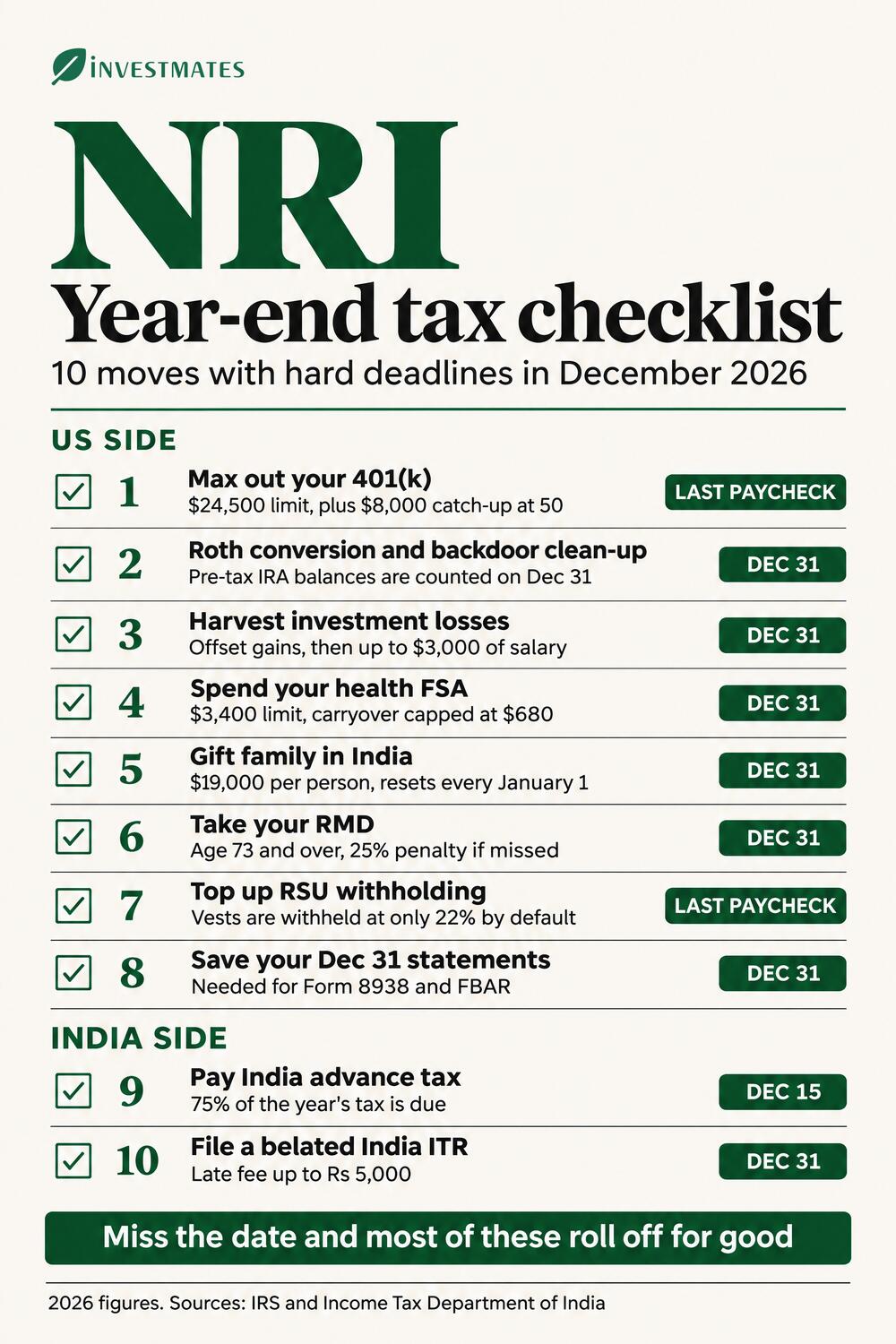
1. Max out your 401(k) deferrals
Your 401(k) deferrals count in the calendar year your employer takes them from pay, so the last December paycheck is your final chance for 2026. The 2026 401(k) limit is $24,500, plus an $8,000 catch-up from age 50, or a larger $11,250 catch-up if you're 60 to 63.
A change you submit today may not reach payroll until the next cycle, so check how many paychecks you have left before you raise the percentage. At a 32% or 35% federal bracket, every pre-tax dollar you defer saves that rate now.
- Check year-to-date deferrals on your latest pay stub.
- Divide the gap by the paychecks left in December.
- Confirm the new rate shows on the next stub.
Best for: anyone below the limit with cash flow to spare in December.
2. Do Roth conversions and backdoor clean-up by December 31
A Roth conversion counts in the year the money moves, so it has to settle by December 31 to be a 2026 event. You pay ordinary income tax on the pre-tax amount you convert, at your 2026 bracket.
For a backdoor Roth, December 31 matters even though the IRA contribution of up to $7,500 can wait until April 15, 2027. Form 8606 prorates your conversion across every pre-tax IRA balance you hold that day, so an old rollover IRA makes most of the backdoor taxable.
The fix is to roll that pre-tax IRA into your current 401(k) before December 31, if the plan accepts roll-ins. It's an easy step to skip, because the April contribution deadline makes the whole move look like it can wait until spring.
If a move to India is likely, slow down. India doesn't treat Roth withdrawals as exempt, so earnings you take out after becoming resident there can be taxed in India.
I'd still do the backdoor for a family staying several more years, but I wouldn't convert a large pre-tax balance in a 35% year just before a move.
3. Harvest losses in your taxable brokerage account
Tax-loss harvesting means selling an investment that's below what you paid, so the loss counts on this year's return. Losses offset your capital gains first, then up to $3,000 of salary ($1,500 if married filing separately), and anything left carries forward.
The trade date must fall in 2026. The wash-sale rule disallows the loss if you buy the same or a substantially identical security within 30 days before or after the sale, so wait out the window or switch to a different fund.
Indian mutual funds don't fit this playbook. They are usually a passive foreign investment company (PFIC) for US tax, and their losses follow separate PFIC rules rather than the normal capital loss rules. Keep tax-loss harvesting to your US brokerage holdings.
Best for: anyone with a 2026 RSU sale or other realised gains to offset.
4. Use your FSA and fund your HSA
A health FSA is use-it-or-lose-it. The 2026 limit is $3,400, and unspent money is forfeited unless your plan offers either a carryover of up to $680 or a short grace period. A plan can offer one of those, not both.
The dependent care FSA limit rises to $7,500 for 2026, up from $5,000. If you pay for daycare or after-school care, check your 2027 election during open enrollment rather than leaving it at the old figure.
An HSA has more room. The 2026 limit is $4,400 for self-only cover and $8,750 for family cover. You can contribute directly until April 15, 2027, but contributions through payroll also skip Social Security and Medicare tax, so December payroll is the cheaper route.
If a layoff or a move to India could happen next year, spend your health FSA balance now. The account generally ends with the job.
5. Make your annual gifts to family in India
The US annual gift exclusion is $19,000 per recipient for 2026, and it resets every January 1. You and your spouse can each give $19,000 to each parent or sibling without filing anything.
That calendar reset is the useful part. If you're planning a larger transfer for a parent's medical bills or a home purchase, splitting it across late December and early January lets you use two years' exclusions on the same need.
Gifts above $19,000 to one person need Form 709 by April 15, though no tax is due until you use up your lifetime exemption.
A gift to a spouse who is not a US citizen has a higher 2026 exclusion of $194,000. The full US gift tax limits for NRIs cover the India side as well.
6. Take your RMD or a QCD before the year ends
An RMD is the amount the Internal Revenue Service (IRS) makes you withdraw from a traditional IRA each year once you reach 73. It's due by December 31, except your first one, which you can delay until April 1 of the following year.
Missing it costs a 25% penalty on the shortfall, cut to 10% if you correct it within two years. RMDs don't stop when you leave the US, so this applies to retired NRIs living in India who still hold IRAs.
From age 70½, a QCD sends money straight from your IRA to an eligible US charity. It counts toward your RMD for the year and stays out of your taxable income.
Best for: older NRIs, and parents with US IRAs whose finances you help manage.
7. Top up your withholding if you hold RSUs
When RSUs vest, your employer withholds federal tax at a flat 22% by default on supplemental pay up to $1 million, and 37% above that. If the vest lands in your 32% or 35% bracket, that 22% leaves a gap.
What the gap looks like
Arjun has $120,000 of RSUs vest in 2026, and his salary already puts those shares in the 35% bracket. His employer withholds $26,400 at 22%, but the federal tax on those shares is $42,000. He's $15,600 short before state tax.
Why December withholding beats a January payment
The IRS treats withholding as paid evenly through the year, whenever it actually happened. So a bigger withholding from your December paycheck can cover earlier quarters, while a January 15 estimated payment counts only from the day you make it. I'd use a December W-4 change first and an estimated payment second.
To avoid the underpayment penalty, your 2026 payments need to reach 110% of your 2025 tax if your 2025 adjusted gross income was over $150,000. More RSU tax planning moves cover selling and timing.
8. Save your December 31 statements for FBAR and Form 8938
December 31 is the date several US forms read your Indian holdings, so download the statements in the first week of January.
Form 8938 for a married couple filing jointly and living in the US applies above $100,000 of foreign assets on the last day of the year or $150,000 at any time. For a single filer, it's $50,000 and $75,000.
The Report of Foreign Bank and Financial Accounts (FBAR) works differently. It applies when your foreign accounts together exceed $10,000 at any point in the year, and it asks for each account's maximum value. Keep every monthly statement, not just December's.
If you made a mark-to-market PFIC election on an Indian mutual fund, its December 31 value sets this year's taxable gain. Get that statement directly from the fund's registrar.
9. Pay your December 15 advance tax in India
Advance tax is India's pay-as-you-earn system, and it applies to NRIs too. If your Indian tax for tax year 2026-27, after tax deducted at source (TDS), comes to Rs 10,000 or more, you owe instalments, with 75% of the year's tax due by December 15, 2026.
The usual triggers for an NRI are Indian rent where the tenant didn't deduct TDS, and capital gains on Indian shares or property where TDS fell short. Interest on non-resident ordinary (NRO) deposits usually has TDS deducted already, so it rarely causes a shortfall on its own.
Missing the instalment adds interest on the shortfall, and you can still pay late. Pay through the income tax e-filing portal from an NRO account.
10. File a belated ITR for last year by December 31
If you missed the July filing date for your Indian ITR for 2025-26, the belated return window closes on December 31, 2026. The late fee is up to Rs 5,000, or Rs 1,000 if your total income is Rs 5 lakh or less.
For most NRIs the reason to file is a refund. TDS on NRO interest and property sales is often higher than the tax you actually owe, and that excess comes back only through a filed return.
The window to revise a return you already filed now runs to March 31, 2027, with a fee.
If you moved back and became a resident with foreign assets you didn't disclose, the one-time Foreign Assets of Small Taxpayers Disclosure Scheme (FAST-DS) also closes on December 31, 2026.
How to work through your year-end tax checklist
Block an hour this week, open your latest pay stub and your brokerage's year-to-date summary, and work down the table from the top. If your year mixes RSUs, Indian income and a possible move, I'd get both countries' returns looked at together before December 31, which is the cross-border review InvestMates does every December.
Frequently asked questions
How can high income earners reduce taxes?
High income earners reduce taxes mostly through pre-tax 401(k) deferrals, HSA contributions, tax-loss harvesting and timing when income lands. For an NRI on a US salary, the December moves above are the time-limited ones. The year-round tax saving strategies for NRIs in the US cover the rest.
What are the biggest tax mistakes people make?
The biggest tax mistakes for NRIs are under-withholding on RSUs, leaving a pre-tax IRA in place before a backdoor Roth, and missing foreign account reporting. Each one is cheap to fix before December 31 and expensive after it. Missing an Indian refund by not filing an ITR comes close behind.
What is tax year 2026-27 in India?
Tax year 2026-27 in India runs from April 1, 2026 to March 31, 2027. The Income-tax Act, 2025 took effect on April 1, 2026 and uses "tax year" in place of the old "previous year" and "assessment year" pair. Your December 15, 2026 advance tax instalment belongs to tax year 2026-27.
What are the new tax rules for NRIs in India?
The main new tax rules for NRIs in India come from the Income-tax Act, 2025, in force from April 1, 2026. Section numbers changed, and the foreign tax credit statement moved from Form 67 to Form 44 for tax year 2026-27 onward. The steps to file Form 67 still apply to earlier years.