

If you hold US mutual funds in a taxable brokerage account, December often brings a mutual fund capital gains distribution: a payout of the fund's own trading gains. It's taxable for 2026 even if you sold nothing and reinvested it all.
For non-resident Indian (NRI) families on an H-1B or green card, the tax can reach 15% plus the 3.8% Net Investment Income Tax (NIIT). Below, you'll see how the payout is taxed, how to check what your funds will pay, and six ways to shrink the bill before December 31.
How a mutual fund capital gains distribution works for US funds
This is about US-registered funds held in a US brokerage account. A US mutual fund buys and sells stocks all year. When its sales produce net gains, the fund passes them to shareholders, usually in November or December, and you report your share from Form 1099-DIV.
Under Internal Revenue Code (IRC) Section 852(b)(3)(B), that capital gain distribution counts as a gain on an asset held more than one year. So it's long-term no matter when you bought your shares.
The fund's net asset value (NAV) drops by the amount it pays out. Your account value stays about the same, but you now owe tax on money that was already yours. If you reinvest, the new shares carry their own cost basis, which lowers your gain when you eventually sell them.
The IRS confirms in its Topic 404 on dividends that these are always reported as long-term gains. Indian mutual funds can also create tax without a sale, but through a different mechanism, covered in PFIC gains without selling.
One timing rule catches people too. Under Section 852(b)(7), a distribution the fund declares in October, November or December and pays in January counts as received on December 31. A January payment can still belong on your 2026 return.
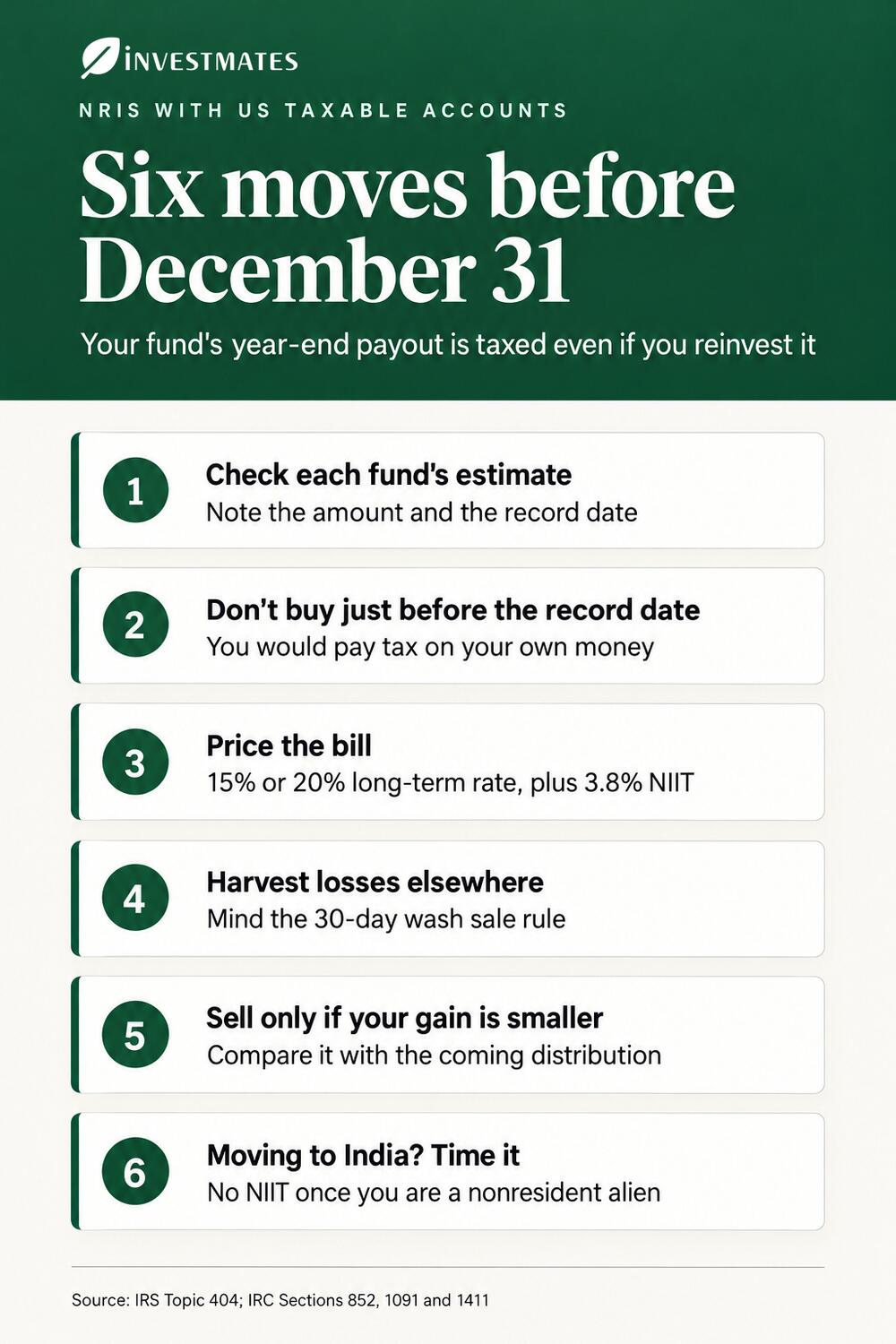 Step 1: Find out which of your funds will pay, and how much
Pull up every mutual fund you hold in a taxable account and look for its year-end distribution estimate. Fund companies usually post estimates in the fall, shown as a dollar amount per share or a percentage of NAV, along with the record date and the payment date.
Only taxable accounts matter here. A distribution inside a 401(k), traditional IRA or Roth IRA isn't taxed when it's paid, so you can ignore those. Exchange-traded funds (ETFs) can pay distributions too, but they're usually smaller, for reasons covered in step 5.
Make a short list with three columns: fund, estimated distribution in dollars, and record date. That list drives every decision that follows.
Step 2: Don't buy into a fund right before its record date
Hold off on new purchases of a fund until after its record date. If you buy the week before, you receive the distribution, the NAV drops by the same amount, and you pay tax on part of the money you just invested.
Year-end bonuses and restricted stock unit (RSU) sale proceeds often get swept into a fund in early December, which is exactly when this happens. Park that cash in a money market fund or an index ETF until the distribution has been paid.
Worked example. Rahul puts $50,000 into an actively managed fund on December 10. The fund pays a 7% distribution on December 15. He now has $3,500 of long-term gain on his 2026 return, and at 15% plus the 3.8% NIIT that may cost him about $658 for owning the fund for five days.
There's a second trap if you then sell quickly at a loss. Under Section 852(b)(4), a loss on shares held six months or less is treated as long-term to the extent of the capital gain distribution you received on them. You can't turn the distribution into a short-term loss by selling right after.
Step 3: Work out what the distribution will actually cost you
Multiply each fund's estimated distribution by your long-term rate. For 2026, that rate comes from Internal Revenue Service (IRS) Revenue Procedure 2025-32.
Filing jointly, you pay 0% up to $98,900 of taxable income, 15% up to $613,700, and 20% above that. Single filers move to 15% at $49,450 and to 20% at $545,500.
Then check the NIIT. Section 1411 adds 3.8% on investment income once your modified adjusted gross income (MAGI) passes $250,000 for married filing jointly or $200,000 for single filers. Those thresholds have never been adjusted for inflation, so more H-1B households cross them every year.
A worked example for an H-1B household
Arjun and Meera are on H-1B and H-4 in Seattle, filing jointly, with MAGI of about $340,000. Arjun holds $180,000 of an actively managed large-cap fund in a Schwab taxable account, and the fund estimates a 7% distribution.
- Distribution: $12,600, all long-term
- Federal rate: 15%, plus 3.8% NIIT, for 18.8%
- Estimated federal tax: about $2,369
They never sold anything. The bill exists because the fund manager did.

Step 4: Harvest losses elsewhere to offset the distribution
Sell positions that are below their cost basis before December 31 and use the losses against the distribution. Capital losses offset capital gains first, including capital gain distributions. Any excess loss can reduce ordinary income by up to $3,000 a year ($1,500 married filing separately), and the rest carries forward.
Watch the wash sale rule. Under Section 1091, if you buy substantially identical securities within 30 days before or after the sale, the loss is disallowed and added to the basis of the new shares instead. Switching to a similar but not identical fund usually keeps the loss intact.
In Arjun's case, a $12,600 loss in an underwater tech holding would wipe out the distribution and may save the full $2,369. The mechanics of picking lots are in this guide to tax loss harvesting for NRIs.
Step 5: Decide whether to sell the fund before the record date
Compare two numbers: the distribution you'll receive if you hold, and the gain you'll realize if you sell before the record date. Selling only helps if your own unrealized gain on the fund is smaller than the coming distribution, or if you're sitting on a loss.
- Unrealized loss or a small gain: selling before the record date usually avoids a bigger taxable distribution.
- Large unrealized gain: selling realizes all of it now, which usually costs more than the distribution.
- Shares held under a year: a sale gain is short-term and taxed as ordinary income, so holding is often cheaper.
My view for NRI families in the US is simple: stop adding new money to actively managed funds in taxable accounts and send it to broad index ETFs instead. ETFs can meet redemptions by handing over shares in kind, which isn't a taxable event, so they rarely pay large distributions.
One thing I've seen go wrong in practice: converting a managed brokerage account to a self-managed one can force the sale of institutional-only funds that the self-managed account can't hold. That sale realizes every embedded gain at once, so check the fund list before you switch account types in December.
Step 6: If you're moving back to India, time the distribution around your move
Work out which side of your residency change each distribution falls on. While you're a US tax resident, every distribution is taxed as above. Once you become a nonresident alien for US tax, Section 1411(e)(1) says the NIIT doesn't apply to you at all.
Capital gains are generally not taxed by the US for a nonresident alien, unless you're present in the US for 183 days or more that year under Section 871(a)(2). Your dual-status move year needs its own calculation, and the exit-year tax planning for H-1B holders lays out the filing choices.
Two practical points before you leave:
- Brokerage restrictions come first. After you switch to a W-8BEN, many brokers stop new mutual fund purchases, and some restrict much more, so rebalance into ETFs while you're still a resident.
- India usually won't tax these yet. As an NRI, and generally during RNOR (Resident but Not Ordinarily Resident) years, India doesn't tax foreign income like a US fund distribution. The RNOR status rules explain how long that window lasts.
What doesn't need any action this December
Your 401(k), IRA and Roth IRA can be left alone, since distributions inside them aren't taxed when paid. Indian mutual funds also aren't part of this exercise, because they're taxed in the US under a different regime entirely.
An Indian mutual fund is a passive foreign investment company for US tax, which brings Form 8621 and its own year-end rules. Start with the PFIC tax rules, and if you need the forms prepared, InvestMates handles PFIC and Form 8621 filing.
Make your list this week
A year-end distribution is far easier to manage before the record date than after it. Open your brokerage account today and list every taxable fund with its estimated distribution and record date.
If a move to India is also on your calendar, I'd have both countries' tax worked out together, and the InvestMates US and India tax team can model it for a fixed fee.
Frequently asked questions
How to report mutual fund capital gain distributions?
You report them from Form 1099-DIV, which your broker sends early in the year. Capital gain distributions go on line 7a of Form 1040, or on Schedule D, line 13, if you need Schedule D for other sales. Keep the form even if every dollar was reinvested.
Are mutual fund capital gain distributions taxable if reinvested?
Yes, these distributions are taxable even if you reinvest every dollar. Your 1099-DIV reports the full amount either way. The reinvested amount becomes the cost basis of the new shares, so keep those records for when you sell.
Do mutual funds pay taxes on capital gain distributions?
A US mutual fund generally doesn't pay tax on gains it distributes, because the tax passes through to shareholders. You pay it on your own return. If a fund keeps some gains, it sends Form 2439 and you report your share of those undistributed gains too.
Do I owe US tax on a mutual fund distribution after I move back to India?
Usually not, if you're a nonresident alien who spent under 183 days in the US that year. The NIIT doesn't apply either, though your move year needs its own split calculation. Once you're settled in India, the rules for a US brokerage account as an Indian resident cover filing and withholding.
Should NRIs switch from mutual funds to ETFs to avoid distributions?
For new money in a taxable account, often yes, because ETFs rarely pay large capital gain distributions. Switching existing funds means selling them, which can realize a bigger gain than the distribution itself. If you plan to move back to India, also weigh US estate tax: Irish-domiciled ETFs avoid US-situs exposure.