
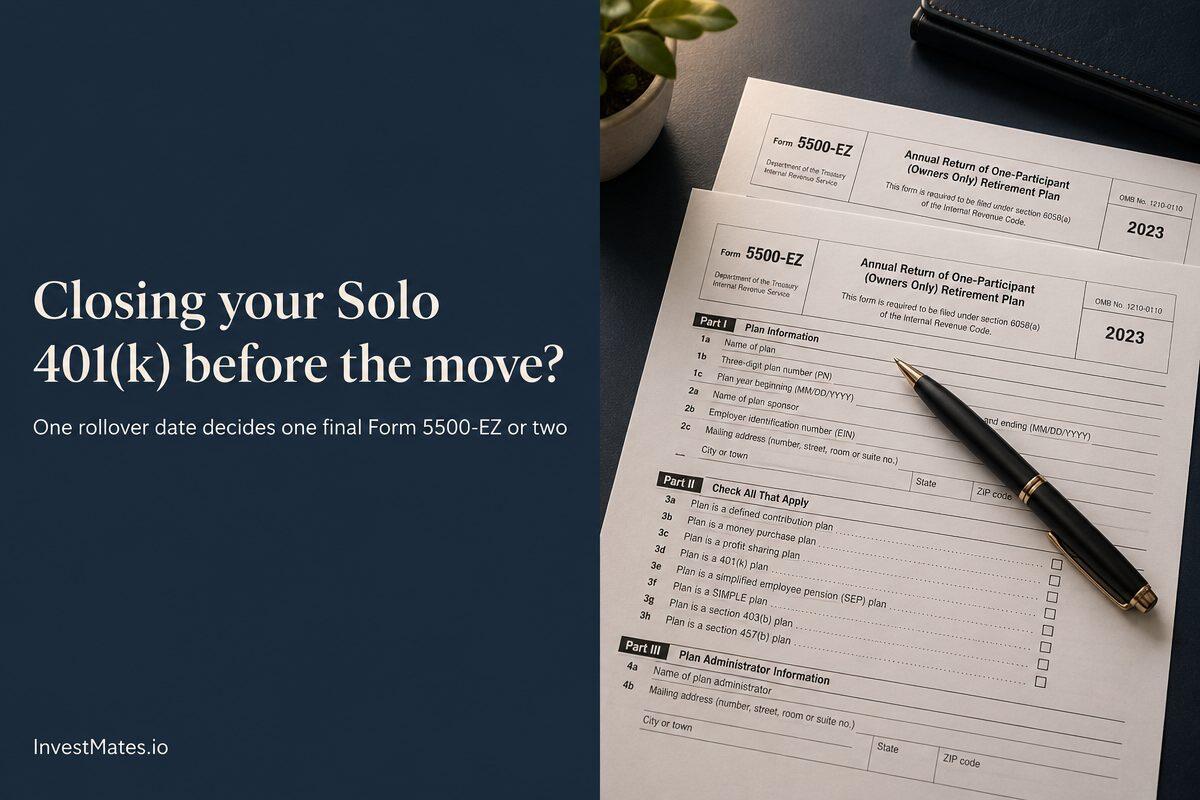
To close a Solo 401(k) before you relocate, sign a termination date, roll every dollar out, and file a final Form 5500-EZ seven months after the year the money leaves. The final return is due on any balance, with a $250 daily late penalty. When that last rollover lands decides how many returns you owe.
Before you start
Gather these before you sign anything. Most of them come from your plan provider's portal, and they're harder to get once your US address and phone number are gone.
- Plan documents: the adoption agreement, which names the plan, its plan number and the plan year.
- Employer Identification Number (EIN): the number your business used to set up the plan, not your SSN.
- Year-end statements: the plan's total value on December 31 for the current year and the year before.
- A receiving IRA: an account already open and able to accept a rollover.
- Your prior annual returns, if the plan ever crossed $250,000 and you filed one.
Step 1: Decide whether the plan should end at all
Check whether the business behind the plan is ending with your move. A Solo 401(k) (the IRS calls it a one-participant plan) covers only you, or you and your spouse, and it belongs to the business that adopted it. Contributions come from that business's self-employment earnings.
If you're winding the business down, the plan has no sponsor left, and you should terminate it rather than leave it sitting. If you're keeping a US business that will still pay you, the plan can stay open, and you'd keep filing the annual return in any year its assets top $250,000.
I'd treat a move as the moment to decide, not something to sort out later. A plan with no working business behind it is the one that quietly misses a filing two years on.
Step 2: Sign a resolution that sets the termination date
Write and sign a short resolution, as the business owner, that says the plan terminates on a specific date. The IRS lets you fix that date by plan amendment or a board resolution, and for a one-person business a resolution you sign as owner does the job.
Send a copy to your plan provider and ask what it needs to process a termination. Two things usually follow:
- The plan must be amended for any law changes that apply to it, even if your normal amendment cycle wasn't due yet. Prototype plan providers generally handle this.
- Contributions stop on the termination date. Any contribution for the final year should be deposited before the money moves out.
Once the date is on paper, every dollar in the plan has a clock on it.
Step 3: Move every dollar out by direct rollover
Request a direct rollover (a trustee-to-trustee transfer) of the whole balance into the IRA you opened. Because the money never passes through your hands, nothing is taxed or withheld. Pre-tax money goes to a traditional IRA, and any Roth balance goes to a Roth IRA.
If you plan to hold US retirement money from India, it's worth reading how an IRA works for NRIs before you pick a custodian.
Finish within about a year
The IRS expects a terminated plan to distribute its assets as soon as administratively feasible, which it generally reads as within one year of the termination date. Miss that window and the plan is treated as ongoing, so it has to keep meeting every qualification rule and keep filing returns.
Open the IRA before you change your address
Some US custodians restrict or close accounts once the owner has a foreign address. Open the receiving IRA, confirm the custodian accepts nonresident account holders, and complete the rollover while your US address is still on file.
Cashing out instead of rolling over is a different decision with real tax cost. If you're weighing it, read through a 401(k) withdrawal strategy for NRIs first, because the plan termination doesn't force a cash-out.
Step 4: Work out which annual returns you owe
List every plan year from now until the plan is empty, and check two tests for each one. A one-participant plan files the annual return for any year its assets exceed $250,000 at year-end, counting all your one-participant plans together. It also files for its final year, whatever the balance.
The final year is the plan year in which the last asset is distributed. That's the detail that catches people who relocate in the fourth quarter.
Worked example. Arjun is a self-employed consultant whose Solo 401(k) holds $310,000 on December 31, 2026. He moves to Pune that December.
- Rollover finished in December 2026. 2026 is the final year. He owes one return, due July 31, 2027.
- Rollover finished in February 2027. 2026 still needs a return, because the plan held over $250,000 at year-end. 2027 becomes the final year, due July 31, 2028. That's two returns, filed from India.
The plan year in this example is the calendar year. If your plan uses a different year, count seven months from its end instead.
Step 5: File the final Form 5500-EZ
File the final return by the last day of the seventh month after the final plan year ends, which is July 31 for a calendar-year plan. In Part I, check box A(3), the final return box, which says all plan assets have been distributed or transferred.
Get more time if you need it
You can get one extension of up to two and a half months by filing Form 5558 on or before the normal due date. For a calendar-year plan that moves the deadline to October 15.
An automatic extension also applies if your plan year matches your business's tax year and your income tax return is already on extension past the due date.
File from India
You have two ways to file once you've moved:
- On paper, signed by you as the employer, mailed to the Department of the Treasury, Internal Revenue Service, Ogden, UT 84201-0020. Write your Indian address in full and don't abbreviate the country name.
- Electronically through EFAST2, the Department of Labor's filing system. Electronic filing is required for plan years beginning on or after January 1, 2025 if you file 10 or more returns of any type with the IRS that year.
Your personal US filing is a separate obligation. The year you move usually means a dual-status return, which is covered in filing US and India taxes after a mid-year move.
What a missed return costs, and how to fix it
The penalty for a late annual return is $250 a day, up to $150,000 per plan year, plus interest, under Internal Revenue Code Section 6652(e). On a final return the plan is already empty, so the money comes from you.
If you've missed one, the IRS runs a penalty relief program for late filers under Revenue Procedure 2015-32. The fee is $500 per late return, capped at $1,500 per plan, and it works like this:
- File a paper return for each late year, with box D in Part I checked.
- Attach Form 14704 to the top of the package and include the fee.
- Mail it to the IRS in Ogden. Electronically filed returns don't qualify.
The program closes for any year in which you've already received a CP283 penalty notice. That's the reason I'd file the moment you notice a gap, not after the next tax season.
Once you're ordinarily resident in India, the IRA that received your rollover becomes a foreign asset for Indian purposes, and you'd report it in Schedule FA on your Indian return.
Before you book your flight, check the date your last rollover will land, because it decides whether you owe one final Form 5500-EZ or two. I'd aim to finish it in the calendar year you move, so a single return closes the plan.
If you'd like a second pair of eyes on the termination and the move-year filings, InvestMates can walk through both with you.
Frequently asked questions
Do I need to file a Solo 401(k) annual return if the plan holds under $250,000?
You don't, in an ordinary year, as long as all your one-participant plans together hold $250,000 or less at year-end. The exception is the plan's final year. A terminating Solo 401(k) files a final return whatever its balance, even if it has never filed before.
When is the final return due after I terminate a Solo 401(k)?
The final return is due by the last day of the seventh month after the plan year in which the last dollar left the plan. For a calendar-year plan emptied in 2026, that's July 31, 2027. Form 5558 can push it to October 15.
Can I keep my Solo 401(k) open after moving to India?
You can keep a Solo 401(k) open only while the business that sponsors it still exists. New contributions also need self-employment earnings from that business. If it closes, terminate the plan, roll the balance into an IRA, and check your US tax filing duties after returning.
What happens if I miss a Solo 401(k) annual return?
A missed Solo 401(k) annual return carries a penalty of $250 a day, up to $150,000 per plan year. The IRS late-filer relief program reduces that to $500 per return, capped at $1,500 per plan, if you file on paper before receiving a CP283 penalty notice for that year.
Can I file my Solo 401(k) annual return from India?
Yes. You can mail a signed paper return to the IRS in Ogden, Utah with your full Indian address, or file through EFAST2. If you'll also file a nonresident return that year, the steps in filing Form 1040-NR sit alongside this one, not in place of it.