
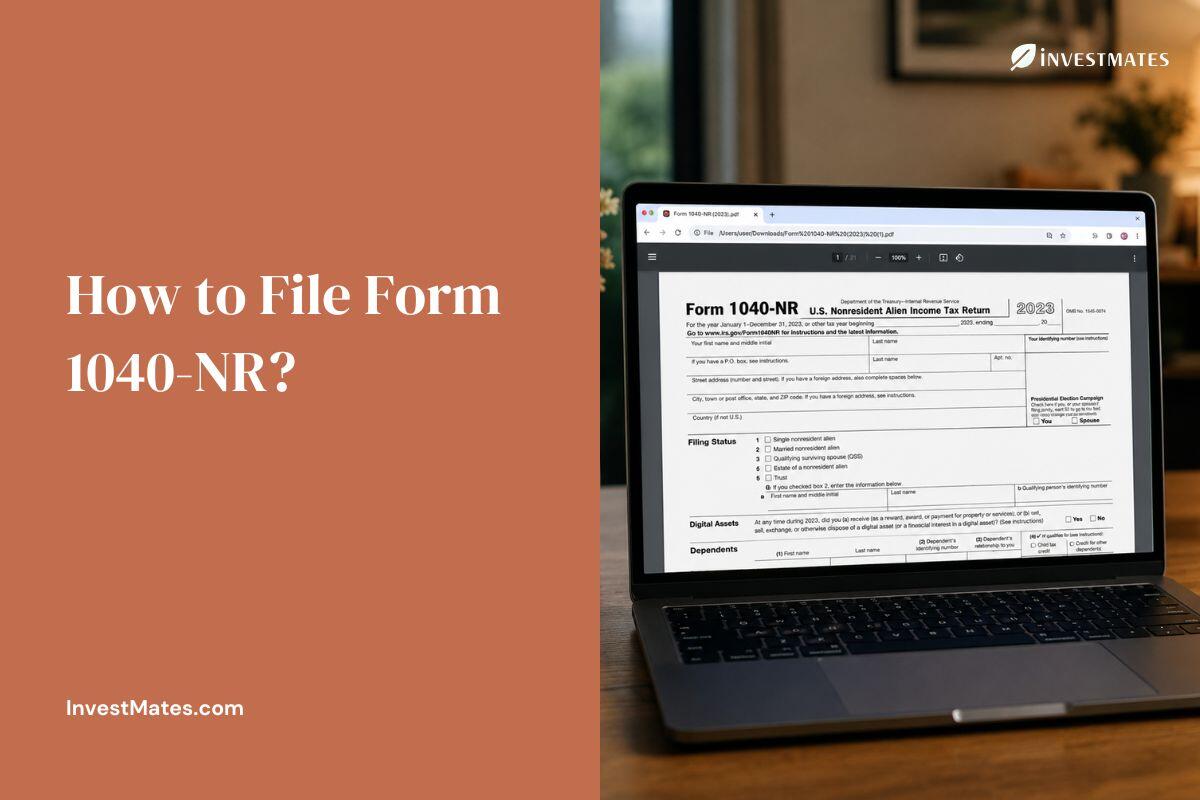
Many NRIs assume their US tax obligations end the moment they board the flight home. They are wrong. If you earned US-sourced income during the year you left, or in any year after, you likely still need to file Form 1040-NR, the U.S. Nonresident Alien Income Tax Return. Missing this filing can mean penalties, lost refunds, and a mess to clean up years later.
This step-by-step guide walks you through the entire 1040-NR process, specifically for former H1B, L1, or other visa holders who have returned to India. You will learn how to determine if you need to file, which return type applies to you, how to meet your deadline, and how to claim treaty benefits that most NRIs leave on the table.
Step 1: Determine If You Need to File Form 1040-NR
Start by confirming that you qualify as a nonresident alien for the relevant tax year. A nonresident alien is someone who is not a US citizen, has not passed the green card test, and has not passed the substantial presence test (183 days or more in the US over a rolling 3-year period, weighted formula).
Who Must File
You must file Form 1040-NR if any of the following apply:
- You were a nonresident alien engaged in a US trade or business, including salaried employment, during the year. You must file even if your income is exempt under a tax treaty.
- You received US-sourced FDAP income (Fixed, Determinable, Annual, or Periodical, such as dividends, interest, or royalties) and the tax was not fully withheld at the source.
- You want to claim a refund for taxes that were overwithheld from your US income.
According to the IRS guidelines on nonresident alien taxation, these rules apply regardless of where you live at the time of filing.
Is There a Minimum Income Threshold?
There is no standard dollar threshold for nonresident aliens with ECI (Effectively Connected Income), such as wages. You must file if you had any such income, even a small amount. For FDAP income where tax was fully withheld at the source, you may not need to file unless you want to claim a refund or deductions. If you are a returning NRI navigating your residency status in India, note that your US filing obligation is separate from your India tax status.
Step 2: Identify Your Return Type for the Year You Left
This is the step most guides skip. The year you left the US is almost certainly a dual-status year, and it changes how you file.
What Is a Dual-Status Alien?
A dual-status alien is someone who held US resident alien status for part of the year and nonresident alien status for the other part. This typically happens in two situations: your first year arriving in the US, or your last year before departing.
If you were on an H1B visa and returned to India in, say, July 2025, you were likely a US resident alien from January 1 through your departure date, and a nonresident alien for the rest of the year. That makes 2025 your dual-status year.
Which Form Is Your Primary Return?
Your status on December 31 of that year determines which form is primary.
- If you were a nonresident alien on December 31 (which applies to most NRIs who returned mid-year), Form 1040-NR is your primary return. You attach Form 1040 as a statement for the resident period.
- If you were somehow still a resident alien on December 31, Form 1040 becomes primary with Form 1040-NR attached as the statement.
Two critical rules for dual-status returns: you cannot claim the standard deduction for either period, and the return cannot be e-filed. It must be printed and mailed to the IRS.
Take Rahul's case as an example. He was on an H1B visa and returned to India in August 2025 after eight years in the US. His December 31 status was nonresident. So he filed Form 1040-NR as his primary return, attached Form 1040 for the January-to-August period, and mailed the full package to the IRS. For more detail on how both the US and India filings work together for the year you moved back, read our complete guide on dual filing.
Step 3: Know Your Filing Deadline for Form 1040-NR
Form 1040-NR is due on April 15 if you received US wages subject to withholding, and on June 15 if you did not. For income earned in 2026, that means April 15, 2027 or June 15, 2027. Which date applies depends on the type of US income you had.
If you left the US mid-year and had wages with US withholding for that period, your deadline is April 15. If you are filing in subsequent years for only passive income like dividends or interest (FDAP with no ECI), your deadline shifts to June 15, giving you nearly two extra months.
You can extend by filing Form 4868 before the original due date. This buys you six additional months. Keep in mind that a filing extension is not a payment extension. If you owe tax, interest starts accruing from the original deadline, not the extended one.
Step 4: Complete Form 1040-NR
The form itself has several parts. Here is how to approach each one.
Fill In Schedule OI (Required for All Filers)
Every Form 1040-NR filer must complete Schedule OI (Other Information). This schedule collects your visa type, country of residence, passport number, and how many days you were present in the US during the tax year. If you want to claim India-US tax treaty benefits, you do it in item L of Schedule OI.
Report Effectively Connected Income
ECI (wages, US business income, freelance income from US clients) goes on page 1 of Form 1040-NR. It is taxed at the same graduated rates as US citizens, ranging from 10% to 37% depending on your income level. Unlike US residents, nonresident aliens cannot claim the standard deduction. You can only itemize deductions that are directly connected to your US income.
Report FDAP Income on Schedule NEC
FDAP income, things like dividends from US stocks, interest from US bank accounts, and royalties, goes on Schedule NEC (Tax on Income Not Effectively Connected). The default tax rate is a flat 30%. However, the India-US tax treaty reduces this significantly for Indian residents.
Under the India-US tax treaty, dividends from US companies paid to individuals are taxed at 25% instead of 30%, provided you claim the treaty benefit properly (the lower 15% rate applies only to companies holding 10% or more of the payer). Indian students and business apprentices covered by Article 21(2) of the treaty also get benefits most nonresident aliens do not, such as the standard deduction, though these rarely apply to NRIs who have returned to India for good. To claim treaty benefits, complete Schedule OI item L. Form 8833 is only needed for treaty positions the IRS does not waive, and a reduced rate on dividends or interest is waived.
If you want to understand how this interacts with your India tax filing and how to avoid paying tax twice on the same income through DTAA benefits, that piece covers the mechanism in detail.
Step 5: File Your Return
How you submit Form 1040-NR depends on your situation.
If you are a full-year nonresident alien (filing for a year after you returned, with only passive US income), you can e-file using IRS-authorized tax software such as Sprintax or similar nonresident alien tax filing platforms.
If you are filing a dual-status return (for the year you left), you cannot e-file. You must print everything, attach the statement form, sign it, and mail it to the IRS. For filers outside the US, the correct address is: Department of the Treasury, Internal Revenue Service, Austin, TX 73301-0215.
If you do not have an SSN and never applied for one, you will need an ITIN (Individual Taxpayer Identification Number). Apply using Form W-7 along with your tax return. Without an SSN or ITIN, the IRS cannot process your return.
Step 6: Handle Ongoing US Income After Your Return
Filing Form 1040-NR is not necessarily a one-time event for the year you left. If you still hold US assets or accounts, you may need to file annually.
Common situations that require continued 1040-NR filings from India:
- Dividends and interest from a US brokerage account you kept open
- Distributions from a 401k or IRA you have not yet closed
- Rental income from a US property you still own
- Royalties from US intellectual property
401k distributions to India-based former visa holders are generally subject to 30% withholding, though the India-US treaty may reduce this. Your 401k withdrawal strategy matters significantly once you factor in treaty rates and India's own taxation of that income.
On the India side, any US income you report on your 1040-NR must also be declared in your India ITR under Schedule FSI. You can claim a foreign tax credit for US taxes paid, using Form 67 filed with your India return, which is how the DTAA prevents double taxation.

3 Mistakes That Can Cost You After Returning to India
1. Skipping the Sailing Permit Before You Left
Before leaving the US, most departing aliens are required to obtain a sailing permit or departure permit from the IRS. You get this by filing Form 1040-C (U.S. Departing Alien Income Tax Return) or Form 2063 (U.S. Departing Alien Income Tax Statement) before your departure date. This requirement surprises most NRIs because visa advisors and employers rarely mention it.
Filing Form 1040-C does not replace your annual return. You still need to file Form 1040-NR for the full tax year even if you already filed 1040-C before leaving. If you left without a sailing permit, the best course of action now is to consult a cross-border tax advisor, since there are administrative ways to address this after the fact.
2. Filing Form 1040 Instead of Form 1040-NR
If you were a nonresident alien for any part of the year and you file a regular Form 1040, you report income incorrectly and may pay more tax than you owe. The forms treat deductions, credits, and income types differently. Filing the wrong form can also trigger IRS correspondence and delay any refund you are owed.
3. Missing the June 15 Deadline When You Qualify
Many NRIs default to April 15 out of habit, not realizing they qualify for the June 15 deadline. If you had no wages subject to US withholding in the filing year, specifically if you are filing for a post-return year with only FDAP income such as dividends or interest, you have until June 15. Rushing to file by April 15 when you have two extra months serves no one.
Conclusion
Filing Form 1040-NR after returning to India requires you to do three things right: confirm your nonresident alien status and return type, choose the correct deadline, and claim the treaty benefits India residents are entitled to. The year you left is almost always the most complex, because dual-status returns have separate rules for both periods of residency. For subsequent years, the process is straightforward if you know what income to report and what schedule to use. If you are dealing with a dual-status year for the first time, working with a cross-border tax advisor who understands both US and India tax rules is worth the cost.
Frequently asked questions
Do I still need to file Form 1040-NR if I earned no US income after returning to India?
If you had zero US-sourced income in a given year and no overwithheld taxes to claim back, you generally do not need to file a 1040-NR for that year. However, if you had any FDAP income such as dividends or interest from a US account, even a small amount, check whether the withholding was sufficient. If it was not, you are required to file.
Can I e-file Form 1040-NR from India?
Yes, if you are filing a standard full-year nonresident alien return, you can e-file using IRS-approved software. However, if you are filing a dual-status return for the year you left the US, you cannot e-file. That return must be printed and mailed to the IRS. Most people filing from India for the departure year will be in the paper-filing camp.
How do I claim India-US tax treaty benefits on Form 1040-NR?
Start by completing item L in Schedule OI, which is where you state the treaty article you are relying on. For US dividends, the treaty rate for individuals is 25% instead of the default 30%. You generally do not need Form 8833 to claim a reduced treaty rate on dividends or interest, because IRS regulations waive the disclosure for this type of income. Form 8833 is needed when a treaty position overrides the tax code in other ways. Avoiding common errors in this process matters, since treaty filing mistakes are one of the top reasons NRI refunds get delayed.
What happens if I miss the Form 1040-NR deadline?
The IRS charges a failure-to-file penalty of 5% of unpaid tax per month, up to a maximum of 25%. Interest on unpaid tax also accrues from the original due date. There is also a separate failure-to-pay penalty of 0.5% per month on any tax still owed. If you miss the deadline, file as soon as possible. The longer you wait, the more penalties accumulate. Filing late is always better than not filing at all.
Do I need to file Form 1040-NR every year after returning to India?
Only for years in which you have US-sourced income. If a particular year has zero US income and no overwithheld tax, there is no filing obligation. But if you hold US brokerage accounts, own US real estate, or are drawing from a 401k, those income streams continue to trigger a filing requirement each year they produce income.
Is there a minimum income threshold for filing Form 1040-NR?
For nonresident aliens with ECI such as wages or US business income, there is no minimum dollar threshold. You must file regardless of the amount. For FDAP income such as dividends and interest where the full 30% (or treaty rate) was withheld at the source, you may not need to file if you do not want a refund and have no deductions to claim. If any withholding was insufficient or you want to claim treaty-based refunds, file regardless of the amount.