
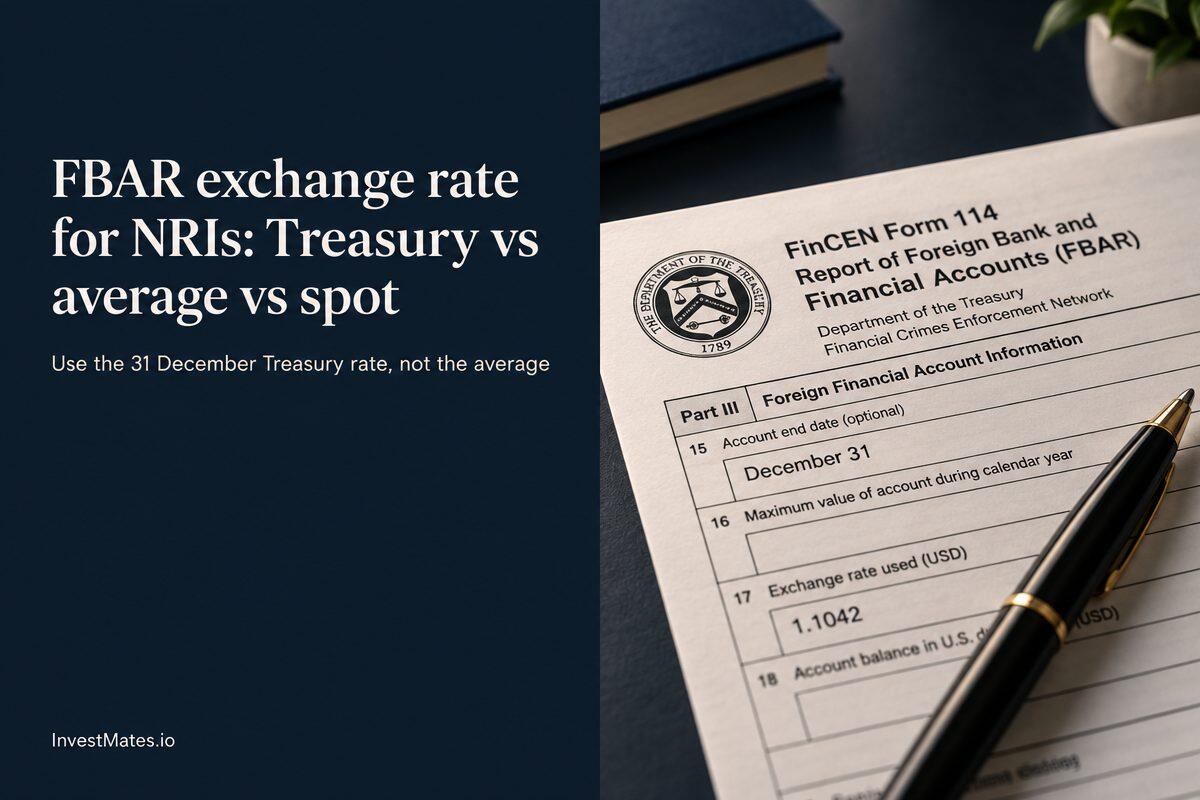
The FBAR exchange rate is the Treasury rate for 31 December of the year you're reporting, not the yearly average or the peak-day rate. For 2025 that's ₹89.854 per dollar, and the wrong rate can push ₹8.8 lakh over the $10,000 line. The other two rates each have a job elsewhere.
Which FBAR exchange rate FinCEN requires
The Form 114 instructions leave little room. FinCEN says to "convert foreign currency by using the Treasury's Financial Management Service rate" for the last day of the calendar year.
Two details trip people up. You work out each account's maximum value in rupees first, then convert once. And the date is the same for every account, so one USD INR conversion rate covers them all, even an account that peaked in March.
Rupees divide by the rate
The Treasury quotes rupees per dollar, so you divide. Meera's NRO account peaked at ₹4,50,000, which is ₹4,50,000 ÷ 89.854 = $5,008.12 at the 2025 rate. FinCEN says to round up to the next whole dollar, so she enters $5,009.
The FBAR Treasury year-end rate for the rupee
Only the 31 December row of the Treasury Reporting Rates of Exchange counts for your FBAR. These are the rupee rates for the last three reporting years:
- 2023: ₹83.162 per dollar
- 2024: ₹85.577 per dollar
- 2025: ₹89.854 per dollar
You'll find them on the Treasury's Fiscal Data site under India-Rupee. The rupee weakened about 5% between the last two year-ends, so the date you pick moves your totals.
How the three rates differ on each US form
The yearly average and the peak-day rate are legitimate rates. They just belong on other forms.

| Treasury 31 December rate | IRS yearly average | Rate on the transaction or peak date | |
|---|---|---|---|
| What it is | The Treasury's rate for the last day of the year | One average rate per currency per year | The spot rate on the day you received, paid or peaked |
| Who publishes it | Treasury, on its Fiscal Data site | The IRS | Banks, the Federal Reserve and other posted sources |
| Rupee figure for 2025 | ₹89.854 per dollar | ₹87.133 per dollar | Changes every day |
| FBAR (Form 114) | Required for every account | Not what the instructions call for | Not what the instructions call for |
| Form 8938 | Called for in most cases | Not named in the instructions | Not named in the instructions |
| Interest, wages and rent on Form 1040 | Not the rule for income | Accepted when used consistently | Accepted: the rate prevailing when you receive or accrue the item |
| Cost of each PFIC purchase on Form 8621 | Not used for cost | A practical stand-in for monthly SIPs | The method: one rate per purchase date |
| PFIC value at 31 December on Form 8621 | Used | Not used | Not used |
| Effort | One lookup per year | One lookup per year | One lookup per transaction |
| Where it goes wrong | Picking the 31 March row because Indian statements end then | Pushing a borderline total over $10,000 | Hunting for a rate on every account's peak date |
Read across the FBAR and Form 8938 rows and one rate wins. The other two columns matter elsewhere on your return.
How the wrong rate flips the $10,000 test
Priya, an H-1B holder in Austin, has an NRO savings account, two fixed deposits and a PPF account. Their highest balances in 2025 add up to ₹8,80,000, and each peaked around 31 March.
Here's what that total becomes at each rate, rounded up to the whole dollar:
- Treasury 31 December 2025 rate (89.854): $9,794, below $10,000
- IRS yearly average (87.133): $10,100, above
- Treasury 31 March 2025 rate (85.417), standing in for the peak-day rate: $10,303, above
Only the first is the FBAR exchange rate. At $9,794, Priya's total sits under the $10,000 threshold, so she has no FBAR for 2025 on these accounts. The other two rates would have sent her to file a report she doesn't owe.
A rate that shrinks your total in a year the rupee weakens can grow it in a year the rupee strengthens, so I never go looking for the friendliest one. I convert every account at the Treasury 31 December rate and round up, with no exception for a balance that peaked earlier.
Which rate to use on which form
Use the Treasury rate on the FBAR and Form 8938
Use the Treasury 31 December rate for the FBAR, and in most cases for Form 8938 too. Its instructions name the Treasury rate for the last day of the tax year, so one lookup keeps the two forms in step.
Use the yearly average or the transaction date for income and purchases
Income on your Form 1040 follows the rate prevailing when you receive, pay or accrue it. The IRS says it has no official rate, accepts any posted rate used consistently and publishes a yearly average table.
For PFIC cost on Form 8621, each purchase gets its own date's rate. Every SIP installment is its own purchase date.
When you don't need a rate at all
Three situations take the conversion off your plate or change what it does.
- Your deposit is already in dollars. An FCNR(B) deposit held in US dollars is a dollar figure from the start.
- You're not a US person for the FBAR. Citizens, green card holders and residents under the substantial presence test file, and an Indian resident with no US status doesn't.
- You hold 25 or more accounts. The FBAR then asks for the count only, with no value per account, so the rate matters for the $10,000 test and Form 8938 instead. A mutual fund folio is its own account, and the count climbs fast when each SIP opens a new one.
What to do before you file
Work through these in order, and keep the rate source with your records.
- Get statements for 1 January to 31 December for every Indian account, because the FBAR covers a calendar year and Indian bank statements run April to March.
- Note each account's highest balance in rupees, one account per account number, folio or deposit number.
- Open the Treasury Reporting Rates of Exchange and copy the India-Rupee rate dated 31 December of your reporting year.
- Divide each rupee maximum by that rate and round up to the next whole dollar.
- Add the dollar figures and compare the total with $10,000.
- Save the rate source with your account records, which you keep for five years.
The steps assume you already know the FBAR threshold and deadline. Folios held directly at a fund house need extra care when you're reporting mutual funds on the FBAR and Form 8621. And Indian earnings follow their own rule, as reporting Indian income on your US return shows.
Your first step
Write down the Treasury's 31 December rate and its source on the first page of your working file before you open Form 114. I'd rather you do that now than rebuild every rupee figure later. If you hold dozens of accounts, InvestMates can build the conversion sheet for you.
Frequently asked questions
What exchange rate do I use to report foreign income?
Use the rate prevailing when you receive, pay or accrue the income, according to the IRS. The IRS publishes a yearly average table and accepts any posted rate that you use consistently. The FBAR is separate and always uses the Treasury 31 December rate.
Can I use my bank's exchange rate for the FBAR instead of the Treasury rate?
No, the FBAR calls for the Treasury rate for the last day of the calendar year. FinCEN allows another verifiable rate, with its source stated, only when no Treasury rate exists. The rupee has a Treasury rate, so your bank's quote isn't an option.
Do I use the same exchange rate for Form 8938 as for the FBAR?
In most cases yes, so use the Treasury rate on both. Form 8938 also lets you rely on the rate printed on an annual account statement, an allowance the FBAR doesn't share. FBAR vs FATCA explains how the two filings differ.
Do I need an exchange rate for a US dollar FCNR(B) deposit on the FBAR?
No, because a dollar deposit is already a dollar amount. You report its maximum value as it is, and it still counts toward the $10,000 total. Only rupee accounts need conversion, and NRE, NRO and FCNR accounts differ in currency, so check each one.