

Every SIP installment you send into an Indian mutual fund looks like one investment. To the IRS, it is not. Each monthly debit buys units at a new NAV and a new exchange rate, creating a fresh SIP cost basis and its own holding period.
Run a Rs 10,000 SIP for five years and you hold roughly 60 separate PFIC tax lots, not one investment, and that detail decides whether your fund costs you nothing or costs you a lot the day you sell. Let's understand exactly why, and what to track because of it.
Why one SIP is actually dozens of separate purchases
An Indian equity or debt mutual fund is a PFIC under US tax law, because its income is mostly dividends, interest, and capital gains rather than active business income. That classification applies to every unit you own, but the tax math that follows treats each unit's acquisition date as its own starting point.
The IRS instructions for Form 8621 describe the Section 1291 excess distribution calculation as one determined on a per share basis, allocated to each day in the shareholder's holding period.
A lump sum investor has one holding period to worry about. An SIP investor has as many holding periods as they have installments, since every purchase restarts the clock for those units.
This is the mechanic competitors gloss over. It is not a special SIP rule bolted onto PFIC law, it is the ordinary per-share PFIC math applied to an investment pattern that generates dozens of acquisition dates instead of one.
The currency layer makes this worse, not better. Every SIP debit converts a fixed INR amount into US dollars at that day's rate, so your USD cost basis per lot moves with two variables, NAV and exchange rate, not just one.
Two lots bought at the identical NAV six months apart can still carry different USD cost bases if the rupee moved in between. A lump sum investor deals with this exchange rate question once. An SIP investor deals with it every single month, for as long as the SIP runs.
A worked example: five years of SIP into a growth option fund
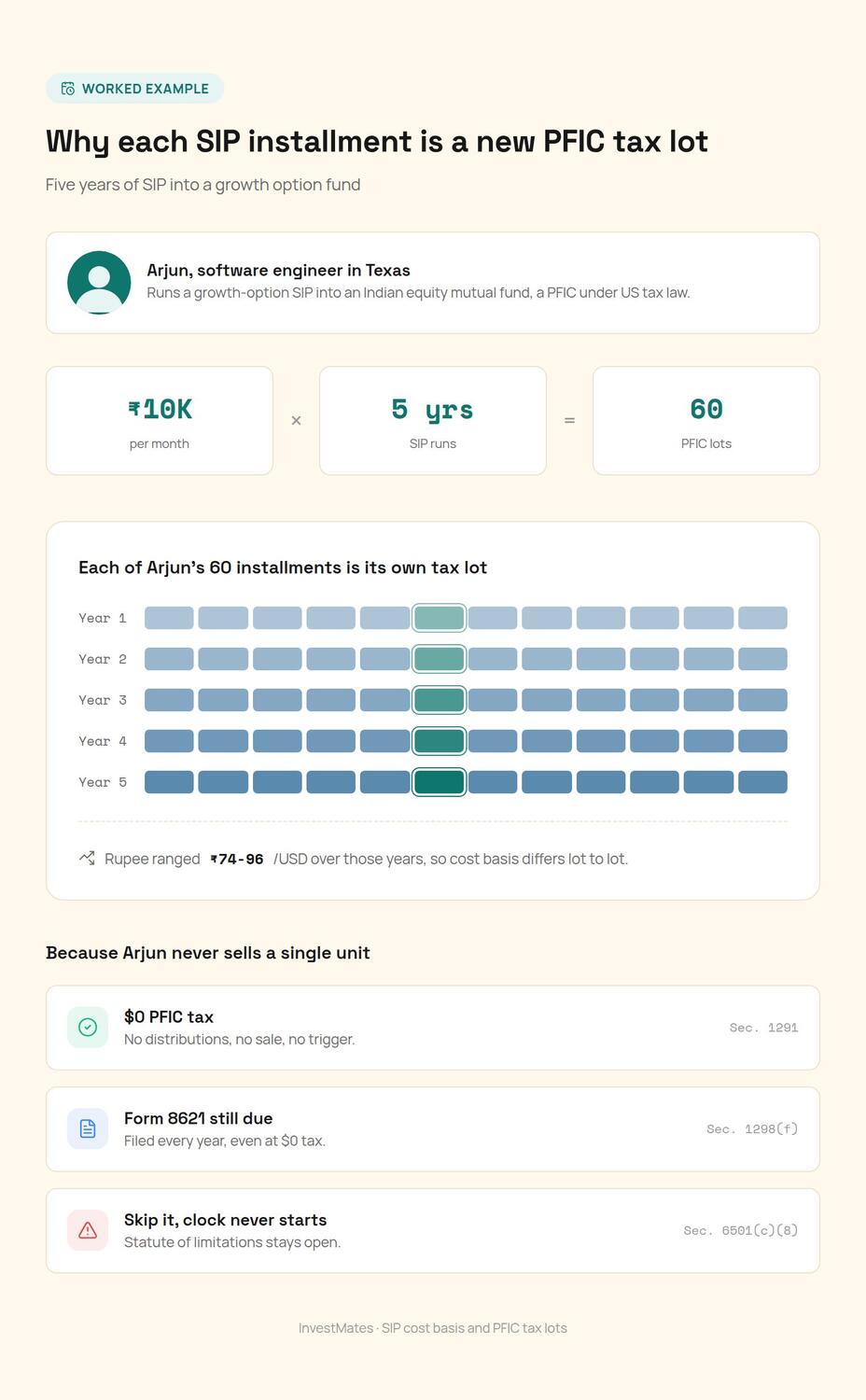
Arjun, a software engineer in Texas, has run a Rs 10,000 monthly SIP into an Indian equity growth option fund for five years. That is 60 separate lots, each bought at a different NAV and a different INR to USD rate.
Say the rupee traded anywhere between roughly 74 and 96 to the dollar across those five years, in line with how it has actually moved since 2021. Arjun's USD cost basis per lot reflects whatever rate applied that day, so his 60 lots sit on 60 slightly different costs, not one clean average.
Because the fund is in growth option, it does not pay distributions, and Arjun has not sold any units. Under the Section 1291 default, tax triggers only on an excess distribution or a disposition.
Neither has happened, so his PFIC tax for each of those five years is zero dollars, regardless of how many lots have piled up underneath the position.
That does not mean Arjun has nothing to do. Section 1298(f) requires a US person holding a PFIC to file Form 8621 Part I every year, even when Parts II through VI stay blank because no taxable event occurred.
Skipping that filing keeps the statute of limitations on Arjun's entire tax return open indefinitely under Section 6501(c)(8), whether or not any tax was ever due.
Section 1291 default versus Mark to Market: how each treats new lots
The choice between staying on the default and electing out changes how new SIP lots behave, and this is where the two paths diverge the most.
Section 1291: one form, but a per-share calculation hiding inside it
Staying on the default costs nothing to elect, because there is nothing to elect. But the day you take an excess distribution or redeem units, every lot's own holding period matters.
A redemption eight years into an SIP touches lots that are eight years old and lots that are two months old. The excess distribution math allocates gain across each lot's own span of days.
Amounts assigned to pre-2018 years are taxed at the old 39.6 percent top rate, and amounts assigned to 2018 onward at 37 percent, plus IRS underpayment interest on each year's slice.
Mark to Market: elect once, it covers every future purchase automatically
Section 1296 works differently. Under the PFIC elections framework, once you make a valid Mark to Market election for a fund, it applies to shares you already hold and to shares "subsequently acquired," per Treasury Regulation 1.1296-1.
You do not file a fresh election for every new SIP installment. Each new lot simply falls under the existing election and gets marked to market annually along with the rest.
The tradeoff is that Mark to Market taxes your unrealized gains as ordinary income every year, whether or not you have sold anything, and whether or not the fund even qualifies for MTM.
Indian equity and debt mutual funds bought directly from an AMC generally do not qualify, since MTM requires a marketable, exchange-traded security. NSE or BSE listed India ETFs are a more realistic candidate.

| Section 1291 default | Section 1296 mark-to-market | |
|---|---|---|
| Election required | None, it is the default | Yes, made once for the fund |
| How new SIP lots are treated | Each lot keeps its own holding period, recalculated at the next taxable event | Automatically covered by the existing election, no new filing per lot |
| Annual tax while holding | Zero, if no distribution or sale occurs | Unrealized gain taxed as ordinary income every year |
| Where it fits an SIP investor | Growth option funds, no near-term redemption plan | Funds that qualify for MTM and where annual certainty is preferred over deferral |
What actually triggers tax on an SIP position
Two events start the clock: an excess distribution, meaning distributions above 125 percent of the average of the prior three years, and a disposition, meaning a sale or redemption.
Say a fund paid Rs 5,000, Rs 6,000, and Rs 7,000 in the prior three years, an average of Rs 6,000. Anything paid this year above 125 percent of that average, Rs 7,500, counts as excess and gets allocated back lot by lot.
A growth option fund avoids this entirely since it does not distribute. Avoiding the second trigger, a sale, is a choice for as long as you do not redeem.
There is a filing exception if your total PFIC value is $25,000 or less single, or $50,000 or less joint, with no distributions, sales, or elections that year.
Most NRI SIP investors exceed that threshold within a year or two, so plan on filing Form 8621 for the fund every year regardless.
Redeeming part of an SIP position: why the lot you sell matters
A partial redemption, say to fund a down payment on a house, is where lot level detail stops being theoretical. Which lot did you sell, the oldest, the newest, or one you specifically choose?
Specific identification and FIFO can produce different gain amounts and holding periods, and no public guidance resolves this cleanly for India SIP scenarios. Treat this as a question for your CPA before you redeem, not after.
This is a different question from the one-time cost basis reset available to NRIs returning to India under RNOR status, which addresses a single transition event. The lot tracking here is ongoing bookkeeping for as long as you keep contributing.
Practical record keeping InvestMates recommends
Every calculation above depends on data you have to capture at the moment each SIP installment clears, not months later when a CPA asks for it. For each installment, keep:
- The purchase date
- The INR amount debited
- The INR to USD exchange rate on that specific date
- The resulting USD cost basis for that lot
- The NAV on that date
- Your cumulative units held after the purchase
Use the exchange rate from the actual transaction date, not a year end or average rate, since that is what the per-lot basis calculation depends on.
A simple spreadsheet with one row per SIP installment is enough for most NRI investors. The goal is to never reconstruct five years of NAV and exchange rate history from memory the year you redeem.
If you are setting up or reviewing an NRI mutual fund SIP, building this log from day one saves a reconstruction project later, when old rates and NAV data are harder to pull together.
Conclusion
An SIP is not one investment for PFIC purposes, it is many, and that lot level detail decides whether you owe tax or file a clean Form 8621 every year. If you want help setting up a lot tracking sheet, or reviewing a position before redemption, InvestMates can walk through it with you.
Frequently asked questions
How is PFIC income taxed if I have dozens of SIP lots?
Under the default method, gain on redemption is allocated per share across each lot's own holding period, taxed at the highest rate for prior years plus interest. Under a Mark to Market election, it is simpler, annual unrealized gains are taxed as ordinary income across your full position, new lots included automatically.
Can US citizens or green card holders invest in an SIP in India at all?
Yes, there is no legal bar to it. The consideration is not whether you can, it is understanding the PFIC tax rules that apply once you do, and setting up your record keeping from the first installment.