
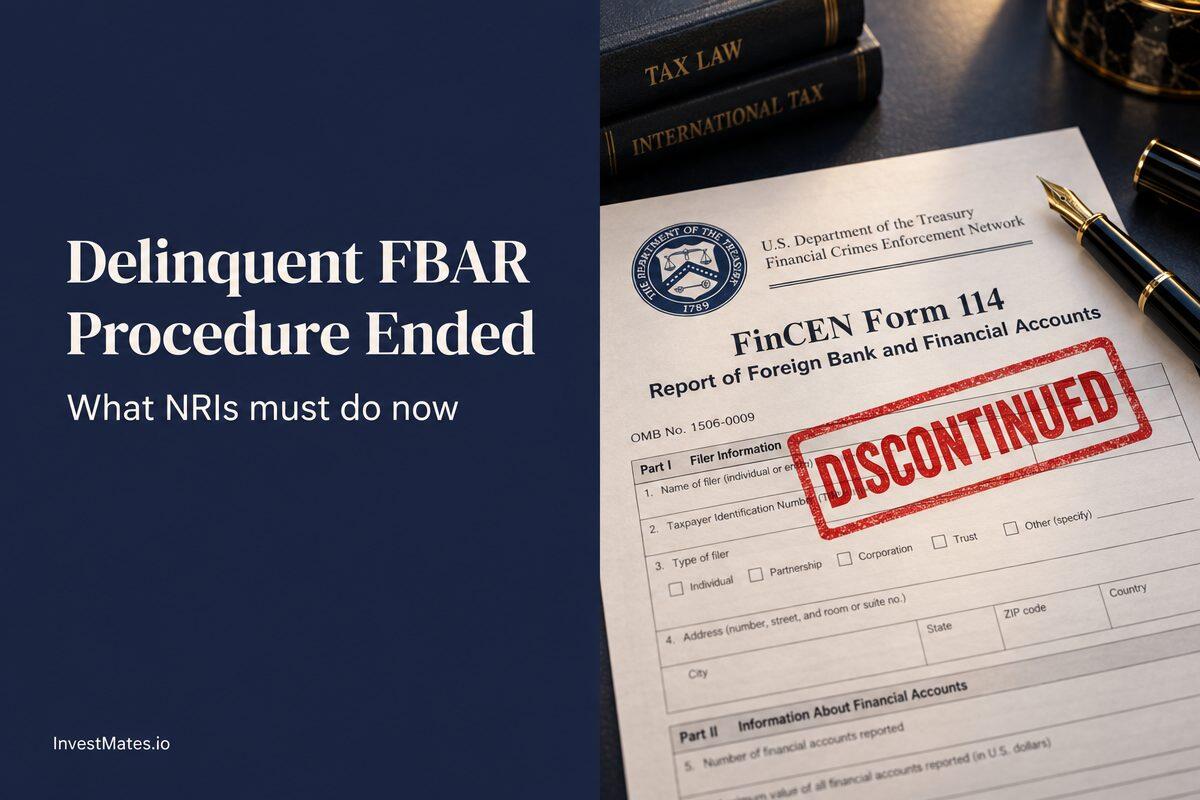
If you missed an FBAR for your Indian accounts, the IRS no longer publishes a penalty-free way to fix it. It removed its Delinquent FBAR Submission Procedures around 1 July 2026. You can still file late and the IRS manual still points to reasonable cause, but relief is now a judgment call.
What the IRS did to the Delinquent FBAR Submission Procedures
Around 1 July 2026, the IRS took down the web page for the Delinquent FBAR Submission Procedures, with no notice. The page had said the IRS would not impose an FBAR penalty if you reported all income from the foreign accounts, paid the tax due, and filed before the IRS contacted you.
Here is what the IRS left in place:
- The IRS FBAR page, last reviewed 30 July 2026, still says to file late FBARs as soon as possible if the IRS hasn't contacted you.
- IRM 4.26.16.3.11 still tells examiners not to assert a penalty on an account when reasonable cause explains the miss and the late FBAR reports it correctly.
- The Streamlined Filing Compliance Procedures remain published, and their IRS page was updated on 11 July 2026.
- The penalty law in 31 U.S.C. § 5321 is unchanged: up to $16,536 per non-willful report, and for willful violations the greater of $165,353 or 50% of the account balance.
How this affects NRIs who missed an FBAR
Your 2025 FBAR is now late if you haven't filed it
You owe an FBAR (FinCEN Form 114) when your Indian accounts together topped $10,000 at any point in the year, and the FBAR threshold counts NRE, NRO and joint accounts. The 2025 report was due 15 April 2026, with an automatic extension to 15 October 2026. That date has now passed.
Relief now rests on your reasonable-cause record
The old procedure gave you a published promise. Today you file the late FBAR through BSA E-Filing, explain the reason in the "Other" box (750 characters), and the IRS doesn't acknowledge it either way. There's no acceptance letter, and silence is the normal outcome.
That silence is the catch. If an examiner disagrees years later, you argue reasonable cause from the record you built on the day you filed. The statute lets the IRS assess an FBAR penalty for six years.
Take Priya, who missed three years of FBARs on her NRE and NRO accounts. The ceiling is 3 × $16,536 = $49,608 in non-willful penalties. That is the ceiling, and it may be far lower or zero depending on your facts.
Clean up the income side first
The old procedure only worked if all income from the foreign accounts had been reported. A few hundred dollars of unreported NRO interest technically broke that test.
I amend the return first, pay the small tax, and file the FBARs with or after it, because a reasonable-cause statement reads better on a clean return. Unreported Indian income is the usual culprit, and PFIC reporting on Indian mutual funds is a separate catch-up.
Where the streamlined domestic offshore procedures fit
Meaningful unreported income changes the math. The streamlined domestic offshore procedures (SDOP) carry a certain 5% penalty on the highest year-end balance of the assets involved.
The streamlined foreign offshore procedures carry no penalty if you spent 330 or more days outside the US in at least one of the last three years, though you still pay the tax and interest. A US-based NRI usually doesn't meet that test.

| Route | Penalty | What you file | Fits when |
|---|---|---|---|
| Late FBARs with reasonable cause | None promised; statutory FBAR penalties if rejected | Late FBARs through BSA E-Filing | All income reported, tax paid, no IRS contact |
| Streamlined Foreign Offshore | No penalty; tax and interest still due | 3 years of returns, 6 years of FBARs, Form 14653 | 330+ days outside the US, no US abode |
| Streamlined Domestic Offshore | 5% of highest year-end balance | Amended returns, 6 years of FBARs, Form 14654 | US resident, conduct non-willful, real unreported income |
| Voluntary Disclosure Practice | Determined by the IRS under the practice | Application to IRS Criminal Investigation | Possibly willful conduct |
What you should do now
Do these in order, and do them before any IRS contact. A civil examination makes you ineligible for the Streamlined procedures.
- List every year you held Indian accounts above $10,000 in aggregate, and check which FBARs were never filed.
- Confirm you haven't received an IRS letter about any of them. If you have, stop and get professional help before filing.
- Check that each year's return reported the interest and fund income from those accounts. Amend first where it didn't.
- Pick the route from the table above. For small gaps, I'd file the late FBARs with a written reasonable-cause statement, and I'd price SDOP only when the income or a PFIC catch-up is large.
- File through BSA E-Filing, write the reason in the "Other" box, and keep a copy of every report.
What to watch next
IRM 4.26.16.3.11 hasn't changed, but manual text can be revised without notice and gives you no rights. If the IRS aligns the manual with the removed page, the reasonable-cause route gets harder first.
Don't wait for the IRS to explain itself. I'd fix the income side, file the missing reports this month, and write the reasonable-cause statement while the facts are fresh. If you'd like a second pair of eyes first, InvestMates can check your years and pick the route with you.
Frequently asked questions
Can I still file a late FBAR without a penalty after the IRS ended the Delinquent FBAR Submission Procedures?
Yes, you can still file it, but no published procedure now promises a penalty-free result. The IRS FBAR page still says to file late, and IRM 4.26.16.3.11 still directs examiners not to assert a penalty where reasonable cause is shown. Whether that covers you depends on your facts.
Is there an automatic exemption from IRS penalties for a late FBAR?
No. The IRS launched its Automatic Exemption from Penalty process in July 2026, but it covers failure-to-file, failure-to-pay and failure-to-deposit penalties on original returns. FBAR penalties arise under 31 U.S.C. § 5321 and aren't among them, so a late FBAR gets no automatic exemption.
Did the IRS also change the Streamlined Filing Compliance Procedures?
No change has been announced. The IRS page for the Streamlined procedures was updated on 11 July 2026 and still lists both routes, with no penalty under the foreign procedures and a 5% penalty under the domestic ones.
Should I wait for the IRS to explain the change before I file my late FBARs?
No. The IRS says to file late FBARs as soon as possible if it hasn't contacted you, and an examination closes the Streamlined procedures to you. Waiting only raises the chance an IRS notice arrives first.
My 2025 FBAR was due 15 October 2026. Am I already late if I haven't filed?
Yes. The report was due 15 April 2026, the automatic extension ran to 15 October 2026, and an unfiled report is now delinquent. Check whether you also needed Form 8938 for 2025, because its thresholds differ from the FBAR's.