

Repatriating a large sum from the US to India is, in mechanical terms, one wire transfer into an NRE account, and it clears in three to five working days once that account exists. India puts no cap on how much you can bring in, charges no tax on the transfer itself, and asks you to file nothing to make it happen.
What decides the outcome is the setup. Send $200,000 into the wrong account and the money is still yours, but you'll need a chartered accountant's certificate and a USD 1 million annual ceiling to move it back out. Send it through the wrong channel and the exchange rate quietly costs you forty times what the wire fee did.
The order matters more than any single decision in it, and most of the cost sits in one step people skim past.
What you'll need before you start
Have these in hand before you touch the money. Missing one of them is what turns a three-day transfer into a three-week one.
- An NRE account already open and funded with a token amount. Send a small test transfer first and confirm it lands. A first-ever credit to a brand new account is the one most likely to be held for verification.
- Your PAN. Indian banks want it on file for any account receiving foreign currency.
- The receiving bank's SWIFT code and the account's IFSC. Both, not one. A wrong SWIFT code is the single most common reason a large transfer sits in limbo.
- Documentation of where the money came from. A CD maturity statement, a closing statement from a house sale, brokerage sale confirmations. Your US bank may ask before it releases the wire, and your Indian bank may ask on receipt.
- Your US bank's outgoing wire limit. Some retail accounts cap online wires well below $200,000 and force you into a branch, which changes both the fee and the timing.
Step 1: Decide which account the money lands in
Choose NRE, and confirm the account is genuinely NRE before you send anything. This one decision governs whether the money can leave India freely later, and it cannot be undone after the fact by moving the balance across.
An NRE account holds foreign earnings converted to rupees. Its interest is exempt from Indian income tax under Section 10(4) while you hold NRI or RNOR status, and both the principal and the interest are fully repatriable with no ceiling and no paperwork. It can only be funded by an inward remittance of foreign currency or a transfer from another NRE or FCNR account, which is exactly what you are doing.
What an NRO landing costs you
An NRO account is for money that arises in India: rent, dividends, a pension, the proceeds of an Indian asset. Foreign money can be credited to it, and this is where people go wrong, because an old resident savings account converts to NRO and it is often the account they already have. Once $200,000 sits in NRO, taking it back out is capped at USD 1 million per financial year and requires Form 15CA plus a chartered accountant's Form 15CB.
That cap does not bite on $200,000. It bites when the NRO balance already holds property sale proceeds or years of rental income, and the new transfer pushes the total past the annual ceiling. In client work, the USD 1 million NRO limit is one of the most consistent surprises people hit. It is always discovered on the way out, never on the way in.
If you want the full picture on how the three account types differ, that comparison is written up separately. For a one-way inward transfer, the answer is NRE.
A note on the word itself. Most searches for "repatriation" mean pulling money out of India, which is a different process with different forms and real limits. If that is what you're after, getting money out of India is covered elsewhere. Nothing on this page applies to it.
Step 2: Open the NRE account while you are still an NRI
Open it now, before the money is ready and before any move back to India is close. An NRE account is only available to a non-resident, and the definition that matters here is the FEMA one, not the tax one.
Under FEMA, you stop being non-resident the moment you return to India intending to stay, not after you have counted out 182 days. Once that happens the NRE route closes, your existing NRE accounts have to be re-designated, and the clean version of this transfer is no longer available to you.
This is the sequencing point I make most often to clients planning a move. Funding an NRE account from the US while you are still an NRI sidesteps the LRS ceiling, TCS, and the NRO repatriation cap in one move. After the status change, all three of those frictions appear. As a rough rule, anything under $50,000 can wait and go across as an operational transfer whenever you need it in India. Anything larger belongs in a planned transfer while the NRE window is still open.
Step 3: Pick a channel that can move a large sum to India
Use a bank wire or a foreign exchange broker, not a remittance app. At $200,000 the popular services are structurally out of the running, because their per-transaction and annual caps sit far below what you are moving. That's a size problem, not a quality problem.
There is no US limit on how much you can send abroad and no Indian limit on how much you can receive, so the constraint is entirely the channel's own. Three practical routes remain:
- A wire from your US bank. Simplest, works at any size, and the most expensive on the exchange rate.
- A foreign exchange broker. Better rates on large tickets, and you can usually speak to a dealer and ask for a quote rather than accepting a screen rate.
- Your Indian bank's US arm or correspondent desk. Worth a call if you already bank with SBI, HDFC or ICICI on both sides.
For smaller, regular transfers, I've compared the transfer services separately. Read that one for anything under about $25,000, and ignore it for this.
Step 4: Price the transfer on the spread, not the fee
Ask for the all-in rupee amount that will land, not the fee. The fee is a rounding error at this size and the exchange rate is the whole cost, which is the reverse of how almost everyone shops for a transfer.
Bank of America publishes $45 for an outgoing international wire sent in US dollars, and $0 when sent in foreign currency, with the note that exchange rate markups apply. That last clause is where the money goes. Here is the same $200,000 transfer at three different spreads over the mid-market rate:
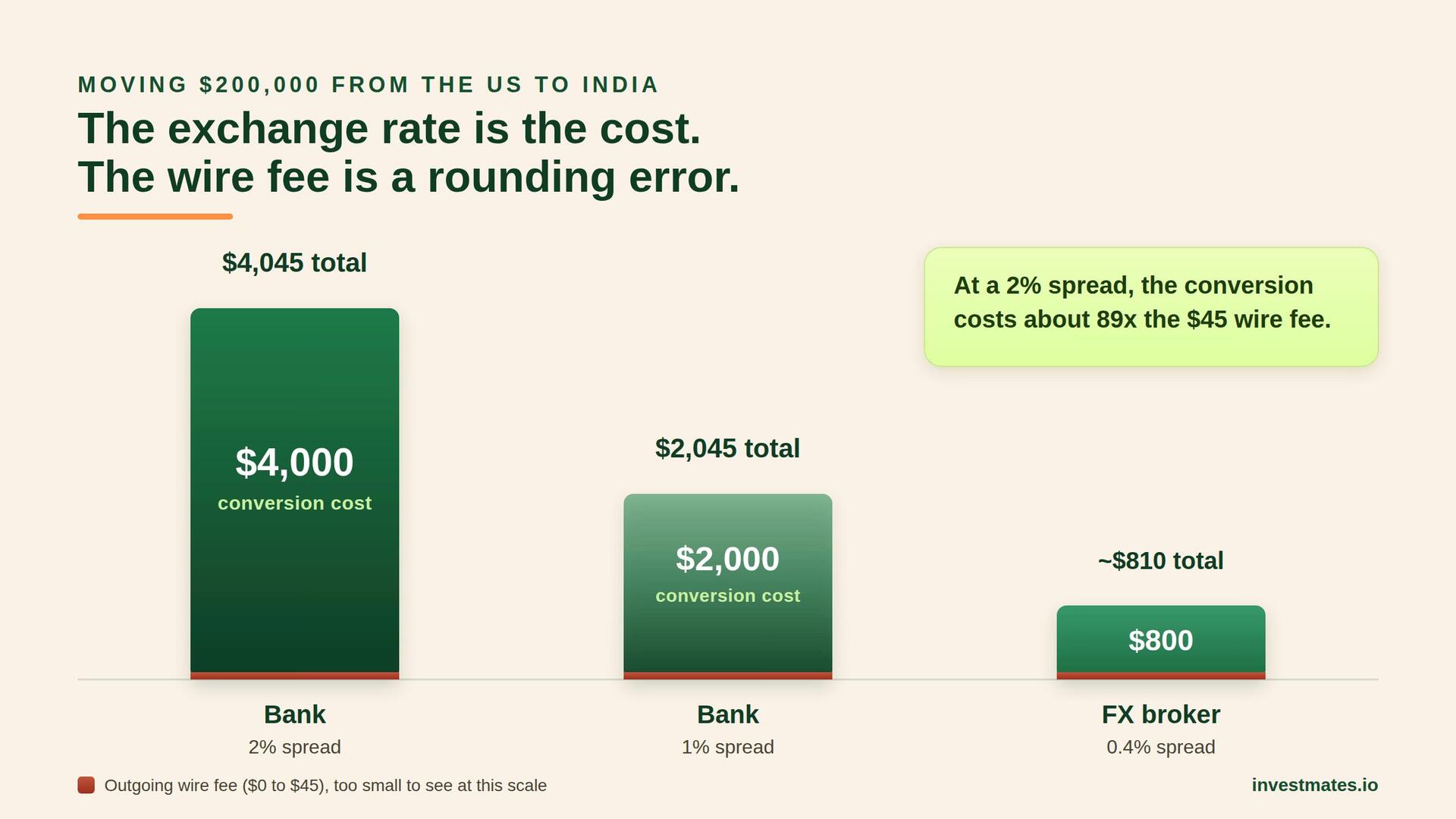

The spreads shown are illustrative bands, not quotes. The point is the ratio. At a 2% spread the conversion costs about eighty-nine times the wire fee, and shaving the fee to zero changes almost nothing.
So do this instead. Look up the USD to INR mid-market rate on the morning you transfer. Ask your bank or broker for the exact rupee figure that will be credited, then divide one by the other, and you have your real spread to two decimal places. It takes two minutes, and it is the only number in this process worth negotiating.
Step 5: Send it, then keep the paperwork
Send the full amount in one transfer and ask your Indian bank for a Foreign Inward Remittance Certificate once it lands. Splitting a large transfer into smaller pieces to stay under a reporting threshold is a federal crime in the US called structuring, and it is prosecuted independently of whether the underlying money is clean. There is no version of this where breaking up the transfer helps you.
The FIRC, or the Foreign Inward Remittance Advice that most banks now issue instead, is your proof that the rupees in the account arrived as foreign currency from abroad. That is what preserves the repatriable character of the funds. Ask for it at the time. Retrieving one three years later, when you actually need it, is far harder than requesting it in the week the money lands.
What the $10,000 threshold actually means
Nothing you have to file. US financial institutions report large transactions to FinCEN themselves, as an obligation that sits on the bank rather than on you, and no tax attaches to that report. A wire is an electronic funds transfer, not a currency transaction, so the cash reporting rules people have in mind do not apply to it in the first place.
What your bank will do is ask about the source of the funds before releasing the money, which is a different rule with a much lower trigger. Answer it plainly, hand over the CD statement or the closing statement, and the wire goes out.
Step 6: Report the account on next April's tax return
Add the Indian account to your FBAR as soon as the money lands, because the obligation is triggered by the balance at any point in the year, not the balance on 31 December. Move $200,000 into an Indian account in June and out again in July, and you still file.
The threshold is $10,000 across all your foreign accounts combined, at any time during the year. You file FinCEN Form 114 electronically through the BSA E-Filing System, and, as the IRS sets out on its FBAR page, it does not go in with your federal return. It is due 15 April with an automatic extension to 15 October. There is a fuller walkthrough of how to file the FBAR if this is your first year.
Form 8938 is separate and it does go in with your return. Living in the US and filing single, you file it once your foreign financial assets pass $50,000 on the last day of the year or $75,000 at any point during it. Married filing jointly, those figures are $100,000 and $150,000. A $200,000 balance clears every one of them.
One thing that catches people. NRE interest is exempt in India, and that exemption is an Indian rule that has no effect on the IRS. If you're a US citizen or a green card holder, the interest is ordinary income on your US return, and there's no Indian tax paid to claim a credit against. Indian deposits are taxed on your US return whatever India does with them.
Alternatives to converting the whole sum to rupees
Converting $200,000 to rupees in one transaction fixes your exchange rate for the entire sum on a single morning. If the money has a job waiting for it in India, that's fine. If it doesn't, three alternatives are worth weighing.
Hold it in dollars in India. An FCNR deposit is a foreign currency term deposit with an Indian bank, running one to five years, with interest exempt in India and full repatriability of both principal and interest. You get an Indian yield without taking the currency conversion. For an uncommitted lump sum this is often the better answer, and it is the one option that removes the exchange rate decision entirely rather than timing it.
Split the transfer across months. Three or four transfers over a quarter averages your rate instead of betting on one. This is not structuring, because the purpose is currency risk and not concealment, and each transfer goes through normally.
Leave it where it is. There is no rule that says money must follow you. If you are not moving to India in the next few years and have no Indian spending to fund, a US account is a perfectly good place for it. No FBAR consequence, no currency conversion to worry about.
Conclusion
If it were my money, I'd open the NRE account this month, before the money is ready and before any return to India is on the calendar. That single step keeps the transfer simple and keeps the funds free to leave again, and it is the one that gets left until last. When the sum is large enough that the exchange rate matters more than the fee, and at these amounts it always is, have the conversation before you convert rather than after.
Frequently asked questions
What happens if you transfer more than $10,000 from the US to India?
Nothing you need to act on. Your US bank handles its own reporting to FinCEN, no tax is triggered by the size of the transfer, and you file nothing at the time. The threshold that does reach you is the FBAR one: once your combined Indian account balances top $10,000 at any point in the year, you file FinCEN Form 114 the following April.
What is the safest way to transfer a large sum from the US to India?
A bank wire sent directly to an NRE account in your own name. It is traceable end to end, both banks keep records, and the SWIFT reference lets either side locate the money if it stalls. Never send a large sum to a third party's account or through an informal transfer arrangement, because a payment you cannot document is a payment whose repatriable status you cannot later prove.
What happens if someone transfers 20 lakh rupees into my Indian account?
If it is your own money arriving from your own foreign account, nothing is taxable, because moving your own funds is not income. If it is a gift from someone else, the answer turns on your relationship to the sender under Section 56(2)(x), and the IRS gift tax limit for NRIs covers both sides of that. Either way, keep the bank advice showing where the credit came from.
Does the $250,000 LRS limit cap how much I can send to India?
No. The Liberalised Remittance Scheme governs Indian residents sending money out of India, and its USD 250,000 annual ceiling applies in that direction only. Money moving from the US into India is an inward remittance and sits entirely outside LRS. The same logic means TCS on foreign remittance is not collected on money coming in.
Can I send money to my NRE account after I have already moved back to India?
Not cleanly. Under FEMA you become resident the moment you return intending to stay, and NRE accounts have to be re-designated after that, generally within one to three months. Banks do not do it automatically, so an NRE account often stays open for a while, but continuing to run it as a resident is a FEMA contravention. Move the money before the move, or plan for an RFC account instead.
Does the 1% US remittance tax apply to a bank wire sent to India?
No, not to a wire funded from a bank account. The excise tax under Section 4475 applies to remittance transfers made after 31 December 2025 that are funded with cash, a money order or a similar physical instrument. Transfers funded by a withdrawal from an account at a financial institution, or by a US-issued debit or credit card, are excluded.