

Every month, millions of NRIs in the United States send money from USA to India to support families, pay EMIs, or fund investments back home. But the real cost of each transfer is not just the fee you see upfront. It also includes the exchange rate markup, which is the gap between the rate you get and the actual mid-market rate.
In 2026, with over a dozen remittance apps competing for your business, picking the right one can save you hundreds of dollars a year. The wrong one can quietly cost you more on every transfer through hidden exchange rate markups.
This guide compares 17 major services, from Wise and Remitly to newer apps like Abound and Aspora. You will see exactly where the hidden costs are, how fast money actually moves, and what transfer limits apply to each platform.
How Do You Choose the Best Money Transfer App for India?
Before comparing individual platforms, you need to understand the five factors that determine how much your recipient actually receives in INR.
- Fees (USD) – Is it a flat charge or % of the amount?
- FX Markup (%) – How much worse is their INR rate vs the true mid-market?
- Speed & Reliability – Instant vs 3–5 days can be the difference between urgent needs met or delayed.
- Transfer Limits – If you’re sending $500 monthly vs $20,000 once a year, the right app may differ.
- Trust & Ecosystem – Licensed operators with good track records are safer for high-value transfers.
How Do the Top Money Transfer Apps Compare?
The table below compares 17 platforms across five data points: fees, exchange rate markup, transfer limits, speed, and key notes. Figures come from each platform's own website where the platform publishes them. Fees, rates and limits change with the amount, payment method and your verification level, so always confirm the live quote before sending.
A few things to keep in mind while reading this table. "Mid-market" means the app claims to use the real exchange rate with no hidden markup. "From" before a fee means the platform says it starts at that price but could be higher depending on your payment method or transfer amount. Where a cell says "Not published" or "Not disclosed," the platform does not publish that figure on its website, and "check live quote" means the figure depends on your transfer.

US to India Money Transfer Apps Compared 2026
| App | Fees (USD) | Markup (%) | Transfer Limits (USD) | Speed & Reliability | Notes |
|---|---|---|---|---|---|
| Wise | Varies by amount and payment method; shown upfront; discount above $25K | None (mid-market rate) | Varies by payment method; check in app | 74% in under 20 seconds; 95% within a day (per Wise) | Best transparency; no hidden markup |
| Remitly | Varies; shown in quote | Not published; included in rate | Varies by verification and delivery method | Instant to bank or UPI when you pay by bank | On-time delivery or fee refund; cash pickup available |
| Ria | From $0 on select online transfers; varies by amount and method | Not published; included in rate | Up to $49,999 per day or per transfer | Cash pickup in minutes; bank deposit takes longer | 145,000+ cash pickup locations in India |
| Xe | $1 < $1K; $0 > $1K | Not published; included in rate | Not published; check in app | Card: minutes; ACH: 1 to 3 business days | Many India transfers arrive the same day |
| Xoom (PayPal) | $0 on eligible transactions (terms apply) | Not published; included in rate | Varies by verification level | Bank deposits up to ₹5 lakh typically in minutes; larger up to 2 hours | PayPal-owned; fee and amount shown before you send |
| Instarem | Shown in app; check live quote | Not published; promo rate on first transfer | Varies by method / KYC | Often minutes; usually 1 to 2 business days | First-transfer promo rate up to $3,000 |
| Paysend | Varies; check live quote | Not published; included in rate | Not published | UPI: usually minutes; bank: same or next business day | UPI and bank delivery |
| Money2India (ICICI) | Not published; check after login | Not published; rate shown after login | Varies by country rules and transfer mode | Instant for select banks; others 1 to 2 business days | ICICI Bank service; send from any US bank |
| TransferGo | Varies; check live quote | Not published; check live quote | Not disclosed | Varies by delivery option | Check current offers in app |
| Sendwave | Varies; check live quote | Not published; check live quote | User caps (not public) | Varies; check in app | Mobile app |
| RemitMoney (Axis Bank) | Not published; check live quote | Not disclosed | Axis defined limits | Varies; check with Axis Bank | Axis Bank service |
| Western Union | $0 on first online transfer (exclusions apply); then varies | Not published; Western Union earns on FX | Up to $50,000 to an Indian bank account | Cash pickup same day; bank up to 5 days | 111,000+ agent locations in India |
| PayPal Direct | 5% (min $0.99, max $4.99) | 4.00% currency conversion spread (or as disclosed) | Varies by account | Varies | Convenient if already on PayPal; expensive |
| Abound | Not publicly disclosed | Not published | Not publicly disclosed | Not published | NRI focused; new entrant |
| Aspora | Not published | Advertises live Google rates | Not disclosed | Not published | US service operated by Vance |
| Remit2Any | Not published | Not disclosed | Not disclosed | Not published | Limited public info |
| RemitUp | Not disclosed | Not disclosed | Not disclosed | Not disclosed | Very limited info public |
Fees and rates fluctuate. Always verify on the platform's official website before sending.
What Is the Cheapest Way to Send Money from the USA to India?
The cheapest way to send money from the USA to India in 2026 is through a platform that combines low transfer fees with a near mid-market exchange rate. Wise, for example, uses the mid-market exchange rate and shows its fee upfront, which makes its total cost easy to compare. Whichever app you use, compare the final rupee amount in each live quote.
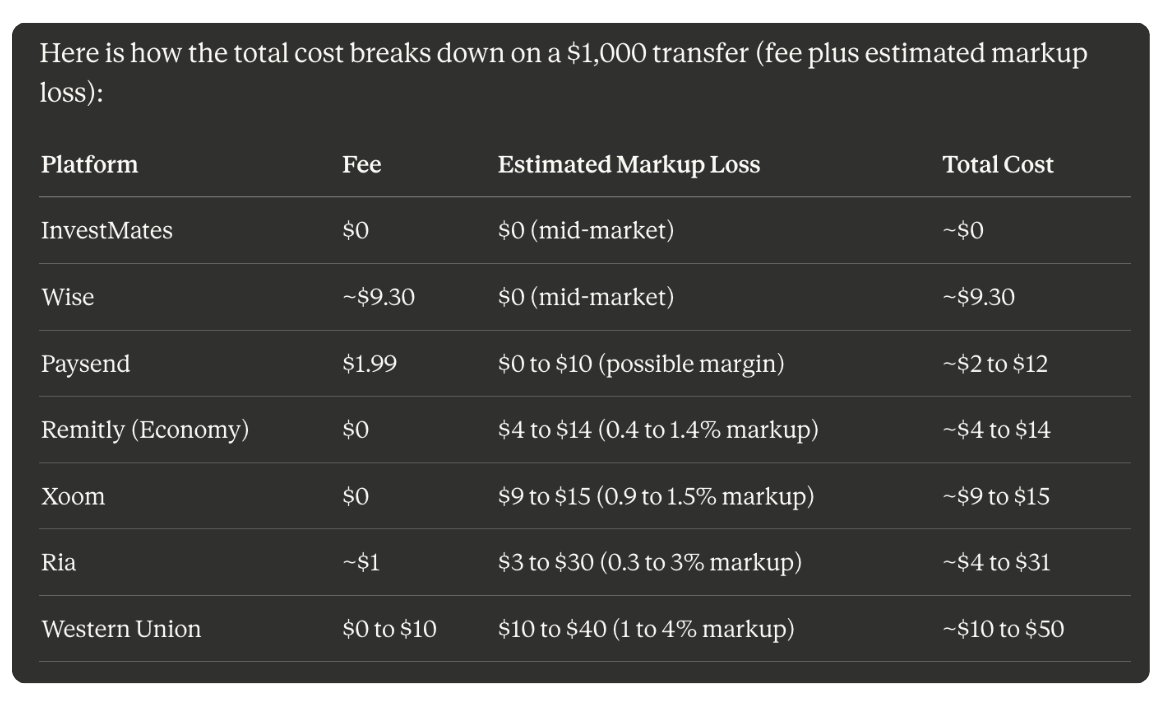
The takeaway is simple. A "zero fee" app is not always the cheapest option. If the exchange rate includes a 1.5% markup, you are paying $15 on a $1,000 transfer even though the fee says $0. Always compare what your recipient will actually receive in rupees, not just the headline fee.
For NRIs who also need to manage NRE, NRO, and FCNR accounts alongside remittances, using a platform that integrates both can save time and reduce errors.
What Is the Fastest Way to Send Money to India?
When your family needs money urgently, speed matters more than saving a few dollars on fees. The fastest options are providers that can deliver in minutes. Remitly says transfers to an Indian bank account or UPI arrive instantly when you pay by bank, Xoom says bank deposits up to ₹5 lakh typically arrive in minutes, and Xe says card-funded payments can be delivered in minutes.
Here is how the major platforms rank by delivery speed:
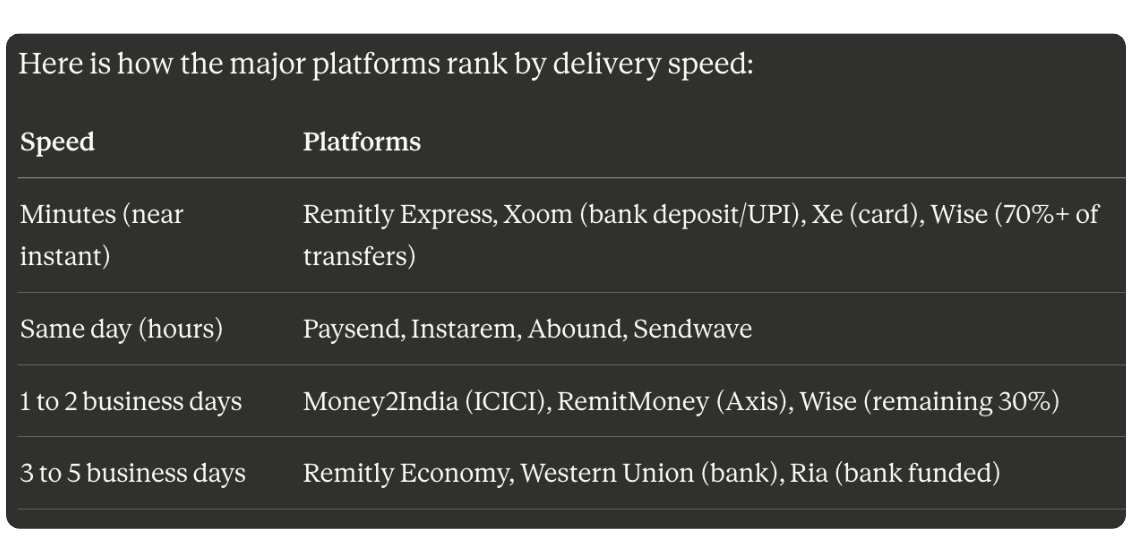
A few things affect speed beyond the platform itself. Your payment method matters. Card payments clear faster than ACH or wire. Your recipient's bank matters too. Transfers to major banks like HDFC, SBI, and ICICI often process faster than smaller regional banks. Compliance checks can also add delays, especially on first transfers or amounts above $10,000.
If speed and cost both matter, Wise hits a good balance. Wise says 74% of its transfers arrive in under 20 seconds and 95% in less than a day, and it uses the mid-market exchange rate with no markup.
How Do You Send Large Amounts of Money from the USA to India?
If you are sending $10,000 or more, whether for a property purchase, an investment, or family support, your options narrow. Not every app supports large transfers, and the ones that do often require additional documentation.
Here are the platforms best suited for large amount transfers:
Xe charges a $1 fee on transfers under $1,000 and $0 on transfers over $1,000, according to its India page. Your maximum depends on your account and verification, so confirm your limit in the app before a large transfer.
Wise offers volume discounts: it reduces its fee when you send more than $25,000 (or equivalent). Check your limit for your payment method in the app before sending a large amount.
Banks (wire transfer) remain the traditional option for very large sums. Your US bank can send a SWIFT wire directly to an Indian bank account. Expect an outgoing wire fee from your bank, possible intermediary bank charges, and the bank's own exchange rate, so compare the final rupee amount with a transfer app before sending.
A Currency Transaction Report (CTR) is filed by a financial institution only for transactions in currency (physical cash) of more than $10,000 in a business day, so a large transfer funded from your US bank account does not trigger one, although your provider may still ask for source-of-funds documents. Separately, if you are a U.S. person and your foreign financial accounts, including Indian bank accounts, had an aggregate value above $10,000 at any time during the calendar year, you must file an FBAR. Make sure your cross border money management is organized before initiating large transfers.
Remitly vs Xoom vs Wise: Which Should You Choose?
These three platforms are the most frequently compared by NRIs sending money from the US to India. Each one wins in a different scenario.
Choose Wise if you prioritize the lowest total cost and full transparency. Wise uses the mid-market rate with no hidden markup, and the fee is shown upfront before you confirm. It is the best option for regular transfers of $500 or more where you want to maximize the rupees your family receives.
Choose Remitly if speed is your top priority and you need flexible delivery options. Remitly says transfers to an Indian bank account or UPI arrive instantly when you pay by bank, and it also offers cash pickup in India. The trade off is that Remitly does not publish its exchange rate margin, so compare the rupee amount in its quote against the mid-market rate.
Choose Xoom if you are already in the PayPal ecosystem. Xoom advertises $0 transfer fees on eligible transactions (terms apply) and shows the exact fee and the amount your recipient gets before you send. It does not publish its exchange rate margin, so compare the final rupee amount with Wise, but the convenience of your existing PayPal account and fast delivery make it a solid option for occasional senders.
For a detailed comparison of how NRI investment options in India interact with your remittance strategy, check our dedicated guide.
Compare rates and send money with InvestMates, with no hidden fees.
Why Do NRIs Choose InvestMates for Remittances?
Unlike standalone transfer apps that solve only one problem, InvestMates combines remittances with a full wealth management platform built specifically for NRIs.
InvestMates helps you send money home with better rates and no hidden fees, and it treats each transfer as more than a wire: the aim is minimal tax impact and full compliance on both sides.
But remittances are just the starting point. InvestMates also lets you track your US and Indian investments in one unified dashboard, get AI driven tax and portfolio insights through Otto (our AI financial coach), and manage compliance needs like FATCA and FBAR reporting without juggling multiple apps.
For NRIs who are tired of using one app to send money, another to track investments, and a third to manage taxes, InvestMates brings everything into a single platform, with the tools to build long term wealth across both countries.
Choosing the right platform to send money from the U.S. to India comes down to what matters most to you: cost, speed, or convenience.
Wise stands out for transparency, Remitly and Xoom shine for fast delivery, and a bank wire or a provider with a higher verified limit suits very large transfers. Yet, these services still force you to trade off between fees, markups, or limits.
That’s where InvestMates changes the game. With remittances that carry no hidden fees, plus the ability to manage investments, taxes, and compliance across the U.S. and India, it’s built specifically for NRIs who want both maximum value today and long-term financial clarity.
Instead of juggling multiple apps, you get a single platform that keeps transfers, investments and taxes in one place and helps you build wealth with confidence.
Frequently asked questions
What is the cheapest way to send money from USA to India?
The cheapest option is the one that delivers the most rupees after both the fee and the exchange rate margin. Wise, for example, uses the mid-market rate with no hidden markup and shows its fee, which depends on the amount and payment method, before you send. Always compare the total amount your recipient will receive in rupees, not just the advertised fee. A "zero fee" app with a 1.5% exchange rate markup costs more than an app that charges $5 but gives you the real rate.
How long does it take to transfer money from USA to India?
It depends on the platform and your payment method. Remitly, Xoom and Xe all say many transfers can arrive in minutes, depending on how you pay and how the money is received. Wise says 74% of its transfers arrive in under 20 seconds. Xe notes that ACH-funded payments typically take 1 to 3 business days, and Western Union says bank transfers may take up to five days. First time transfers may take longer due to identity verification.
How much money can I send from USA to India per day?
Limits vary by platform, payment method and verification level. Ria lists up to $49,999 per day or per transfer to India, and Western Union lists up to $50,000 to an Indian bank account. Remitly says its limits depend on your verification, delivery method and destination. Most platforms start new users on lower limits and raise them after identity verification. A Currency Transaction Report applies only to cash transactions over $10,000, not to a transfer funded from your bank account, though your provider may ask for source-of-funds documents on large amounts.
Is Wise or Remitly better for sending money to India?
It depends on what matters most to you. Wise is better for total cost because it uses the mid-market exchange rate with no markup. Remitly is better for speed and flexibility because it says bank-funded transfers to Indian bank accounts or UPI arrive instantly, and it offers cash pickup in India. For regular senders focused on maximizing the rupees received, Wise typically wins. For occasional urgent transfers, Remitly's instant delivery is hard to beat. If you are managing finances across both countries, a platform like InvestMates that combines NRI tax planning with remittances may be a better fit.
Do I have to pay tax on money sent to India from USA?
Personal remittances sent from the US to India are generally not taxable for the sender. If you give one person more than $19,000 in 2026 (the US annual gift tax exclusion), you generally need to file a gift tax return (Form 709), though no tax is typically owed. In India, a monetary gift received from a relative is not taxed, while gifts from non-relatives that total more than ₹50,000 in a year are taxable for the person who receives them. Separately, a 1% US federal excise tax applies to remittance transfers made after December 31, 2025 when the sender pays the provider with cash, a money order, a cashier's check or a similar physical instrument; the provider collects it from the sender. For a fuller breakdown, see our guide to tax rules on NRI remittances. NRIs should also be aware of FATCA and CRS reporting obligations that apply to financial accounts held across borders.