

NRIs face one of their most important life decisions when they plan their trip back home - a moment filled with both excitement and apprehension.
More Indians now live abroad than ever before, and an interesting trend has emerged. Many NRIs are moving back to India permanently. This transformation goes beyond just changing locations. It marks the start of a new financial chapter that brings mixed emotions.
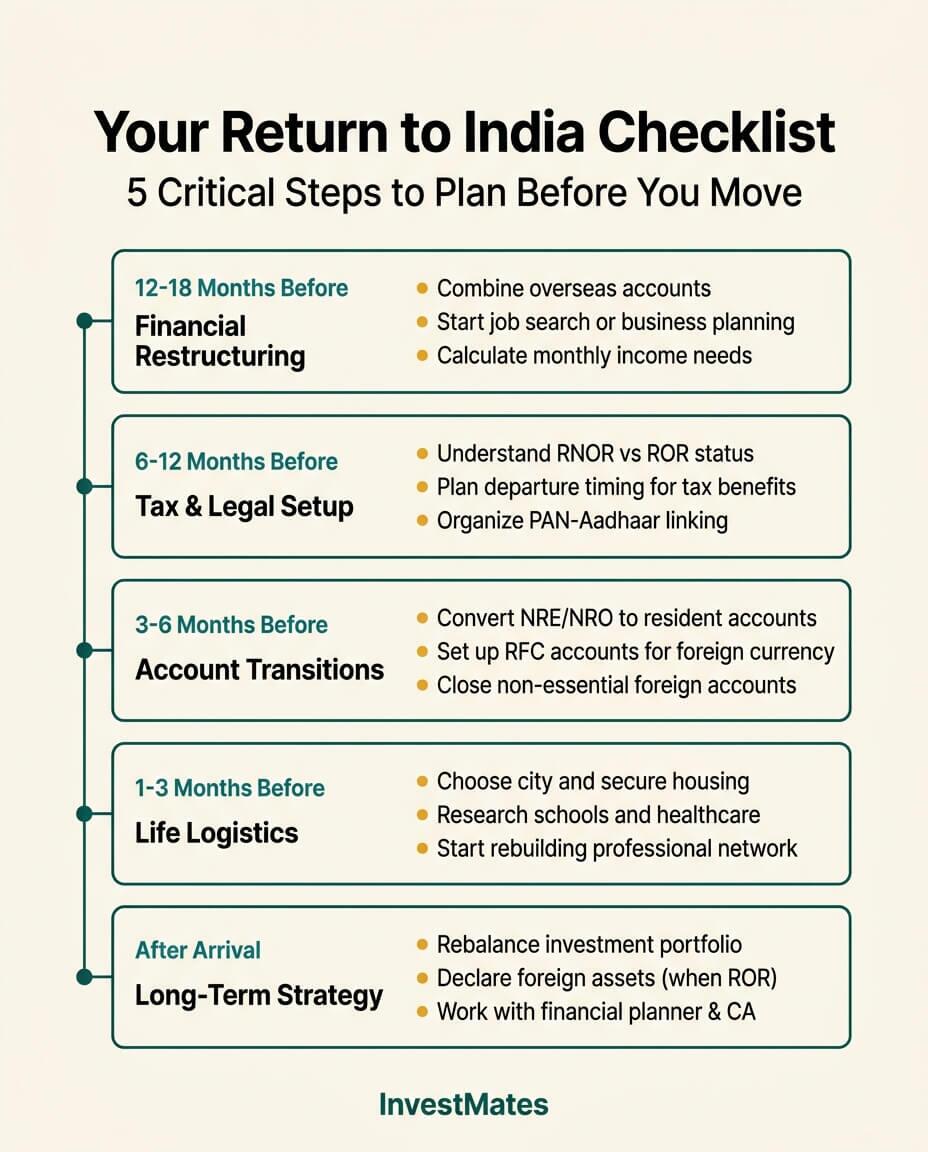
Planning your move back to India should be a well-laid-out 12-18 month project, according to experts. Each step needs careful planning - from converting overseas accounts to updating investments. You'll need to figure out if your income matches your lifestyle goals.
This piece covers everything you need to know before booking that one-way ticket home. We'll help make your transition smooth and successful.
Assessing Your Readiness to Return
Moving back to India needs careful financial analysis and lifestyle planning. Your preparation will determine whether you have a smooth transition or face unexpected challenges during your experience.
Do you have enough funds to sustain your lifestyle?
Financial planning stands as one of the most complex yet vital parts of returning to India. You should think over how much of your wealth should stay invested abroad versus being moved to India before finalizing your move. A globally diversified portfolio usually reduces overall risk.
You need adequate liquid funds in India to handle immediate expenses like rent, school fees, or healthcare. These liquid funds are the foundations of financial stability during relocation.
Bank deposits in India currently offer interest rates between 3.50% to 8% for NRO FDs (as of November 2023), which makes keeping sufficient cash reserves even more important.
Will you work, retire, or start a business?
Career clarity before moving back is vital - job uncertainty tops the list of reasons why NRIs hesitate to return. Most industries in India offer lower salaries than developed countries, but lower living costs and easy access to household help often balance this gap.
Start your job hunt 9-12 months before moving and update your CV to match Indian market expectations. At least one family member should have a confirmed job offer to ensure steady monthly income after return.
India now offers one of the fastest-growing startup ecosystems for those with entrepreneurial dreams, especially when you have interests in fintech, healthtech, and consumer businesses.
More returning NRIs are exploring business opportunities where chartered accountancy firms are a great way to get help with setup, GST implications, and regulatory compliance.
It's worth mentioning that planning retirement needs estimates of your living costs, life expectancy, family needs, and provisions for medical emergencies.
How much monthly income will you need?
The Nomad List suggests you'll need about USD 950 (around ₹70,000) monthly to live comfortably in India. This amount changes based on your city choice, lifestyle, and family size.
A ₹1 crore investment can generate different monthly incomes:
- Equity Mutual Fund SWPs: ₹80,000-₹1,20,000
- Debt Mutual Funds: ₹50,000-₹75,000
- Fixed Deposits: ₹25,000-₹65,000
- Commercial Real Estate Rentals: ₹60,000-₹90,000
Your return plans should include both income needed for your desired lifestyle and investment options that can give steady returns. Monthly Income Plans (MIPs) provide regular income streams with lower risk than equity investments, making them ideal for long-term investment goals.
Simplifying Your Finances Before the Move
Financial streamlining is a vital step in your repatriation experience. You should take care of money matters well ahead to avoid complications after settling back in India.
Combine bank accounts and investments
The first step is to review all your financial accounts in different countries. Most NRIs have multiple accounts that should be combined before returning. You should liquidate non-essential assets and bring scattered investments together to make management easier.
Your NRE/NRO accounts in India must change to resident accounts when you relocate permanently. The NRO accounts must convert to resident savings accounts. You can either convert NRE accounts to resident savings accounts or move their funds to a Resident Foreign Currency (RFC) account.
RFC accounts give you a great advantage - you can keep foreign currency without converting it to Indian rupees right away. FCNR deposits can stay until they mature, then you must move the money to resident savings or RFC accounts.
Exit planning from host country
Smart timing of your departure can help you save on taxes. Your return date should match tax residency rules in both countries. A few extra months of stay might lead to substantial tax savings.
Your host country might need exit tax returns or final declarations. Make sure to document your departure date, change of domicile, and tax payments in your previous home to prevent legal issues in either country.
US residents must follow FATCA rules by reporting foreign financial accounts that exceed certain values. This includes NRE, NRO, FCNR accounts, mutual funds, and Indian stocks.
Organize the core team documents: PAN, Aadhaar, OCI
Once you decide to return, update your PAN card details with your new residential status. You must link your PAN with Aadhaar to comply with tax rules after returning to India.
NRIs can apply for Aadhaar only after living in India for 182 days or more in the previous 12 months. After becoming eligible, book an appointment through the UIDAI website or visit your nearest Aadhaar Seva Kendra.
You'll need these items to apply:
- Indian passport (as proof of identity and address)
- Completed Aadhaar enrollment/update form
- Indian mobile number for verification
Yes, it is crucial to organize your family's documents too. Make sure everyone has current passports, Aadhaar cards (if eligible), and PAN cards. This preparation makes everything easier when you return to India, from banking to property deals.
Tax and Legal Compliance for Returning NRIs
Your tax implications in India depend on your residential status. These details will help you manage your finances better in your first years after moving back.
Understanding RNOR and ROR status
When you return to India, your residency status changes through different stages. You become a 'resident' in any Financial Year if you stay in India for 182 days or more. After that, you'll likely become a Resident but Not Ordinarily Resident (RNOR) before you transition to a Resident and Ordinarily Resident (ROR).
You qualify as RNOR under these conditions:
- You were a non-resident for at least 9 out of 10 previous financial years
- You stayed in India less than 730 days during the previous 7 years
This RNOR status usually lasts 2-3 years after your return. During this time, you pay tax only on income earned or received in India – your foreign income stays exempt unless it comes from an Indian-controlled business. Your worldwide income becomes fully taxable in India once you become an ROR.
Foreign asset disclosure requirements
As an RNOR, you don't need to declare foreign assets in your income tax returns. This gives you time to settle back comfortably.
In spite of that, you must report all foreign assets in Schedule FA of your tax returns when you become an ROR. This covers:
- Foreign bank accounts
- Overseas property
- Investments in foreign stocks/securities
- Other international assets
The Black Money Act imposes heavy penalties if you fail to disclose these assets. Accurate records of your global financial holdings are crucial for future compliance.
Double Taxation Avoidance Agreement (DTAA)
India has DTAAs with over 90 countries to prevent double taxation of income. These agreements give you three main benefits:
- Foreign Tax Credit for taxes paid overseas
- Exemptions for certain income categories
- Reduced tax rates on specific income types
You need a Tax Residency Certificate from your previous country to claim DTAA benefits. File Form 67 with proof of overseas tax payments to claim foreign tax credits in India.
Note that DTAA benefits continue through your RNOR period but become vital once you're an ROR and your global income falls under India's tax net.

Rebuilding Your Life in India
Finding a comfortable place to live is one of the most important steps when you return to India permanently. Your daily life quality depends on where and how you settle back, beyond just managing your finances.
Choosing the right city and home
The place you pick will shape your entire return experience. Bengaluru, Hyderabad, Pune, and Chennai are top choices among returning NRIs because of their strong job markets, infrastructure, and lifestyle options. Families often lean toward Chennai, Delhi, and Hyderabad for their excellent healthcare facilities. Mumbai still draws many people despite its high living costs.
Living costs differ substantially between cities. A 2BHK apartment in Mumbai's upscale areas might set you back ₹1.5 lakh monthly, while suburban options range from ₹40,000-₹70,000. Hyderabad offers better value with similar homes at ₹30,000-₹50,000, making it the most economical metro city.
Schooling and healthcare access
Parents need to think about good schools for their children. Bengaluru, Pune, and Chennai stand out with their international schools and universities that match global education standards.
Healthcare in India offers excellent value—a heart bypass surgery costs USD 5,000-8,000 compared to USD 70,000-150,000 in the US. South Indian cities lead in healthcare quality, though Mumbai, Kolkata, and Pune are becoming popular choices among NRI patients.
Rebuilding your social and professional network
A good support system makes settling back easier. Start by reaching out to old college friends, former colleagues, and neighbors who can help you adjust. LinkedIn and other professional platforms are great ways to showcase your international background.
Digital connections help, but meeting people in person works best in India. You should join industry events, connect with alumni groups, and try co-working spaces like WeWork or 91springboard. These places host workshops and meetups that help you network naturally. Remember that moving back isn't just about changing locations - it's about reinventing yourself and finding your new definition of home.
Creating a Long-Term Financial Strategy
A resilient financial framework needs careful planning after you settle back in India. Your overseas earnings and investments require careful restructuring to maximize returns in your home country.
Rebalancing your investment portfolio
Portfolio assessment becomes significant after settling in India. You need a combined real-time dashboard that shows your exact allocation across asset classes. The step-by-step rebalancing process helps you identify over-performing assets to trim and under-performing ones to increase.
Fresh investments can be redirected toward under-allocated areas instead of selling appreciated assets directly. Tax changes introduced in mid-2024 mean equity fund gains held over 12 months are now taxed at 12.5% with the first ₹1.25 lakh tax-free.
Using RFC accounts and tax-free options
Resident Foreign Currency (RFC) accounts are excellent tools for returning NRIs. These accounts help you hold foreign currency earnings without immediate conversion to rupees. The funds can be maintained in multiple currencies including USD, GBP, and EURO with fully repatriable balances.
The tax benefits are substantial. Interest earned on RFC accounts stays exempt from Indian income tax during your RNOR period. You'll need to pay tax on interest earned as per your tax slab after this period.
Working with a financial planner and CA
Professional guidance is a great way to get through your transition. A specialized team should include a financial planner for portfolio structure and a chartered accountant who knows NRI taxation well.
Expert professionals help with property transactions, repatriation services, and tax litigation. They monitor investments, make liquidation of property easier, and advise on repatriation of sale proceeds. A focused tax plan customized to your situation can substantially affect your financial success.
Conclusion
Moving back to India after years abroad is a major life change that needs careful planning on several fronts. Your success in returning home largely depends on how well you prepare financially, legally, and emotionally before the big move.
Money management is the life-blood of your return experience. You should start preparing 12-18 months before your planned return date. This gives you time to unite your accounts, understand tax implications, and build cash reserves. The RNOR status gives you tax advantages in your first few years back, so timing your return well can help you make the most of these benefits.
Your paperwork needs equal attention. You must update your PAN, link your Aadhaar, and disclose foreign assets before taking that one-way flight. The city you choose will also affect your quality of life substantially. Each metro area has its own advantages in terms of living costs, healthcare access, and job opportunities.
Expert guidance can make a real difference during this transition. Working with financial planners and chartered accountants who know NRI taxation helps you direct complex financial matters and avoid common mistakes. RFC accounts are great options to keep your foreign currency earnings without converting them to rupees right away.
Note that coming home involves more than just logistics - you need to adjust emotionally too. Building new social and professional networks takes time and effort. Many returning NRIs find this rewarding as they use their global experience to help India grow.
Your return marks a fresh start, not an end. With proper planning, smart financial management, and realistic expectations about lifestyle changes, you can turn challenges into opportunities as you start this new chapter of life in India.
Frequently asked questions
What financial steps should NRIs take before returning to India?
NRIs should consolidate bank accounts and investments, convert NRE/NRO accounts to resident accounts, and consider opening a Resident Foreign Currency (RFC) account. It's also important to organize key documents like PAN and Aadhaar, and plan for tax implications.
How does the tax status change for NRIs returning to India?
Upon return, NRIs may qualify for Resident but Not Ordinarily Resident (RNOR) status for up to three years. During this period, only Indian income is taxable. After transitioning to Resident and Ordinarily Resident (ROR) status, global income becomes taxable in India.
What factors should NRIs consider when choosing a city to settle in India?
NRIs should consider job markets, infrastructure, healthcare facilities, education options, and cost of living. Cities like Bengaluru, Hyderabad, Pune, and Chennai are popular choices due to their balance of these factors.
What role do financial professionals play in an NRI's return to India?
Financial planners and chartered accountants familiar with NRI taxation can provide crucial guidance on portfolio restructuring, tax planning, property transactions, and repatriation services. Their expertise can significantly impact financial success during the transition.