
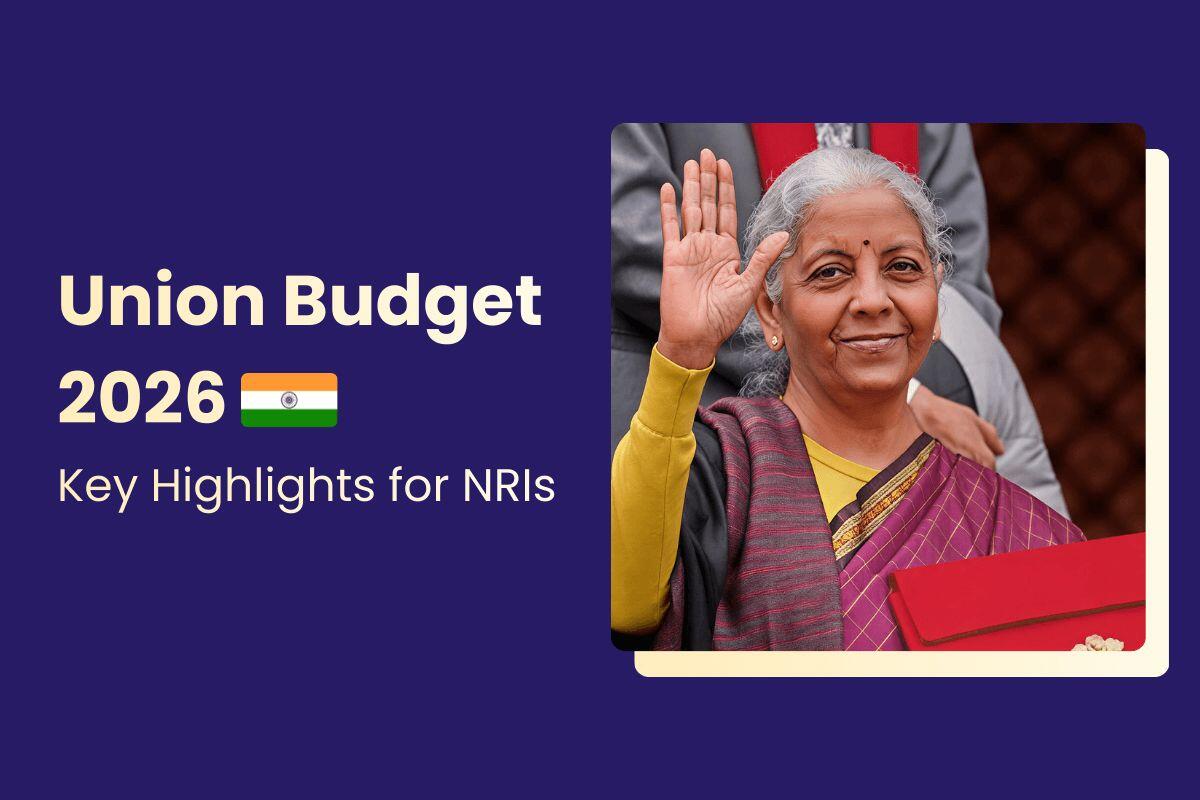
If you are an NRI watching India's economic transformation from abroad, February 1, 2026, marked a watershed moment. Finance Minister Nirmala Sitharaman unveiled her ninth consecutive budget, and this time, she is speaking directly to you.
You can watch the FM Nirmala Sitharaman presents Union Budget 2026-27
After years of navigating complex compliance requirements, restrictive investment limits, and procedural headaches, you are finally getting the relief you have been waiting for. For the first time in years, the Indian government has taken a comprehensive look at the real challenges you face, from buying property back home to managing foreign assets, from investing in Indian equities to sending money for your children's education.
Finance Minister Sitharaman set the tone early in her speech, emphasizing that this budget focuses on "fulfilling aspirations of our people and building their capacity, making them strong partners in India's path to prosperity."
Let me break down what this means for your wallet, your investments, and your peace of mind.
1. Your Equity Investments Just Got a Major Upgrade
The Announcement
Finance Minister Sitharaman made a bold move for overseas investors. Here is what she said:
"Individual Persons Resident Outside India (PROI) will be permitted to invest in equity instruments of listed Indian companies through the Portfolio Investment Scheme. It is also proposed to increase the investment limit for an individual PROI under this scheme from 5% to 10%, with an overall investment limit for all individual PROIs to 24%, from the current 10%."
What This Means for You
Remember that frustrating moment when you hit the 5% ownership ceiling in a company you believed in? Those days are over. You can now own up to 10% of any listed Indian company, that is double your previous limit.
Even better, the aggregate ceiling for all NRIs combined has jumped from 10% to 24%. This means you will not be locked out of opportunities just because other overseas Indians got there first.
Real-World Impact
This change particularly benefits those of you who have been watching India's tech boom, manufacturing renaissance, or green energy revolution from the sidelines. You can now participate more substantially in these growth stories.
Here is what the new limits enable:
- Build meaningful positions in companies you are passionate about
- No more forced diversification due to arbitrary limits
- Greater flexibility to invest in mid-cap and small-cap companies where you see potential
- Align your NRI investment strategy with your conviction, not regulatory constraints
2. Property Transactions Just Got Infinitely Simpler
The Announcement
If you have ever sold property in India while living abroad, you know the TAN nightmare. The Finance Minister addressed this directly:
"TDS on the sale of immovable property by a non-resident is proposed to be deducted and deposited through resident buyer's PAN based challan instead of requiring TAN."
What This Changes
Previously, when you sold property in India, your buyer needed to obtain a separate Tax Deduction and Collection Account Number (TAN) just to pay you. This process could take 2-4 weeks, often delaying closings and creating unnecessary stress.
Starting October 1, 2026, buyers can simply use their existing PAN to deposit your TDS. No more waiting, no more bureaucratic runarounds.
Important Clarification
The TDS rate for NRI property sales itself has not changed. It remains 12.5% plus applicable surcharge and cess on long-term capital gains, the rate in force since July 23, 2024. But the procedural simplification means:
- Faster transaction closures
- Reduced compliance burden on buyers
- Lower risk of inadvertent non-compliance
- Smoother family property transfers
If you are planning to sell Indian real estate, this makes your life considerably easier.
3. Sending Money Just Got Cheaper
The Announcements
The Finance Minister made three separate announcements that directly impact your remittances.
On education and medical expenses:
"I propose to reduce TCS rate for pursuing education and for medical purposes under the Liberalized Remittance Scheme (LRS) from 5 percent to 2 percent."
On travel packages:
"I propose to reduce TCS rate on the sale of overseas tour program package from the current 5 percent and 20 percent to 2 percent without any stipulation of amount."
What This Saves You
Let me put real numbers to this. Say you are remitting ₹50 lakh for your child's education abroad:
- Before Budget 2026: TCS of 5% on the ₹40 lakh above the ₹10 lakh threshold, so ₹2,00,000 collected upfront
- From April 1, 2026: TCS of 2% on the same ₹40 lakh, so ₹80,000
- Cash released: ₹1,20,000 that no longer sits with the tax department until you claim it back
That is significant cash flow improvement when you are already managing substantial expenses abroad:

Why This Matters
TCS is not an additional tax. It is tax collected at source that you can claim back when filing returns. But having that money upfront makes a massive difference when you are dealing with semester fees, medical emergencies, or travel bookings.
The reduced rates mean more of your money works for you immediately rather than waiting for tax refunds.
4. The One-Time Foreign Asset Disclosure Opportunity
The Announcement
This might be the most significant announcement for many of you. The Finance Minister acknowledged real-world complications:
"To address practical issues of small taxpayers like students, young professionals, tech employees, relocated NRIs, and such others, I propose to introduce a one-time 6-month foreign asset disclosure scheme for these taxpayers to disclose income or assets below a certain size."
Two Categories, Two Solutions
Category A: Undisclosed Income or Assets (Up to ₹1 Crore)
You did not disclose foreign income or assets at all. Here is your path to compliance:
- Pay 30% tax on the fair market value or undisclosed income
- Pay an additional 30% as penalty (total 60%)
- Receive complete immunity from prosecution
Category B: Disclosed Income, Undeclared Assets (Up to ₹5 Crore)
You paid tax on the income but forgot to report the asset itself, like that foreign bank account you opened during your MBA:
- Pay a flat fee of ₹1 lakh
- Receive immunity from both penalty and prosecution
Who This Helps
This scheme benefits several categories of NRIs:
- Students who opened foreign bank accounts for university stipends
- Tech professionals with RSUs or stock options from global employers
- Relocated NRIs returning to India with foreign holdings
- Anyone with dormant foreign accounts they forgot to declare
Why You Should Act
This is a defined window: the scheme was notified on August 14, 2026, and declarations can be filed on Form 1 until December 31, 2026. The government is essentially saying, "We understand mistakes happen, here is your chance to clean the slate without criminal consequences."
If you have been worried about FBAR compliance or Schedule FA reporting gaps, do not let this opportunity pass. Engage a qualified chartered accountant to assess your eligibility.

5. More Time to Get Your Returns Right
The Announcement
The Finance Minister recognized that overseas compliance is complex:
"I propose to extend time available for revising returns from 31st December to up to 31st March with the payment of a nominal fee."
Why This Helps You
As an NRI, your tax situation is inherently more complex than a resident's. Consider what you need to coordinate:
- Foreign tax credits require coordination with overseas tax returns
- Currency conversions need RBI reference rates for each transaction
- Schedule FA foreign asset reporting requires year-end foreign bank statements
- DTAA treaty relief demands tax residency certificates from foreign jurisdictions
That extra three months, taking you to March 31 instead of December 31, gives you breathing room to get everything right without rushing or risking errors.
Previously, the December 31 deadline created pressure. Your US tax return might not be finalized, your foreign bank statements might not be ready, and coordinating with tax advisors across time zones is challenging.
The extended deadline lets you file your NRI tax return correctly rather than making mistakes under time pressure.
6. Trust-Based Taxation: Reduced Penalties and Prosecution
The Broader Context
The Finance Minister articulated a philosophical shift in her speech:
"Penalties for certain technical defaults such as failure to get accounts audited, non-furnishing of transfer pricing audit report and default in furnishing statement for financial transactions, are proposed to be converted into fee."
What Changed
The government is moving from punitive to facilitative tax administration. Technical compliance failures, the kind that happen when you are managing Indian affairs from 10,000 miles away, are being decriminalized.
Specific Reliefs
Here are the concrete changes that benefit NRIs:
- Pre-payment for tax appeals reduced from 20% to 10%
- Integrated assessment and penalty orders (no separate proceedings)
- Immunity extended to misreporting cases, not just underreporting
- No interest on penalty during first appeal
This means less fear of criminal prosecution for inadvertent errors and more focus on just getting your taxes right.
7. Additional Protections for Small Foreign Asset Holdings
The Announcement
For those of you with minor overseas holdings, there is additional relief:
"There is no penalty presently for non-disclosure of non-immovable foreign assets with aggregate value less than 20 lakh rupees. I propose to also provide them with immunity from prosecution with retrospective effect from 1.10.2024."
What This Covers
If you have non-immovable foreign assets (bank accounts, securities, etc.) worth less than ₹20 lakh that you did not disclose, you now have immunity from prosecution, effective retroactively from October 1, 2024.
This acknowledges that small overseas holdings often go unreported due to complexity rather than malicious intent. The government is drawing a clear line between deliberate tax evasion and genuine administrative oversights.
What You Should Do Right Now
Budget 2026 hands you concrete benefits. But benefits only materialize when you take action.
Immediate Actions
Review your portfolio. If you have been wanting to increase positions in Indian equities, now is the time to plan your strategy around the new 10% limits. Contact your broker to understand the revised PIS procedures.
Audit foreign assets. Conduct a comprehensive review of all foreign bank accounts, securities, and assets you hold or have held. Identify any gaps in Schedule FA reporting across previous returns.
Property planning. If you are planning to sell Indian property, inform potential buyers about the simplified PAN-based TDS process starting October 1, 2026.
Assess disclosure eligibility. Determine if you fall under Category A or Category B of the foreign asset disclosure scheme. The window closes on December 31, 2026.
Track remittances. If you regularly send money for education, medical treatment, or travel, calculate your actual TCS savings and adjust your cash flow planning accordingly.
Medium-Term Planning
- Establish robust systems for annual foreign asset documentation
- Coordinate between Indian and foreign tax advisors for seamless compliance
- Consider the 120-day residency threshold if your income from Indian sources exceeds ₹15 lakh
- Explore opportunities in India's expanding corporate bond market as liquidity improves
The Bigger Picture: What This Signals
This budget represents more than isolated policy changes. It signals a fundamental shift in how India views its diaspora, from potential tax evaders to valued partners in national development.
The Finance Minister's budget acknowledges that you face unique challenges:
- Managing compliance across multiple jurisdictions
- Coordinating tax filings from different time zones
- Dealing with currency conversions and exchange rate fluctuations
- Navigating complex DTAA treaty provisions
Rather than adding more restrictions, the government is removing barriers, simplifying processes, and creating amnesty windows for genuine compliance mistakes.
India is building towards Viksit Bharat, a developed India by 2047. The 35.4 million strong NRI diaspora is integral to that vision. The question is not whether India wants your participation, it is whether you will seize the opportunities this budget creates.
Final Thoughts
Budget 2026 hands you concrete benefits, reduced TCS rates, higher investment limits, simplified compliance, and amnesty opportunities. But benefits only materialize when you take action.
The foreign asset disclosure window closes on December 31, 2026. The opportunity to restructure your portfolio around new equity limits requires planning now. The simplified property transaction rules become effective October 1, 2026, perfect timing to accelerate sales you have been considering.
Most importantly, this budget creates a foundation for deeper engagement with India's growth story. You have watched India's transformation from abroad. Now you have better tools to participate in and benefit from that growth.
Ready to optimize your India strategy around Budget 2026 changes? Get started with InvestMates for personalized NRI wealth management.
Frequently asked questions
When do the new NRI equity investment limits take effect?
The increased individual limit of 10% and aggregate limit of 24% for NRI investments in listed Indian companies will apply from the financial year 2026-27. Check with your depository participant for updated PIS account procedures. These changes make tax-efficient NRI investment planning more flexible than before.
Is the TDS rate on NRI property sales reduced in Budget 2026?
The TDS rate itself did not change in Budget 2026 -- what changed is the deposit procedure. Long-term capital gains on NRI property sales continue to be taxed at 12.5% (without indexation, per the July 2024 capital gains reforms, now under Section 393(2) of the Income-tax Act 2025), plus applicable surcharge and cess. From October 1, 2026, buyers can deposit this TDS using their PAN instead of obtaining a separate TAN. This simplifies the process but does not change the tax rate.
How do I apply for the foreign asset disclosure scheme?
The scheme, called the Foreign Assets of Small Taxpayers Disclosure Scheme (FAST-DS), 2026, was notified on August 14, 2026. Declarations are filed online on Form 1 through the income tax e-filing portal from August 16 until December 31, 2026, with assets valued as on March 31, 2026. You should audit your foreign assets now, determine whether you fall under Category A (undisclosed income up to ₹1 crore) or Category B (undeclared assets up to ₹5 crore), and consult a chartered accountant.
Will the reduced TCS rates affect my tax liability?
TCS is tax collected at source, not additional tax. The reduced rates of 2% for education, medical, and travel mean better cash flow since less money is blocked upfront. You can claim TCS credit when filing returns. Your overall tax liability depends on your total income and applicable slabs.
Can NRIs benefit from the extended return revision deadline?
Yes. NRIs can now revise returns until March 31 with a nominal fee, instead of the earlier December 31 deadline. This extra time helps coordinate foreign tax credits, obtain tax residency certificates, and ensure accurate Schedule FA reporting. Understanding your RNOR status implications becomes easier with more time.