

If you're domiciled in Illinois when you die, Illinois estate tax reaches everything above $4,000,000, at rates running to 16%, apart from the federal government. That $4 million line hasn't moved since 2013, unlike the $15 million federal exemption.
For an NRI professional with a house, vested RSU stock, and a 401(k), that number arrives fast. Here's how it works, and why married couples need a different plan than single filers.
How Illinois estate tax actually works
Illinois runs its own estate tax, separate from the federal one. It doesn't borrow the federal government's $15 million number.
Instead, Illinois sets its own exclusion amount at $4,000,000, fixed by statute since January 1, 2013, and never adjusted since.
Cross that line and Illinois taxes the excess. Stay under it, and you owe nothing to the state.
That $4 million figure is a threshold, not a credit. Once your Illinois taxable estate exceeds it, the tax applies to the full calculation, not just the amount above the line.
That's why the Attorney General's estate tax guidance describes it as a cliff rather than a gradual phase-in.
What counts toward the $4 million
For an Illinois domiciliary, the number that matters is your full estate, wherever the assets sit.
The India property, the vested RSU stock, the 401(k), the life insurance death benefit if you owned the policy, the house equity.
Illinois starts from the same gross estate definition the federal government uses, which reaches property regardless of location for a resident. It's not limited to what's physically inside the state.
Add up a paid-off Chicago-area home, ten years of vested equity compensation, a 401(k) balance, and a life insurance policy, and $4 million stops sounding like a rich person's problem.
It's an upper-middle-income professional's problem. That's exactly why this threshold catches people who never thought of themselves as needing estate tax planning.
The rate table Illinois actually uses
Illinois computes its tax with the same graduated rate schedule the federal government used for its old state death tax credit, before Congress repealed that credit in 2001.
Illinois froze its own law to that schedule rather than following the federal repeal. Every Form 700 filing still runs through it today.
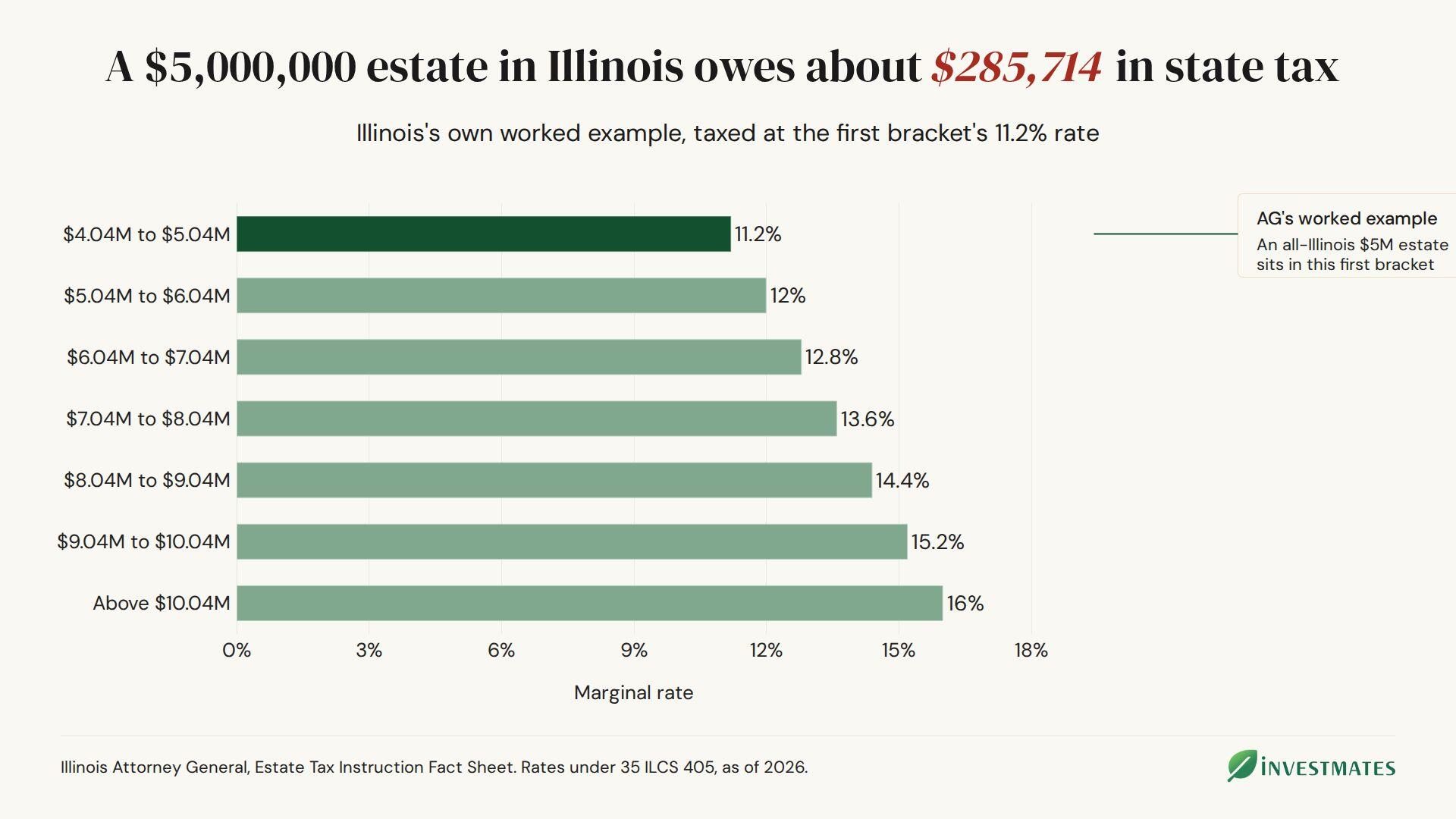
The Illinois Attorney General's own filing instructions work through an example: an estate worth $5,000,000, located entirely in Illinois, owes about $285,714 in state tax.
That's before the federal question even starts. A $15 million federal exemption does nothing to prevent it.
Why residents and nonresidents are taxed so differently
The domicile question splits into two completely different regimes, and mixing them up is an easy trap for anyone who assumes a visa type settles it.
If you're domiciled in Illinois
If you're domiciled in Illinois, meaning it's genuinely your home and you intend to stay, the state taxes your full worldwide estate above $4 million.
Every asset counts: US stock, India real estate, foreign bank accounts, all of it.
If you're not
If you're not an Illinois domiciliary but happen to own property here, the rule flips. Illinois only reaches real estate and tangible personal property physically located in the state, apportioned against your total estate.
Stocks, brokerage accounts, and other intangible assets stay out of the calculation entirely, unless they've acquired a genuine Illinois business situs.
Take Meera, a product manager who spent six years in Naperville before her employer transferred her to Austin. She kept the Naperville condo as a rental.
As a Texas domiciliary, Illinois only taxes the condo's value against her total estate. Her Texas brokerage account and India mutual funds never enter the calculation. Domicile, not property location, decided her exposure.
If you haven't established US domicile at all, a different federal regime governs instead.
See estate tax for non-citizens for how the $60,000 nonresident alien exemption works at the federal level, separately from anything Illinois does.
The mistake that costs married couples the most
Illinois has no portability. The federal system lets a surviving spouse absorb whatever exemption the first spouse didn't use, so a married couple effectively shares $30 million in 2026.
Illinois offers nothing equivalent. If the first spouse's $4 million exemption isn't used at the first death, it's gone.
That happens by default more often than people expect, because most couples leave everything to each other outright. That qualifies for an unlimited marital deduction and defers all tax to the second death.
It also means the first spouse's $4 million Illinois exemption goes completely unused. The full weight of Illinois tax then lands on one exemption instead of two, when the second spouse dies.
A credit shelter trust fixes this, and I recommend it to any Illinois-domiciled couple with a combined estate anywhere near $4 million:
- Route an amount up to the first spouse's exemption into the trust at the first death, instead of straight to the survivor.
- Let the survivor draw income, and principal if needed, from that trust for the rest of their life.
Skip this, and the mistake stays invisible until the second spouse's death, when there is no longer anything you can do about it.
That's exactly why I treat it as a priority in Illinois planning for any couple near the threshold, not an optional add-on.
Who counts as an Illinois domiciliary
Domicile is a legal test, not a visa category, and it trips up NRI professionals specifically because a work visa says nothing about it either way.
Illinois domicile requires physical presence plus intent to remain indefinitely. Signs that point toward it:
- Buying a house or signing a long-term lease.
- Registering to vote in Illinois.
- Getting an Illinois driver's license.
- Building a life with no fixed date to leave.
None of this depends on immigration status. A green card holder who's actually planning to return to India within a few years can sometimes argue against Illinois domicile.
An H-1B holder who's built a life in Naperville with no plan to leave can be an Illinois domiciliary, despite having no permanent immigration status at all.
This isn't automatic in either direction. If you're unsure which side of the line you fall on, that determination belongs in front of an estate attorney, not a guess based on your visa type.
What to do if you're over, or near, the threshold
Start by adding up your actual gross estate, not your net worth as you think about it day to day. Most people underestimate this number because retirement accounts and life insurance rarely feel like "estate":
- Vested and soon-to-vest RSU stock, at current value.
- 401(k) and IRA balances.
- Life insurance death benefits on any policy you own.
- Home equity.
- India property or accounts, if you're an Illinois domiciliary.
If the total is anywhere near $4 million, married or single, talk to an Illinois estate attorney about a credit shelter trust structure before you need one.
It only works if it's in place before the first spouse's death, not after.
If a meaningful share of your exposure comes from concentrated RSU stock, look at whether a charitable remainder trust or an irrevocable life insurance trust fits your situation.
Both move value outside your taxable estate while still benefiting your family.
And if you're not sure whether Illinois has already made you a domiciliary, get that answered directly rather than assuming your visa status settles it.
Common misreadings
The federal $15 million exemption does not protect you from Illinois tax. Illinois runs its own separate exemption at $4 million, and the federal number does nothing to change that.
Spouses do not automatically share one exemption the way the federal system allows. Illinois has no portability, so without a trust structure in place before the first death, the first spouse's exemption is lost entirely.
A life insurance payout still counts toward the estate, even though it never feels like spendable money day to day, the same as it does for federal estate tax.
Illinois also calls this an estate tax, not an inheritance tax, and nothing extra sits on top of it. What decides the bill is the size of the estate, not what any heir receives.
Final Words
Run the actual numbers on your gross estate before assuming $4 million is someone else's problem, because for a lot of Illinois-based NRI professionals it isn't.
I'd rather a client work through this while there's still time to build a credit shelter trust, than have their family discover the $4 million line during probate.
If a domicile question or a spouse's unused exemption applies to you, talk to an Illinois estate attorney about it sooner rather than later.
Frequently asked questions
Do Illinois nonresidents owe estate tax on property they own in the state?
Yes, if the value crosses $4 million once apportioned against the total estate. Illinois taxes a nonresident's real estate and tangible personal property physically located in the state, but excludes stocks, brokerage accounts, and other intangibles from that calculation.
That distinction is why the broader picture of estate planning for NRIs still matters, even after you've left the state.
How much Illinois estate tax would I owe on a $5 million estate?
The Illinois Attorney General's own filing instructions work through this exact scenario: an estate worth $5,000,000, located entirely in Illinois, owes about $285,714 in state tax.
The precise figure depends on your full asset mix and any prior taxable gifts, so treat this as an illustration rather than your own number.
Can spouses combine the Illinois estate exemption?
No. Illinois does not allow portability of an unused exemption between spouses.
If the first spouse dies without using their $4 million exemption, usually because everything passed outright to the survivor, that exemption is gone permanently, unless a credit shelter trust was already in place.
Does Illinois tax my 401(k) and vested RSU stock at death?
Yes, if you're an Illinois domiciliary. Both count toward your gross estate at full value, the same way they count for federal estate tax purposes.
If you've since moved out of Illinois and established domicile in a different state, Illinois no longer reaches your retirement accounts or stock at all.
Those are intangible assets tied to your domicile, not your former address.
What form reports Illinois estate tax, and when is it due?
Form 700, filed with the Illinois Attorney General's office rather than the Department of Revenue, is due nine months after the date of death.
A six-month extension is available on request, though it extends the filing deadline only, not the payment deadline.