

The Washington estate tax reaches every RSU share you own if you're domiciled there when you die, stacked on top of the federal one, at rates up to 20% above a $3 million exclusion. For a non-citizen who's also a federal nonresident alien, that lands on top of a federal exemption of just $60,000. A work visa doesn't decide which side of that line you're on, your actual conduct does.
How Washington taxes RSU stock differently depending on where you're domiciled
Domicile decides everything, not your employer's address
Washington's estate tax regulations treat intangible property, and RSU shares are intangible property, as located in the state only when the owner is domiciled there. WAC 458-57-125 states that intangible personal property is located in Washington if the decedent was a resident of the state at death.
For a nonresident decedent, the same regulation excludes intangible property from the apportionment calculation entirely. In practice, that means a true nonresident's RSU shares carry no Washington situs at all, even if the issuing company sits three miles from the Space Needle.
That single rule flips the entire planning question. The rule follows you, not your employer.
What counts as Washington property in each case
For a Washington domiciliary, the state starts with the entire worldwide estate, then apportions tax between Washington and out-of-state property. That fraction keeps every dollar of intangible holdings, RSUs, brokerage accounts, retirement plans, on the Washington side of the calculation. A domiciliary who also owns a house in Arizona still pays full Washington tax on the RSU stock; only the Arizona real estate itself gets carved out of the apportionment.
For a true nonresident, Washington only reaches real estate and tangible personal property physically located in the state. RSU shares, cash, and other intangibles stay out of scope entirely, regardless of the employer's headquarters. That's because the same regulation excludes a nonresident's intangible property from the apportionment numerator by name (source: WAC 458-57-125; dor.wa.gov, Estate tax apportionment for out-of-state property).
I treat this domicile question as the single most consequential decision in this entire scenario, well ahead of any choice about when to sell a vested tranche. Everything downstream depends on which side of that line you actually sit on, and it's rarely as obvious as people assume.
The 2026 Washington estate tax exclusion and rate table
Washington's applicable exclusion amount has moved twice in the last two years. It rose to a flat $3,000,000 in July 2025, then ticked up to $3,076,000 for the first half of 2026 under the statute's cost-of-living formula.
It reset to a flat $3,000,000 for deaths on or after July 1, 2026, because the CPI adjustment built into the statute has now expired.
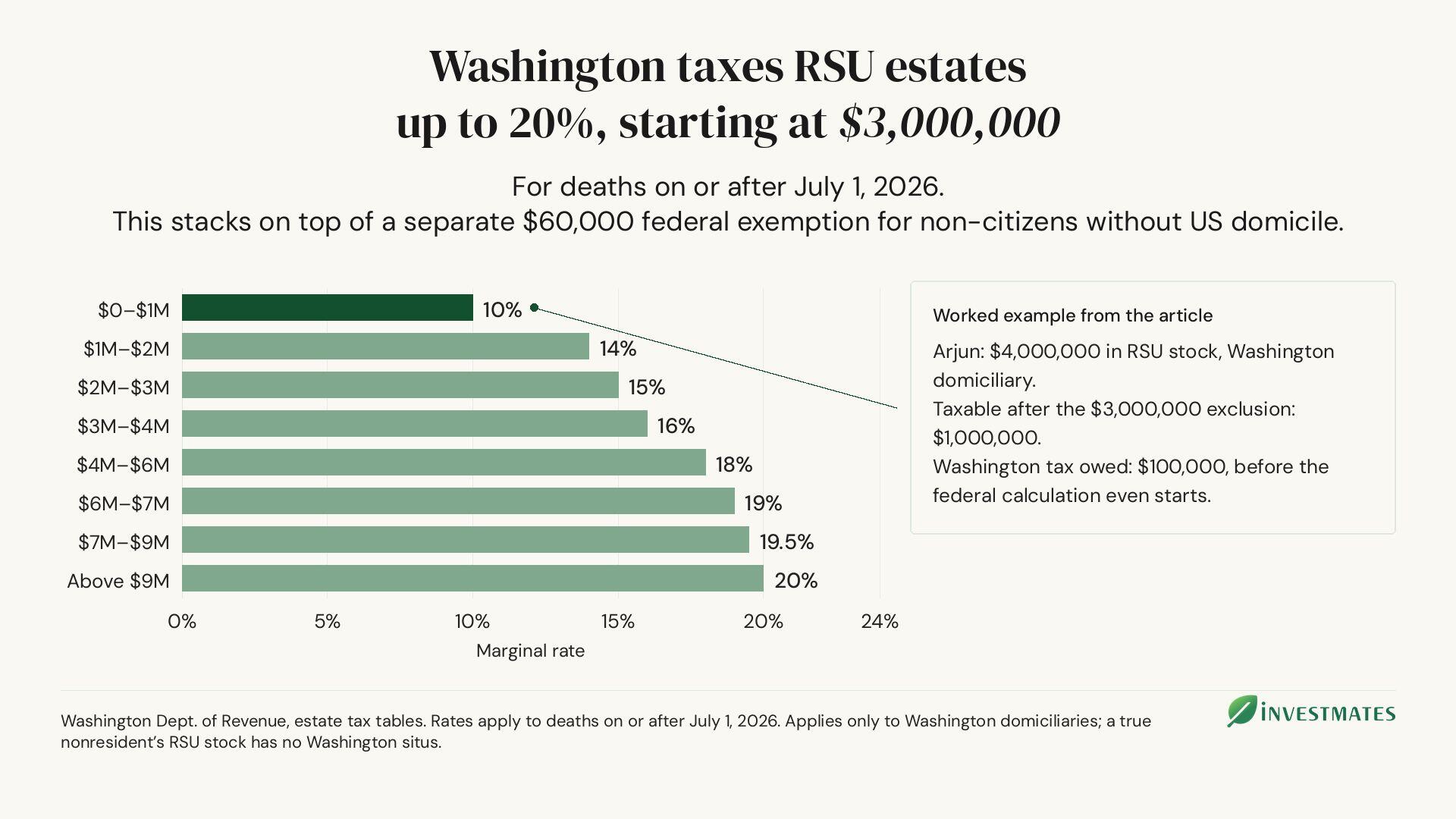
The rate schedule tells a similar story. A one-year "millionaire's tax" pushed the top rate to 35% for deaths between July 1, 2025 and June 30, 2026. That window has closed. For a death on or after July 1, 2026, the schedule reverts to the rates Washington used for over a decade:
| Washington taxable estate | Marginal rate |
|---|---|
| $0 to $1,000,000 | 10% |
| $1,000,000 to $2,000,000 | 14% |
| $2,000,000 to $3,000,000 | 15% |
| $3,000,000 to $4,000,000 | 16% |
| $4,000,000 to $6,000,000 | 18% |
| $6,000,000 to $7,000,000 | 19% |
| $7,000,000 to $9,000,000 | 19.5% |
| Above $9,000,000 | 20% |
Who this actually applies to
This applies to you if you've lived in the Seattle metro area for several years and hold meaningful RSU value concentrated in a current or former tech employer, or if you don't have a clear, evidenced date by which you're leaving Washington for good. It applies whether you're on an H-1B, an L-1, a green card, or already a citizen; immigration status doesn't decide Washington domicile, your actual conduct does.
It does not apply if you're a genuine Washington nonresident: you never lived there, or you left with real, documented finality, selling the house, changing your driver's license, moving your voter registration, and no longer filing as a Washington resident. In that case, your RSU stock sits outside Washington's reach entirely, and only a literal piece of Washington real estate or tangible property still located there would bring you back into scope.
What to do about it
- Establish your actual domicile status honestly, using the same evidence Washington's Department of Revenue and courts look at. That means where your driver's license and voter registration sit, where you file as a resident for other purposes, where your home and family are, and how long you've stayed with no fixed departure date.
- If you plan to leave Washington before you die, build the paper trail before a health scare forces the question, not after. Sell or genuinely vacate the Washington residence, re-register to vote elsewhere, and update your address on every account that asks.
- Keep your federal and state positions consistent. Arguing nonresident alien status to the IRS while your Washington paperwork still shows a driver's license, a home, and years of residency is exactly the kind of inconsistency an estate audit is built to catch.
- Model both exposures together once your RSU value plus other US assets clears roughly $2 million, since that's where the state exclusion, not just the federal one, starts to matter. This decision sits inside your broader estate plan, not apart from it.
- Get a domicile opinion in writing from someone who has actually run this analysis before, rather than relying on the assumption that a work visa settles the question on its own. If you're also weighing your green card status, that decision changes the federal side of this calculus too, and the two should be worked through together.
Common misreadings worth correcting
Belief: my RSUs are only exposed if my employer is headquartered in Washington. Correction: situs follows your domicile, not your employer's address. A Washington domiciliary owes Washington tax on stock from a New York company exactly as much as on Microsoft or Amazon shares, and a genuine nonresident owes nothing on either.
Belief: a valid H-1B or L-1 visa proves I'm not domiciled in Washington or the US. Correction: domicile is a facts-and-circumstances test built on physical presence plus intent to remain indefinitely. It doesn't ask what visa you hold. Years in Seattle with no active, evidenced plan to leave can establish domicile regardless of immigration category.
Belief: Washington's estate tax rate now runs as high as 35%. Correction: that was true only for deaths between July 1, 2025 and June 30, 2026. For deaths on or after July 1, 2026, the top rate is back to 20%.
What to do next
If your RSU value plus other US holdings is within reach of $2 million and you're not certain whether Washington still treats you as a domiciliary, that's the question to answer first. It comes before any decision about selling or holding the stock itself.
I'd rather see a client get a clear domicile opinion a year too early than find out the answer from an estate audit. Book time with an InvestMates advisor to work through the domicile analysis and see exactly where you stand on both the state and federal side.
Frequently asked questions
Does Washington have its own estate tax separate from the federal estate tax?
Yes. Washington imposes a state-level estate tax under RCW 83.100 that applies independently of, and in addition to, the federal estate tax. A Washington domiciliary's estate can owe both taxes on the same RSU stock, calculated separately under separate exclusions and rate schedules.
What is the Washington estate tax exclusion amount in 2026?
For deaths on or after July 1, 2026, the applicable exclusion amount is $3,000,000. The figure moved twice earlier in the year, $3,000,000 from July 2025 and $3,076,000 for the first half of 2026, before settling at a flat $3,000,000 because the statute's cost-of-living adjustment has now expired.
Does Washington have its own estate tax separate from the federal estate tax?
Yes. Washington imposes a state-level estate tax under RCW 83.100 that applies independently of, and in addition to, the federal estate tax. A Washington domiciliary's estate can owe both taxes on the same RSU stock, calculated separately under separate exclusions and rate schedules.
What is the Washington estate tax exclusion amount in 2026?
For deaths on or after July 1, 2026, the applicable exclusion amount is $3,000,000. The figure moved twice earlier in the year, $3,000,000 from July 2025 and $3,076,000 for the first half of 2026, before settling at a flat $3,000,000 because the statute's cost-of-living adjustment has now expired.
Can I avoid Washington estate tax by moving back to India before I die?
Only if the move genuinely severs Washington domicile, which takes more than an intention to leave. Selling or vacating the Washington home, deregistering to vote there, and stopping the Washington-resident filings that show continued ties all matter. A move made only on paper, with the underlying ties still intact, doesn't change the outcome.
If I already owe federal estate tax as a non-citizen, do I also owe Washington's tax on the same RSUs?
Yes, if you're a Washington domiciliary at death. The two taxes are calculated independently under separate law. The same RSU value can appear in both the federal nonresident alien calculation and Washington's state calculation, a stacking effect covered further in non-citizen estate tax planning.