

Yes, an OCI card holder can buy property in India. You can buy homes, plots, shops and offices, as many as you like, without RBI permission. The only thing you can't buy is agricultural land, including plantations and farmhouses.
This guide covers what you can own, how to pay so you can take the sale money back to the US later, and what you need to report on your US tax return.
What an OCI card lets you buy in India
You hold a foreign passport, but for property RBI gives your OCI card the same rights as an NRI, an Indian citizen living abroad. Its Master Direction on immovable property under FEMA sets the rules. Paragraph 3.1.1 lets you buy anything except agricultural land, plantation property or a farmhouse.
No permission and no cap on numbers
You don't apply to RBI before buying a flat, a villa plot in an approved layout, a shop or an office. Nothing in the Master Direction limits how many units you hold. Two flats in Pune and an office in Hyderabad are all fine, provided you pay the right way.
Farmland is the one firm line
The bar on agricultural land covers buying it and receiving it as a gift. It doesn't cover inheritance, so farmland left to you by a parent is yours to keep. When you later dispose of it, the only buyer or recipient you can transfer it to is a person resident in India.

| Property type | Buy | Receive as a gift | Inherit |
|---|---|---|---|
| Residential (flat, house, plot) | Yes | Yes | Yes |
| Commercial (shop, office) | Yes | Yes | Yes |
| Agricultural land, plantation, farmhouse | No | No | Yes |
A gift has to come from a person resident in India, or from an NRI or OCI who is your relative under Section 2(77) of the Companies Act, 2013.
Can OCI buy property in India with US dollars? How you pay decides what comes back
You can't pay with traveller's cheques or foreign currency notes. The price reaches the seller in rupees through Indian banking channels: a wire from abroad, or a debit to your NRE, NRO or FCNR account. All three routes are legal, but they don't treat your money alike when you sell.
The two-property repatriation limit
Paragraph 8.2 lets your bank send sale proceeds abroad when you paid in foreign exchange: a wire from abroad, or NRE or FCNR funds. For residential property, that clean route covers no more than two properties. A home loan repaid from abroad or from NRE counts as foreign exchange too.
Money that came from your NRO account follows a different path. After tax, it goes back under the general facility of up to USD 1 million per financial year from NRO balances, which means more paperwork and a yearly ceiling.
Worked example. Priya, a US citizen with an OCI card, buys a ₹1.2 crore flat in Bengaluru. She wires ₹80 lakh from her US bank and pays ₹40 lakh from NRO savings built up from Indian rent.
Years later she sells. The ₹80 lakh she wired can go back through the foreign exchange route. The ₹40 lakh and the gain go through NRO, inside the USD 1 million yearly limit, once tax is paid.
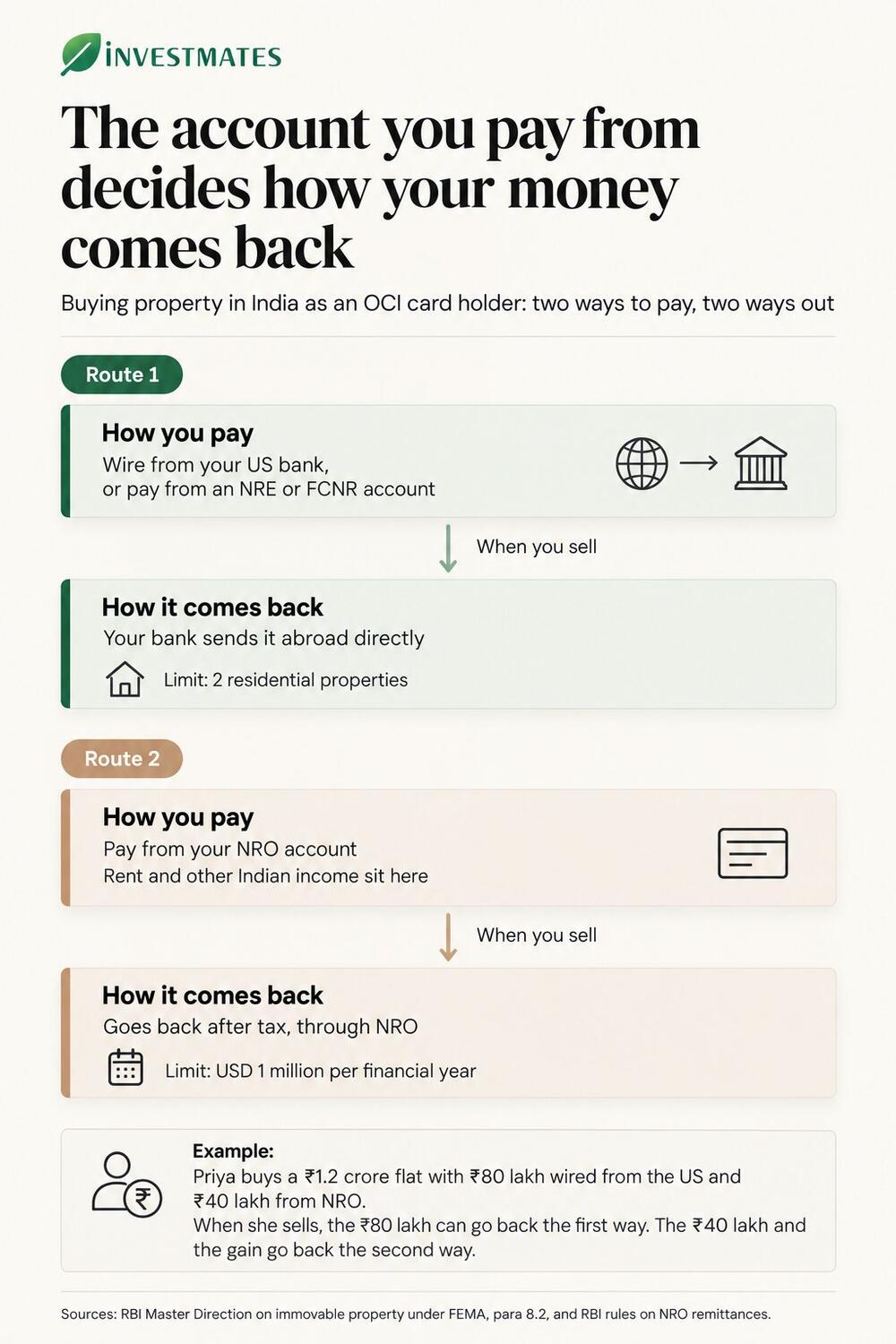
My position is simple: if there's any chance you'll want the money back in the US, fund the purchase with a wire from abroad or from NRE, and keep NRO for Indian expenses. It's the one decision in the deal you can't fix after registration.
Buying from an NRI seller, or with a foreign spouse
When the seller is an NRI
If the seller lives abroad, you deduct tax before paying them. From 1 April 2026 that's Section 393(2) of the Income-tax Act, 2025, which replaced Section 195. Missing it makes you answerable to the tax department, and the TAN rules for property buyers changed in October 2026.
When your spouse isn't an NRI or OCI
A foreign-citizen spouse without OCI status can't buy alone. Paragraph 4 of the Master Direction lets them buy one property jointly with you, on three conditions:
- It isn't agricultural land, a plantation or a farmhouse.
- Your marriage is registered and has lasted at least two continuous years before the purchase.
- Payment follows the same banking-channel rules as above.
Your US side: what goes on the return
If you're a US citizen or green card holder, an Indian flat you own directly doesn't go on your FBAR or Form 8938, since real estate isn't a financial account. The NRO account collecting your rent does count. The FBAR and FATCA thresholds apply to your accounts, not the flat.
Rent is taxable on your US return every year, and so is the gain when you sell, with credit for Indian tax paid. That's ongoing work, so price it into the decision to buy.
Who these rules cover
- OCI card holders, including former PIO card holders, since the PIO scheme merged into OCI in 2015.
- NRIs, who follow the same purchase rules.
- A foreign spouse without OCI, only through the joint route above.
One thing doesn't apply to you. Paragraph 9 bars citizens of Pakistan, Bangladesh, China and eight other listed countries from buying without RBI approval, and paragraph 9.2 says that bar doesn't apply to an OCI. Other OCI card limitations, like voting and most government jobs, sit outside property law.
What to do before you sign
- Confirm the land use. Check that the plot or flat isn't recorded as agricultural land in state revenue records.
- Choose the funding account. Wire from abroad or use NRE or FCNR if you want the clean repatriation route.
- Check the seller's status. If they're an NRI, plan the TDS deduction before the first payment.
- Keep every bank advice. You'll need proof of foreign exchange inflow when you sell, which could be twenty years away.
- Set up the US side. Add the NRO account to your FBAR list and plan for rent on Schedule E.
If you can't travel, a power of attorney lets a relative sign and register for you, though tax filing stays in your name. Selling property in India later works the same way.
Before you shortlist anything, decide which account will pay for it, because that choice sets how the money comes back. I'd settle it before you pay even a booking amount. If you want a second pair of eyes on the funding plan and the US filings, I'm glad to help at InvestMates.
Frequently asked questions
Who can an OCI card holder sell property in India to?
An OCI card holder can sell residential or commercial property in India to a person resident in India, an NRI or another OCI. Agricultural land, a plantation or a farmhouse you inherited can go only to a person resident in India. State rules on inherited agricultural land can add their own conditions to that sale.
Can an OCI card holder give power of attorney to buy property in India?
Yes. An OCI card holder can give a power of attorney to a relative or professional to sign and register the purchase. A PoA signed in the US is usually notarised and apostilled there, then must meet the stamping and registration rules of the state where the property sits.
Can an OCI card holder get a home loan in India?
Yes. Indian banks lend to OCI card holders to buy residential property. EMIs paid from abroad or from an NRE account count as foreign exchange, which keeps the two-property repatriation route open when you sell.
Can an OCI card holder buy property in India from an NRI or another OCI?
Yes. An OCI card holder can buy residential or commercial property from an NRI or another OCI, because paragraph 3.2 of the Master Direction allows that transfer for anything except farmland. Since the seller is a non-resident, you deduct TDS before you pay.