
The main OCI card disadvantages: you can't vote, hold constitutional office, take most government jobs or buy farmland, and some work needs a permit. The farmland rule quietly costs families the most. This list follows Section 7B of the Citizenship Act and the March 2021 MHA notification.
Where OCI card disadvantages come from
You're a foreign citizen. The Overseas Citizen of India (OCI) card is a registration under Section 7A of the Citizenship Act, 1955, not a second citizenship, and Section 7B(2) lists the citizen rights it never gives you.
The rest of the OCI card disadvantages come from the Ministry of Home Affairs notification of 4 March 2021. It lists what you get, such as lifelong multiple entry and parity with NRIs on property and certain professions.
Anything it doesn't list, you're treated like any other foreign national. The benefits of an OCI card are real, but they're a closed list.
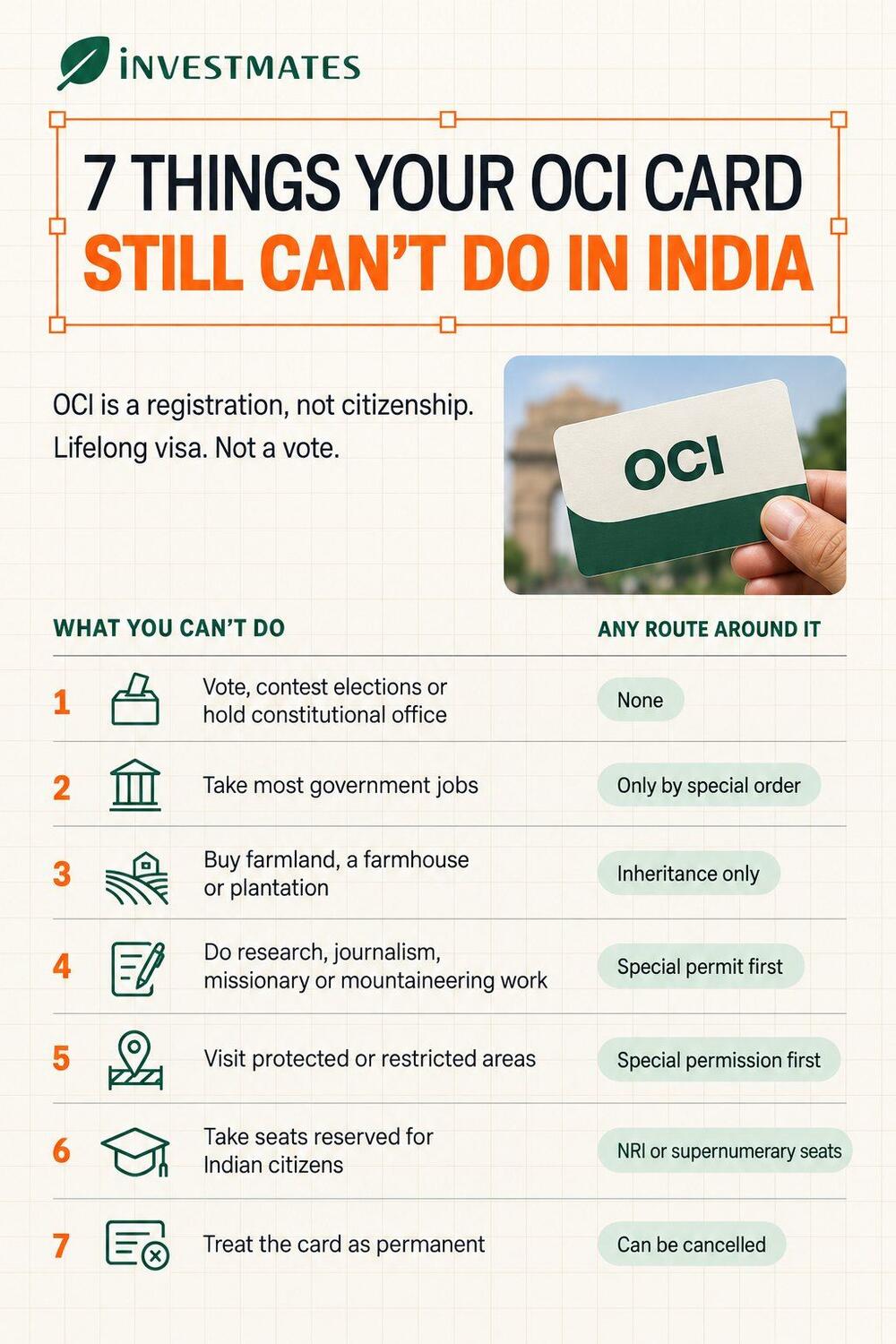
1. You can't vote, contest elections or hold constitutional office
Voting and elections
Section 7B(2) bars you from registering as a voter under the Representation of the People Act, 1950. It also bars you from sitting in the Lok Sabha, the Rajya Sabha, a state Legislative Assembly or a Legislative Council.
An old voter ID from your citizen years doesn't carry over. Once you took another nationality, the right it stood for ended.
Constitutional posts
You can't be elected President or Vice-President. You can't be appointed a judge of the Supreme Court or a High Court either, since the same section shuts all four posts.
Bottom line: OCI gives you no political rights at all, at any level.
2. You can't take most government jobs
Section 7B(2) removes your right to equal opportunity in public employment under Article 16. You also can't be appointed to public services and posts under the Union or any state, unless the Central Government opens a specific post to OCI cardholders by special order.
Private employment is a different story. You can take a private-sector job or run a business without a work visa. The 2021 notification also puts you at par with NRIs if you practise as a doctor, dentist, nurse, pharmacist, lawyer, architect or chartered accountant.
Bottom line: if your plan depends on a central or state government post, check for a special order before you count on it.
3. You can't buy farmland, a farmhouse or plantation property
Under the foreign exchange rules, you can buy homes and commercial property in India but never agricultural land, a farmhouse or plantation property. The same carve-out sits in the 2021 notification and in the RBI's rules on immovable property for NRIs and OCI cardholders.
The rule isn't only about buying, though:
- You can't receive farmland as a gift, even from a parent.
- You can inherit it.
- If you sell inherited farmland, the buyer has to be a person resident in India.
What I'd do: if your parents own farmland and you hold an OCI card, I'd have them leave it to you in a will rather than plan a lifetime transfer. A gift to you isn't permitted; an inheritance is.
The wider rules for NRIs sit in this guide on buying agricultural land.
Bottom line: farmland reaches you only by inheritance, and it leaves you only to a buyer resident in India.
4. You can't do certain work without special permission
Since March 2021, four kinds of activity need a special permit from the Foreigners Regional Registration Office (FRRO) or an Indian mission before you start:
- Research work
- Missionary or tabligh work
- Mountaineering expeditions
- Journalism
Internships or jobs with foreign diplomatic missions or foreign government organisations in India need the same permission.
Take Arjun, a US citizen with an OCI card who freelances for an American newspaper. A family visit to Pune needs nothing, but a reporting trip during that visit needs the permit first. Applying after you've started doesn't fix it.
Bottom line: if your trip has a professional purpose on this list, get the permit before you fly.
5. You can't visit protected or restricted areas without a permit
Any place the Central Government has notified as a protected, restricted or prohibited area needs special permission for OCI cardholders, under the March 2021 notification. That puts you in the same queue as any other foreign national.
Several border and island regions are notified this way, and a family trip can cross into one without you noticing. Processing takes time, so don't leave the application to the last week.
Bottom line: check your itinerary against the protected and restricted lists before you book.
6. You can't take seats reserved for Indian citizens
The 2021 notification lets you sit all-India entrance tests such as NEET and JEE, at par with NRIs. It doesn't let you compete for seats reserved for Indian citizens. You're limited to NRI-quota or supernumerary seats.
Say Meera's daughter is a US citizen with an OCI card and wants to study medicine in India. She can write NEET, but she competes only for NRI-quota seats, which usually carry higher fees than the general seats her cousins compete for.
Bottom line: plan an Indian degree around NRI seats and NRI-level fees, not citizen seats.
7. You can't treat the card as permanent
The Central Government can cancel your registration under Section 7D. The grounds include fraud in the application, disaffection towards the Constitution, and the interests of India's sovereignty, security or the general public.
An MHA notification announced in August 2025 goes further. Your registration can be cancelled if you're sentenced to two years or more in prison, or charge-sheeted for an offence punishable with seven years or more, whether the case is in India or abroad.
The card also isn't dual citizenship. India doesn't allow it, so you can't hold an Indian passport alongside your foreign one.
Bottom line: OCI is a registration the government can withdraw, not a status you own.

| What you can't do | Where the rule sits | Any route around it |
|---|---|---|
| Vote or contest elections | Citizenship Act s.7B(2); RP Acts 1950 and 1951 | None |
| Hold a constitutional post | s.7B(2), Articles 58, 66, 124, 217 | None |
| Take most government jobs | s.7B(2), Article 16 | Only posts opened by special order |
| Buy farmland, a farmhouse or plantation | Foreign exchange rules; 2021 notification | Inheritance only |
| Research, journalism, missionary or mountaineering work | 2021 notification | Special permit first |
| Visit protected or restricted areas | 2021 notification | Area permit first |
| Take citizen-reserved seats | 2021 notification | NRI or supernumerary seats |
What the OCI card doesn't decide: your tax status
The card says nothing about whether you're taxed in India as a resident or a non-resident. That depends on your days in India under Section 6 of the Income-tax Act, which holds the residence tests in both the 1961 and 2025 Acts.
The same test applies to everyone, so an OCI cardholder can be a resident taxpayer and an Indian citizen abroad can be an NRI.
If you're weighing the two labels, this NRI and OCI comparison sets them side by side. For the day count itself, start with how residential status works.
What to do next
Before your next property decision or work trip, check whether family farmland might come to you, and whether your plans touch research, reporting or a restricted area. If farmland is in the picture, I'd get the will drafted now, before anyone attempts a gift. That's a planning conversation I'm glad to help with at InvestMates.
Frequently asked questions
Can an OCI card holder become Indian citizen?
Yes, an adult OCI cardholder can apply for Indian citizenship by registration under Section 5(1)(g) of the Citizenship Act after five years as an OCI and twelve months of ordinary residence in India before applying. Because India doesn't allow dual citizenship, you'd have to give up your foreign nationality.
Can I travel to India without my OCI card?
No, not on OCI status: the MHA treats your passport as the travel document and the OCI as your lifelong visa, so carry the OCI card with the passport. If your card shows an old passport, check the OCI reissue rules before you fly, or travel on a regular visa.
Can an OCI card holder inherit agricultural land in India?
Yes, an OCI cardholder can inherit agricultural land, a farmhouse or plantation property in India, even though buying or receiving one as a gift isn't allowed. If you later sell it, the buyer must be a person resident in India. A large inheritance can also trigger Form 3520 reporting if you're a US taxpayer.
Do OCI card holders need permission to work as journalists in India?
Yes, OCI cardholders need a special permit from the FRRO or an Indian mission before doing journalism in India, under the March 2021 MHA notification. The same applies to research, missionary or tabligh work and mountaineering.