
No, an OCI card does not change your US tax status. It's an Indian immigration status, not citizenship, so US citizens and green card holders still report worldwide income to the IRS. The costly mistake is assuming "citizen" in its name shields your Indian accounts, and India runs a separate day count.
Why your OCI card leaves your US tax status alone
You hold a US passport, and the card in your wallet lets you live and work in India without a visa. That Overseas Citizen of India (OCI) card is a registration under Section 7A of India's Citizenship Act, 1955, not citizenship.
It gives you a lifelong visa and general parity with NRIs on economic and financial matters, except buying farmland. It doesn't make you an Indian citizen, because India does not allow dual citizenship.
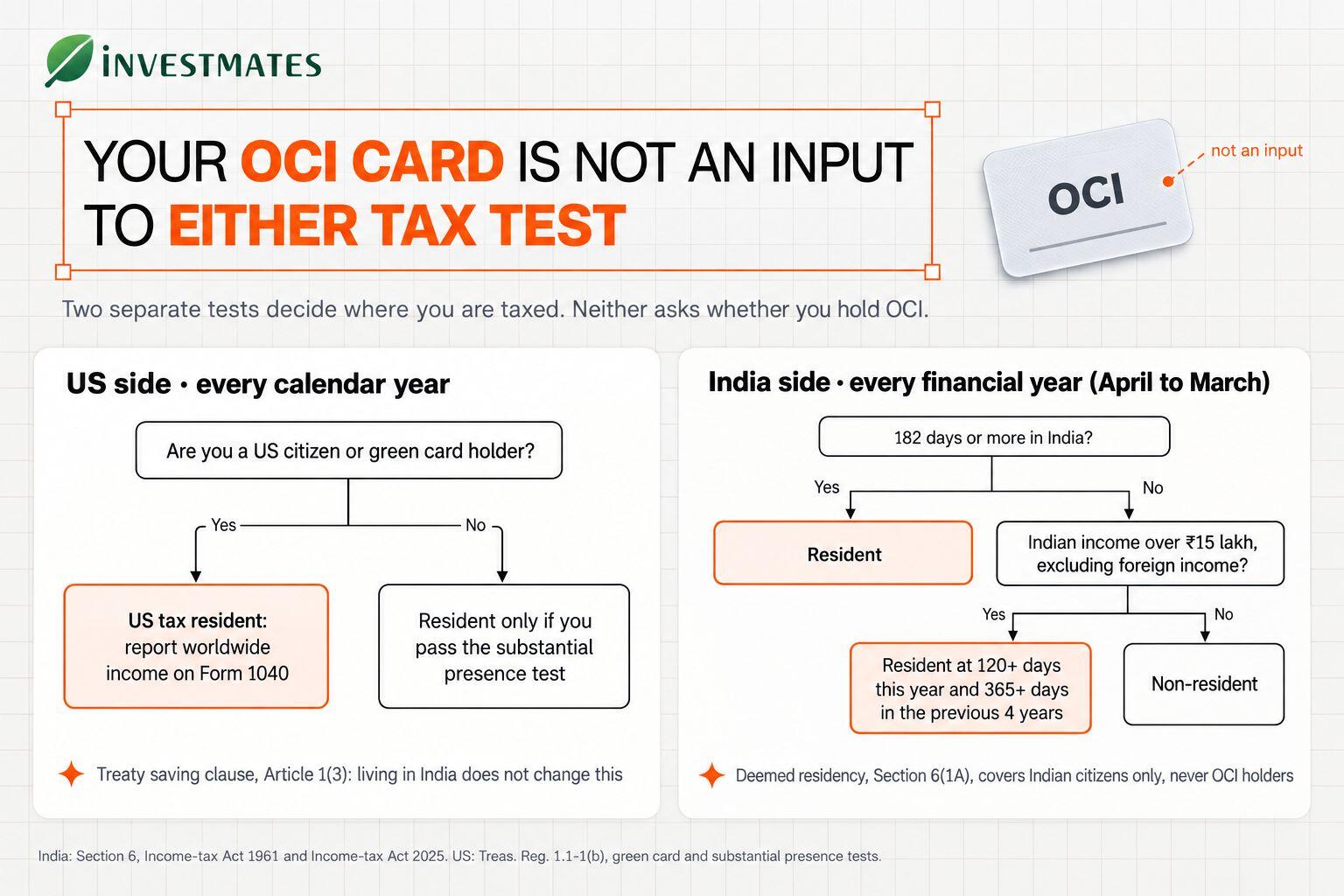
The US decides who it taxes with three questions, and none of them asks about OCI:
- US citizens are taxed on worldwide income wherever they live, under Treasury Regulation 1.1-1(b).
- Green card holders are resident aliens under the green card test until the card is formally abandoned with Form I-407.
- Everyone else is resident only if they pass the substantial presence test, which counts days physically spent in the US.
So a US citizen who adds an OCI card files the same Form 1040 the next April, with the same worldwide income on it. The IRS rules for US citizens living abroad apply whether or not you hold OCI.
If you're also resident in India in some years, that overlap is a dual tax residency question, and OCI doesn't settle it.
The US-India tax treaty won't help either. Its saving clause, Article 1(3), lets the US tax its citizens and residents as if the treaty didn't exist. Your relief for Indian tax paid is a foreign tax credit, not an exemption.
What getting this wrong costs you
The belief I'd correct first comes from the word "citizen" on the card. On InvestMates discovery calls, I've heard a US citizen say their Indian mutual funds were fine because they held OCI, on an Indian advisor's word.
Reporting gaps are the more common problem. In the tax discovery calls I reviewed, missed FBAR and FATCA reporting on Indian fixed deposits, NRE and NRO accounts and PPF came up in about half of them.
The card changes nothing about which US forms you file:
- FBAR (FinCEN Form 114), once your foreign accounts together exceed $10,000 at any point in the year. It's due April 15, with an automatic extension to October 15.
- Form 8938 under FATCA, which has its own, higher thresholds.
- Form 8621 for each Indian mutual fund, because those funds are still PFICs for US tax.
The FBAR threshold and filing steps work the same for you as for any other US person.

How India decides whether it taxes you
India ignores your OCI card when it sets your tax residency. It counts the days you're physically in India during each financial year, April 1 to March 31, under Section 6 of the Income-tax Act, 1961. The Income-tax Act, 2025 keeps the same tests from April 1, 2026.
You're resident in India for a year if either test is met:
- You spend 182 days or more in India that year.
- You spend 60 days or more that year and 365 days or more across the previous four years.
For a person of Indian origin visiting India, which covers most OCI holders, the 60 days in the second test becomes 182. It drops to 120 days if your Indian income, excluding foreign income, exceeds ₹15 lakh.
The deemed residency rule in Section 6(1A) applies only to citizens of India, so it can't make an OCI holder resident. If you move to India for good, the same day count decides when you become resident, and you get the same RNOR window as anyone else.
A worked example
Priya is a US citizen with an OCI card who spends 150 days a year with her parents in Pune. Her only Indian income is ₹4 lakh of interest on an NRO deposit. She stays under 182 days, so India treats her as a non-resident and taxes only that interest.
If Priya's Indian income rose above ₹15 lakh, those same 150 days would cross the 120-day line. Either way, the US taxes all of her income, including the NRO interest.
Do OCI holders pay more tax in India than NRIs? Mostly not, and NRI and OCI tax rules set the two side by side.
How to check your own position
Run these checks once a year, before you file in either country:
- Confirm your US status. Citizen or green card holder means Form 1040 on worldwide income.
- Count your days in India for the financial year, arrival and departure days included.
- Add up your Indian income, excluding foreign income, against the ₹15 lakh line.
- Note the highest balance of every Indian account during the calendar year for FBAR.
- List every Indian mutual fund, ULIP or other pooled fund for Form 8621.
What to do next
Before your next India trip, I'd pull the peak balance of every Indian account you held last year and check it against the $10,000 FBAR line. That single check catches the gap I see most often. If you split time or income between both countries, InvestMates can review your US and Indian filings together.
Frequently asked questions
Does OCI affect US citizenship?
No, OCI does not affect US citizenship. OCI is a registration under Indian law, not a second nationality, so you remain a US citizen with the same filing duties. Giving up US citizenship is a separate, formal process with its own exit tax rules.
Can a US citizen with an OCI card use the US-India tax treaty to stop paying US tax?
No, a US citizen with an OCI card can't use the US-India tax treaty to escape US tax. The saving clause in Article 1(3) keeps the US right to tax its citizens, even if the treaty's tie-breaker points to India. You claim a foreign tax credit for Indian tax instead, on Form 1116.
Does India's Section 6(1A) deemed residency rule apply to OCI card holders?
No, Section 6(1A) does not apply to OCI card holders. It covers only citizens of India with Indian income above ₹15 lakh who aren't liable to tax in any other country. Your residential status in India still follows the day count.
Does an OCI card change the US tax status of a green card holder?
No, an OCI card doesn't change a green card holder's US tax status. A green card holder is a US tax resident under the green card test until the card is formally abandoned, whatever other documents they hold.