
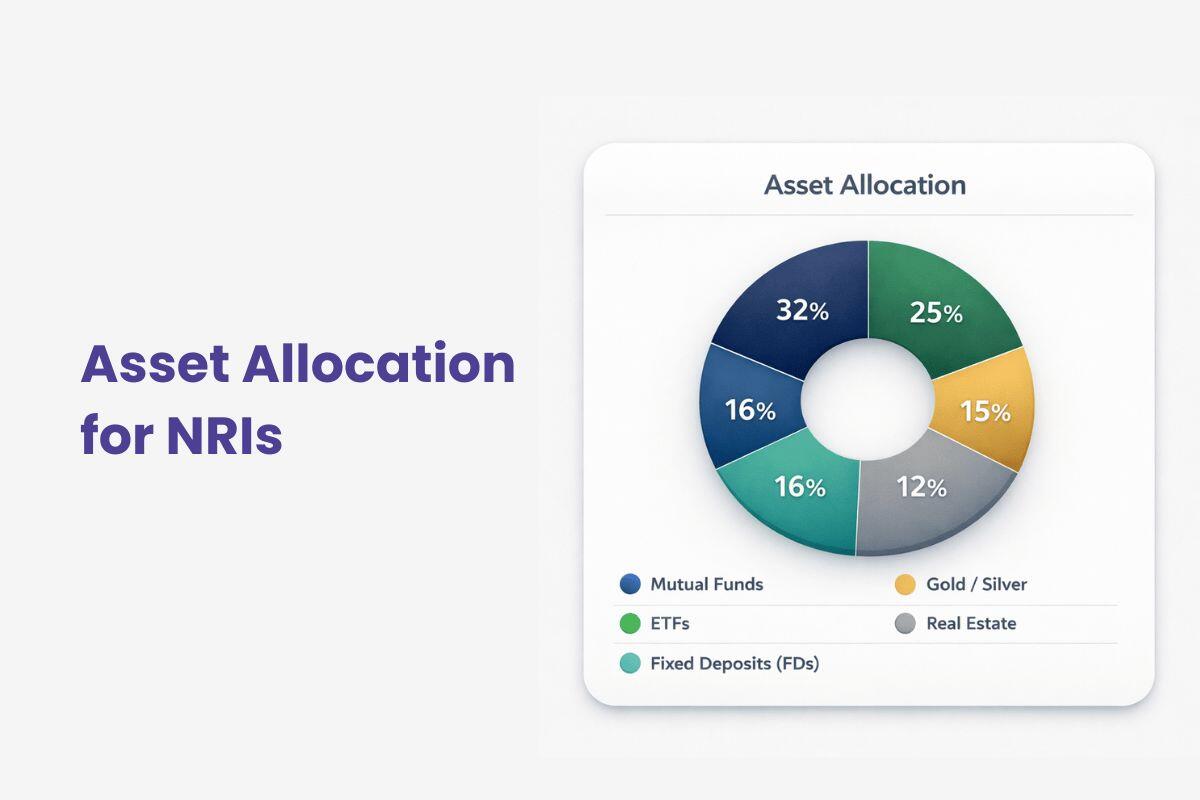
Asset allocation for NRIs is more complex than choosing good stocks or funds. Asset allocation, not stock selection, drives long-term outcomes. Diversified NRIs lost just 5 to 8% during the 2013 rupee crisis while portfolios concentrated in INR dropped 15 to 20%. That difference matters when you're building wealth across borders.
The challenge? You earn in one currency, have goals in multiple countries, and face tax rules in different jurisdictions. Getting your asset allocation right means balancing India exposure with global diversification based on where your future expenses are.
This piece walks you through building an NRI portfolio that protects your wealth and lines up with your goals.
Understanding Asset Allocation for NRIs
What is Asset Allocation
Asset allocation is how you split your portfolio among different asset classes like equities, debt, gold and cash. You decide what percentage goes into stocks, bonds, real estate or other investments. This decision shapes your investment experience more than picking individual securities.
Research shows that 88% of your portfolio's volatility and returns come from your asset allocation choices. How you split your money across asset classes matters nowhere near as much as your specific stock picks. Different categories respond to economic changes in different ways. Some investments may deliver satisfactory returns while others underperform.
Why Asset Allocation Matters for NRIs
Asset allocation for NRIs isn't about copying formulas from resident Indians. You manage wealth across two economies with different growth cycles, tax structures and currencies.
Your situation is different in four critical ways. Currency concentration creates hidden risks. A fund showing 15% returns in INR might deliver just 5% after you account for rupee depreciation. Tax complications multiply when you deal with TDS regulations, capital gains rules and potential double taxation across jurisdictions. Repatriation rules add layers of complexity when you move money across borders. Distance makes oversight harder than hands-on management.
International lives change the rules. An investment working well in one country can behave different once residency changes, tax treatment moves or currency becomes relevant. Most investments lack portability as a feature. You have to design it.
Common Asset Allocation Mistakes NRIs Make
NRIs make five costly errors:
- Real estate over-concentration: Properties deliver just 2-3% rental yields while diversified mutual funds return 10-12%. You buy property because "everyone is doing it" and ignore liquidity constraints and management challenges.
- Excessive fixed deposit allocation: You park 70-80% in FDs at 6-7% returns that beat inflation. Real returns sit at 3-4%. You keep pace with rising prices, not build wealth.
- Following generic advice: NRI investing needs specialized strategies. Relationship managers often favor high-commission products over suitable ones.
- Ignoring portfolio reviews: You set up SIPs and forget them for years. No rebalancing happens, no adjustments for life changes occur and misalignment with actual goals grows.
- Currency concentration blindness: You keep everything in one currency and postpone risk awareness rather than eliminate it. International investing needs currency diversification that lines up with where you'll spend the money.
India vs Global Asset Allocation: Finding the Right Balance
Factors That Determine Your India-Global Split
Your India-global split depends on four interconnected factors rather than a universal formula. Where you plan to live shapes your baseline allocation, since physical location influences both earnings and expenses. The currency of your important life goals determines whether returns need translation or can stay put. Your current global exposure through employment benefits, property holdings, or existing investments affects how much additional diversification you need. Risk appetite rounds out the picture, since higher India allocation brings growth potential with corresponding volatility.
Where Your Future Goals Are Located
Goals anchored in India just need different asset positioning than those abroad. When you support parents, fund children's education in India, or plan retirement in your home country, higher INR asset concentration makes sense. If your future life, expenses and retirement remain overseas, global allocation should dominate your portfolio. This approach prevents the mistake of concentrating everything in one country while your financial responsibilities span different borders.
A straightforward framework matches assets to goal locations. Children's US education pairs with US-based ETFs and mutual funds. Indian retirement fits Indian mutual funds and PMSs. Short-term expenses in your residence country need local bank deposits.
Currency Exposure and Risk Management
Currency movements reshape returns without you noticing. An NRI earning in USD but investing in INR alone faces rupee depreciation risk. INR weakens 3-4% each year, which compounds over time. Even strong 15% INR returns translate to around 11% after currency adjustment. When you match assets with liabilities in the same currency, you get natural hedging without complex derivatives.
How Much to Allocate to India vs Global Markets
Balanced portfolios allocate 50-60% to Indian assets and 20-30% to international equities, with the remainder in fixed income and gold. This mix accounts for currency risks, valuation differences and structural growth drivers in different markets. If most goals center on India, higher domestic allocation works. For goals mostly abroad, global exposure should increase. A roughly even India-global split serves those wanting balanced risk exposure in different regions.

Core Asset Classes in an NRI Portfolio
Equity Investments for Growth
Equity forms your growth engine. Mutual funds pool money invested in stocks by professional managers and deliver 11-12% average returns over 10+ years. For NRIs, equity investment adds geographical diversification to international holdings while tapping into India's ever-changing economy.
You can access Indian equities through mutual funds, direct stocks via a PIS account, or index funds that track measures like Nifty 50. Equity investments carry higher risk but offer inflation-beating returns over time. Dividend income and capital appreciation provide dual income opportunities.
Debt Instruments for Stability
Debt mutual funds invest in bonds and government securities. They generate 6-8% returns with lower volatility than equity. These funds offer better liquidity than fixed deposits and let you exit whenever needed. Corporate bonds and government securities provide fixed income options to conservative investors.
Liquid funds suit NRIs well and offer 7-8% returns compared to 3-4% in savings accounts. Redemptions process within one business day, which makes them ideal emergency fund vehicles.
Real Estate Allocation
NRIs can purchase residential and commercial properties in India without RBI approval, though agricultural land remains restricted. Real estate provides rental income potential and capital appreciation. NRI share in primary sales rose from 10% in 2019 to nearly 20% in 2025. Rental income faces 30% TDS, while long-term capital gains are taxed at 12.5% without indexation - or 20% with indexation if the property was acquired before July 23, 2024, whichever works out lower.
Gold as a Portfolio Hedge
Gold serves as an inflation hedge and portfolio diversifier with recommended allocation of 5-10%. Digital Gold and Gold ETFs offer available alternatives since Sovereign Gold Bonds discontinued for NRIs in Union Budget 2025. Gold's low correlation with stocks provides stability during market volatility.
Cash and Liquid Assets
Liquid funds maintain your emergency reserves while earning much more than savings accounts. With maturity periods up to 91 days, these low-risk instruments allow instant withdrawals up to ₹50,000 daily. NRIs can invest through NRE or NRO accounts subject to FEMA guidelines.
Building Your NRI Asset Allocation Strategy
Define Your Financial Goals and Timeline
Identify specific objectives with clear timelines rather than vague aspirations. Short-term goals within 1-3 years include emergency funds or vacations. Medium-term goals spanning 3-10 years cover house down payments or education funding. Long-term objectives beyond 10 years focus on retirement planning. Your time horizon dictates risk tolerance. Longer periods allow more equity exposure while shorter timelines demand stability through bonds or cash.
Choose Investment Options Based on Location
Investments should match where expenses occur. US-based education goals pair with dollar-denominated ETFs, and Indian retirement suits rupee mutual funds and PMS. NRE accounts work for foreign earnings converted to rupees with full repatriation. NRO accounts handle India-sourced income with partial repatriation limits.
Tax-Efficient Structuring for NRIs
NRE fixed deposit interest remains tax-free in India. ELSS mutual funds qualify for Section 80C deductions up to ₹1.5 lakh each year - but only under the old tax regime; the new regime, now the default, doesn't allow this deduction.
Rebalancing within tax-advantaged accounts avoids capital gains triggers.
Monitor and Rebalance Your Portfolio
Allocations need review at least once a year. Rebalance assets that drift 5 percentage points from targets. Annual rebalancing is optimal. It avoids excessive transaction costs from frequent adjustments while preventing dangerous drift from infrequent reviews.
Working with Financial Advisors
SEBI-registered advisors who specialize in NRI portfolios understand cross-border taxation, FEMA regulations and repatriation rules. Advisors help structure tax-efficient strategies and ensure regulatory compliance across jurisdictions.
Conclusion
Smart asset allocation protects your wealth in different borders and currencies. Your success depends on matching investments to goal locations and balancing India-global exposure based on where you'll spend. Rebalance your portfolio often.
Work with SEBI-registered advisors who understand cross-border taxation and FEMA regulations. You'll build a portfolio that grows wealth while managing currency and tax risks when you arrange your asset mix with your international life and review it annually.
Frequently asked questions
What percentage of my portfolio should I allocate to Indian vs global assets as an NRI?
A balanced approach typically involves allocating 50-60% to Indian assets, 20-30% to international equities, with the remainder in fixed income and gold. However, your specific allocation should depend on where your future goals are located—if most expenses will be in India, increase domestic allocation; if abroad, prioritize global exposure.
Why do NRIs need a different asset allocation strategy compared to resident Indians?
NRIs face unique challenges including currency concentration risks, complex tax regulations across multiple jurisdictions, repatriation rules when moving money across borders, and the difficulty of managing investments from a distance. These factors require specialized strategies rather than simply copying investment approaches designed for resident Indians.
How does currency depreciation affect my investment returns as an NRI?
Currency movements can significantly impact your actual returns. For example, if you earn in USD but invest solely in INR, and the rupee depreciates 3-4% annually (typical historical trend), a 15% return in INR terms translates to approximately 11% after currency adjustment. Matching your investments to the currency of your future expenses provides natural protection.
What are the most common mistakes NRIs make with asset allocation?
The five major mistakes include: over-concentrating in real estate (which delivers only 2-3% rental yields), parking too much in fixed deposits at 6-7% returns that barely beat inflation, following generic advice not tailored to NRI situations, neglecting regular portfolio reviews and rebalancing, and ignoring currency concentration risks.
How often should I review and rebalance my NRI portfolio?
You should review your portfolio at least annually and rebalance when any asset class drifts 5 percentage points from your target allocation. Annual rebalancing strikes the right balance - it avoids excessive transaction costs from too-frequent adjustments while preventing dangerous portfolio drift that comes from infrequent reviews.