

FCNR(B) deposits drew a lot of attention this summer. RBI introduced a special swap facility covering fresh FCNR(B) deposits on 8 June 2026, and the FCNR(B) part of that scheme was open only until 31 August 2026, so RBI's FCNR(B) swap window is now closed to new deposits. If you are weighing an FCNR(B) deposit today, check each bank's current rate rather than the rates quoted while the window was open. The pitch still sounds simple: dollar deposits, no currency risk on the principal, tax free interest. That last part is true in India. It is not true once you file a US return, and the gap between the two can be a lot bigger than the headline rate suggests.
Is FCNR interest taxable in the US? Yes, in full, as ordinary income, every year the interest is credited. India's exemption, which applies while you are a non-resident or a resident but not ordinarily resident, has no effect on your US tax bill.
I will walk you through what actually determines your real return: your marginal federal bracket, whether you cross into Net Investment Income Tax territory, what your state does, and what happens to the rate once currency and tax both take a turn at it. By the end you will know what you are actually earning, not just the rate on the ad.
Why India's tax break doesn't travel with you
Section 10(15)(iv)(fa) of India's Income-tax Act, 1961 exempts interest on an FCNR(B) deposit from Indian tax while you are a non-resident or a resident but not ordinarily resident. The Income-tax Act, 2025, which replaced the 1961 Act from 1 April 2026, carries the same exemption in Schedule IV (serial 14) read with section 11, so banks do not deduct TDS on it. That is a real benefit if you are only thinking about your India side. Compare it to an NRO fixed deposit, where the bank deducts TDS at 30% plus surcharge and cess, or at the lower US-India treaty rate where that applies, before you see a rupee.
The US does not care what India exempts. If you are a US person, meaning a citizen, a green card holder, or a resident alien who meets the Substantial Presence Test, the IRS taxes your worldwide income. Your FCNR(B) interest counts, in full, the same year it is credited to your account, regardless of whether India ever touched it.
This is where a lot of the confusion starts. The marketing around FCNR(B) is written for an Indian audience, where tax free really does mean tax free. Nobody adjusts that pitch for a reader who also files a 1040.
If you are still getting familiar with how an FCNR(B) account works day to day, InvestMates has a separate guide covering FCNR account eligibility and documents that I will not repeat here.
Why the interest costs more than it looks
Most other investments give you a shot at a lower tax rate if you hold them long enough. Sell a stock or a fund after more than a year and the gain typically qualifies for the long-term capital gains rate, 0%, 15%, or 20% depending on your income, well below what you pay on your paycheck.
FCNR(B) interest never gets that treatment, no matter how long you hold the deposit. It is interest, not a capital gain, so it is taxed at your full ordinary income rate every single year.
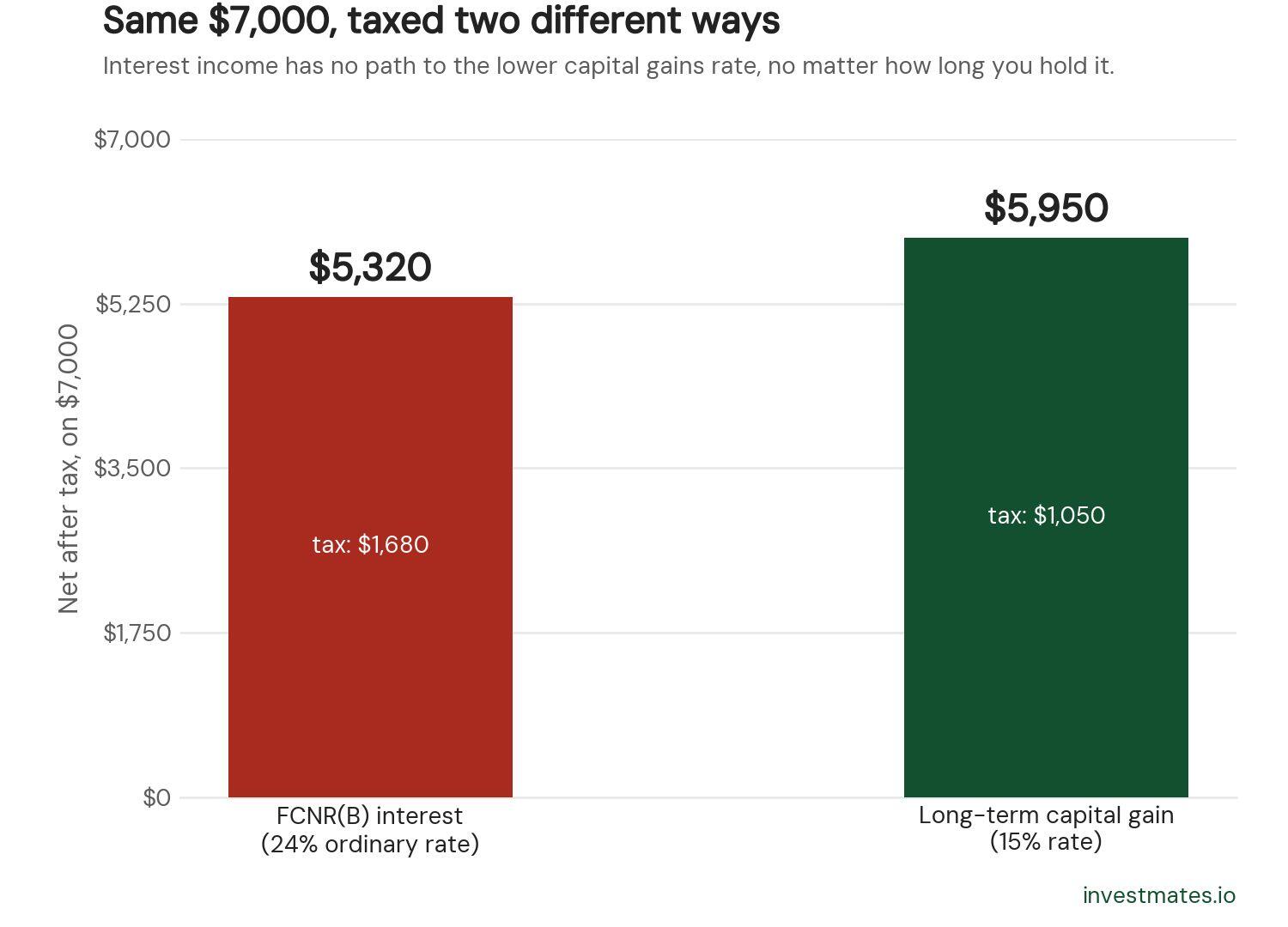
Neha is in the 24% federal bracket. If she had put the same money into a taxable brokerage account and held it more than a year, a gain would likely land in the 15% long-term capital gains bracket that covers most middle and upper income earners.
On FCNR(B) interest, she pays 24%, not 15%, purely because of how the income is classified. That is a 9 percentage point gap before NIIT, state tax, or the missing foreign tax credit even enter the picture.
Leveraged FCNR(B) offers are a different product
You may also have seen much higher return figures attached to FCNR(B) coverage this year. Some of those describe leveraged structures, where a bank lends against your FCNR(B) deposit, rather than the deposit's own interest rate.
A leveraged structure carries its own borrowing cost and repayment risk. It is a completely different decision from simply holding an FCNR(B) deposit, and nothing here applies to it.
Keep the two separate when you compare what you read online. Conflating them is an easy way to think your plain deposit is earning far more than it actually is.
How and when the IRS taxes FCNR(B) interest
Under RBI's rules, FCNR(B) interest is calculated on a 360 day year and paid at intervals of 180 days, or, if you choose, compounded and paid at maturity. Choosing the compounding option does not push your US tax out to maturity. Interest you are entitled to receive counts as income when it is credited, and interest deferred for more than a year generally falls under the IRS original issue discount rules, which tax it as it accrues each year rather than when you withdraw it or the deposit matures.
You report it on Schedule B of Form 1040. If your deposit is in a currency other than US dollars, such as pounds or euros, translate the interest into dollars at the exchange rate prevailing when you receive or accrue it, since the IRS requires every amount on your return in US dollars. Arjun, a software engineer in Texas, opens a five year FCNR(B) deposit.
Even though he will not touch a rupee, or a dollar, of that money until year five, he has to report a slice of interest income on his US return every single year of the term, based on the interest that accrues on his deposit each year.
That timing detail catches people off guard more than the tax rate itself does. You cannot defer the US tax bill just because you chose a longer term deposit.
The full mechanics of converting the interest, plus your FBAR and Form 8938 obligations on the underlying account, are covered in InvestMates' guide on FD taxation in the US. I am focusing here on what that interest actually costs you after tax, not the reporting paperwork.
The real problem, there's no foreign tax credit to lean on
When India taxes your income and the US also taxes it, Form 1116 usually lets you claim a foreign tax credit for the Indian tax you legally owe on that income, dollar for dollar, up to a limit. That is how double taxation gets avoided on most cross border income, and it is the mechanism most NRIs assume protects them here too.
FCNR(B) breaks that pattern. Because India charges zero tax and zero TDS on the interest, there is nothing to credit.
Meera holds an NRO fixed deposit earning $7,000 in interest, and India deducts TDS before she receives anything. The US-India treaty caps India's tax on this kind of interest at 15%, and she can generally claim the Indian tax she legally owes, up to that treaty rate, as a foreign tax credit against her US tax on the same income. Anything withheld above the treaty rate has to be reclaimed from India, not credited.
Priya holds an FCNR(B) deposit instead, earning the same $7,000. India took nothing from her, so she has nothing to credit, and the full US tax bill lands on her with no offset at all. The account that looks tax free is, for a US filer, the one with no cushion whatsoever.

What your bracket actually costs you
The 2026 federal brackets run from 10% up to 37%, with the top rate starting at $640,600 of taxable income for single filers and $768,700 for married filing jointly.
Your marginal bracket is the rate on your last dollar earned, not an average across all your income. Since FCNR(B) interest stacks on top of whatever else you earn, it typically gets taxed at that marginal rate rather than some blended figure.
Here is what a $100,000 FCNR(B) deposit at an illustrative 7% rate actually nets after one year, assuming the $7,000 in interest lands entirely inside a single bracket.
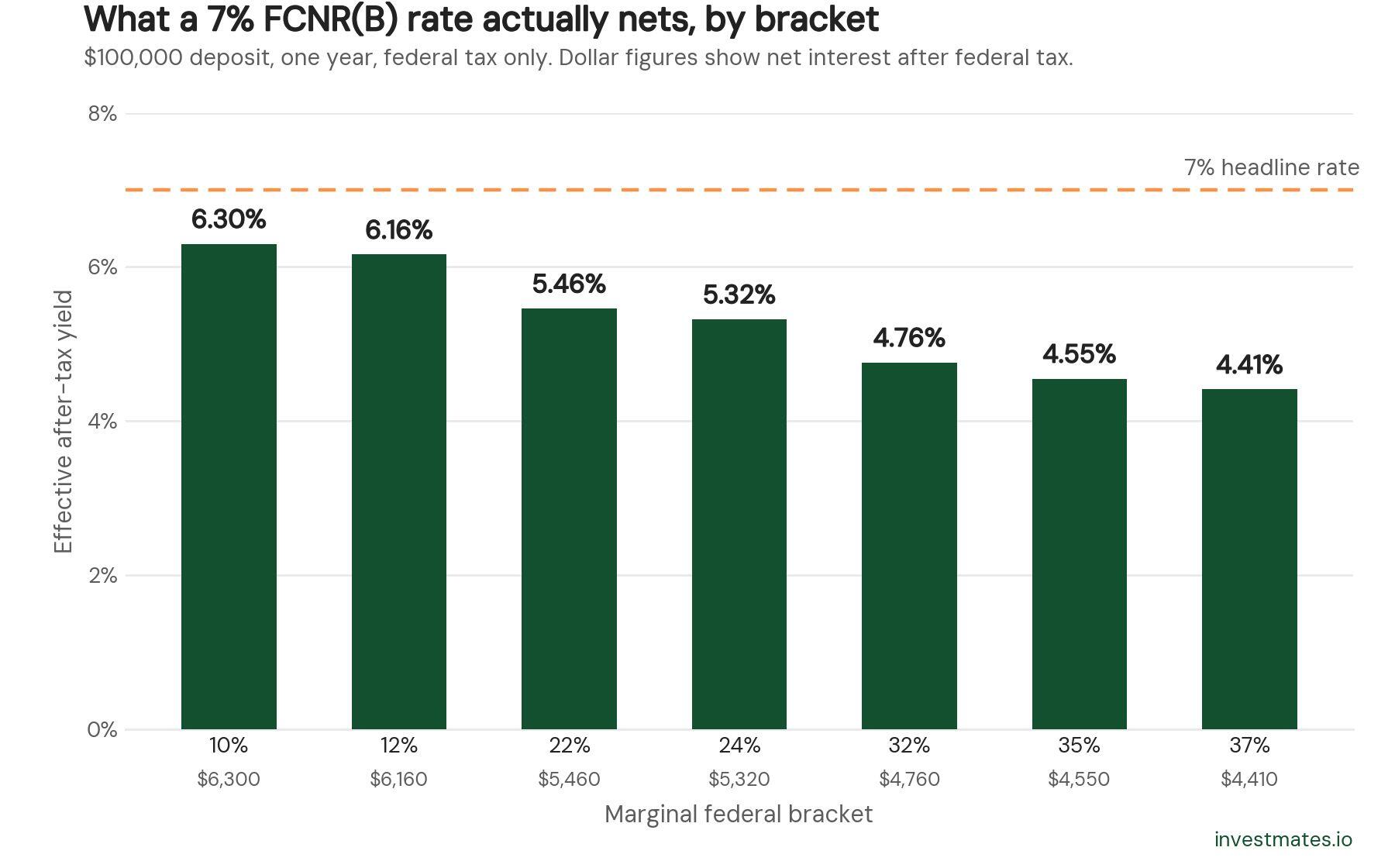
$100,000 FCNR(B) deposit, one year, federal tax only. Net interest shown under each bar.
A real return is rarely one clean bracket the whole way through, since brackets are progressive and only the income above each threshold gets taxed at the next rate up.
The chart above simplifies that by treating the FCNR(B) interest as the last dollars you earn for the year, stacked entirely on top of your other income. That is the realistic case for most salaried NRIs, whose interest income is a small slice of a larger W-2 income.
If your total MAGI sits above $200,000 as a single filer or $250,000 married filing jointly, which is common once you are in the 32% bracket or higher, add roughly 3.8% more on top of these numbers. That is the Net Investment Income Tax, and the next section covers why you usually cannot avoid it.
Your bracket doesn't stop at federal tax
The Net Investment Income Tax, or NIIT, adds a 3.8% surtax on the lesser of your net investment income or the amount your MAGI exceeds the threshold. Interest income, including FCNR(B) interest, counts as net investment income under IRC Section 1411.
You might expect a foreign tax credit to soften this too. It cannot. The IRS states in its questions and answers on the Net Investment Income Tax that foreign income tax credits are allowed only against regular income tax under chapter 1 of the Internal Revenue Code, and so may not be used to reduce NIIT.
In August 2026 the US Court of Appeals for the Federal Circuit reached the same answer under the US-France treaty in Christensen v. United States, reversing the Court of Federal Claims, and applied the same reasoning to the US-Canada treaty in the companion case, United States v. Bruyea. With FCNR(B) the question is moot anyway, because India charges no tax on the interest, so there is nothing to credit.
Run the numbers for someone in the 35% bracket who is also over the NIIT threshold. Their combined federal rate on that FCNR(B) interest is 38.8%, not 35%.
On the same $7,000 in interest, that is $2,716 in federal tax, leaving $4,284 net, an effective yield of 4.28% against a 7% headline rate. That is more than a third of the advertised return gone before you even get to your state return.
Your state can add another layer
Your state return can add another layer on top of all of this. The US-India tax treaty covers only federal income taxes, not state taxes, so it does nothing to limit how your state treats this interest.
If you live in a state with an income tax, check how it treats foreign bank interest before you settle on an after-tax yield. The exact impact depends on your state and your total income, so treat this as a reason to check, not a final number. Confirm your own state's treatment with a preparer who has actually filed cross border returns rather than assuming your state follows federal treatment by default.
What FCNR(B) doesn't protect you from
FCNR(B) protects your principal from rupee moves while the deposit sits in the bank, since you hold it in the original foreign currency, not rupees. That protection ends the moment you convert the proceeds.
If you eventually move the money to India and convert it to rupees, whatever the dollar to rupee rate is on that day becomes part of your real return, not the rate on the day you opened the account. A weaker rupee at withdrawal works in your favor. A stronger rupee works against you.
This cuts both ways, so it is not a guaranteed loss the way the tax treatment is. It is a real unknown if your plan includes spending this money in India, and it is worth weighing on its own, separate from everything above.
Where this leaves FCNR(B) next to your other options
None of this makes FCNR(B) a bad choice. It still offers a real dollar denominated rate with no currency conversion risk on the principal while it sits in the account, which NRE and NRO options do not match in the same way, since NRE deposits sit in rupees and carry that conversion risk instead.
If you are still deciding between NRE, NRO, and FCNR(B) as account types, InvestMates has a full guide comparing NRE, NRO, and FCNR that walks through the tradeoffs beyond tax.
FCNR(B) also is not a PFIC, unlike most Indian mutual funds, so it will not saddle you with Form 8621 filings the way a fund investment can. If PFIC exposure is part of what is steering you toward a bank deposit in the first place, InvestMates has a roundup of PFIC-safe investment options that puts FCNR(B) next to the other choices that avoid the same problem.
So, should you invest in an FCNR(B) deposit?
There is no single right answer here. FCNR(B) still gives you a real, dollar denominated rate with no currency risk while the money sits in the account, and for some NRIs that stability is worth more than squeezing out the last percentage point of yield.
For others, once you add up the ordinary income tax, the missing foreign tax credit, NIIT, state tax, and the currency question on withdrawal, a similar duration dollar alternative ends up ahead after tax. Which one is right for you depends on your bracket, your state, your timeline, and whether you plan to spend this money in the US or in India.
If you want a straight answer for your own numbers instead of a general rule, book a call with an NRI financial advisor. We will run your bracket, state, and goals against the alternatives before you commit.
Frequently asked questions
Is FCNR interest taxable in India?
Not while you are a non-resident or a resident but not ordinarily resident (RNOR). The exemption sits in section 10(15)(iv)(fa) of the Income-tax Act, 1961, and the Income-tax Act, 2025 carries it forward through Schedule IV (serial 14) read with section 11. Once you become ordinarily resident, the exemption no longer applies. The US taxes the same interest in full either way.
Is FCNR interest taxable in the US?
Yes. It is ordinary income, reported on Schedule B, and taxed each year as it is credited or accrues, not when you withdraw it or the deposit matures. India's exemption does not carry across the border.
What is the difference between FCNR and NRE FD for a US-based NRI's tax bill?
Very little on the US side. Both are exempt in India and both are fully taxable in the US the same way. The real difference between them is currency exposure, since FCNR(B) holds foreign currency and NRE holds rupees, not how the US taxes the interest.
Does FCNR interest trigger the Net Investment Income Tax?
It can. Once your MAGI crosses $200,000 as a single filer or $250,000 married filing jointly, FCNR(B) interest counts toward net investment income and the 3.8% NIIT applies on top of your regular federal tax.
What happens to an FCNR(B) deposit if I move back to India?
Your bank may, at its discretion, let the deposit run until maturity at the contracted rate of interest, after which it is converted into a resident rupee account or an RFC account. An NRE account, by contrast, has to be redesignated as a resident account or moved to an RFC account as soon as you return. The interest stays exempt in India while you are RNOR but not once you become ordinarily resident, so the move changes your tax planning on both sides.