
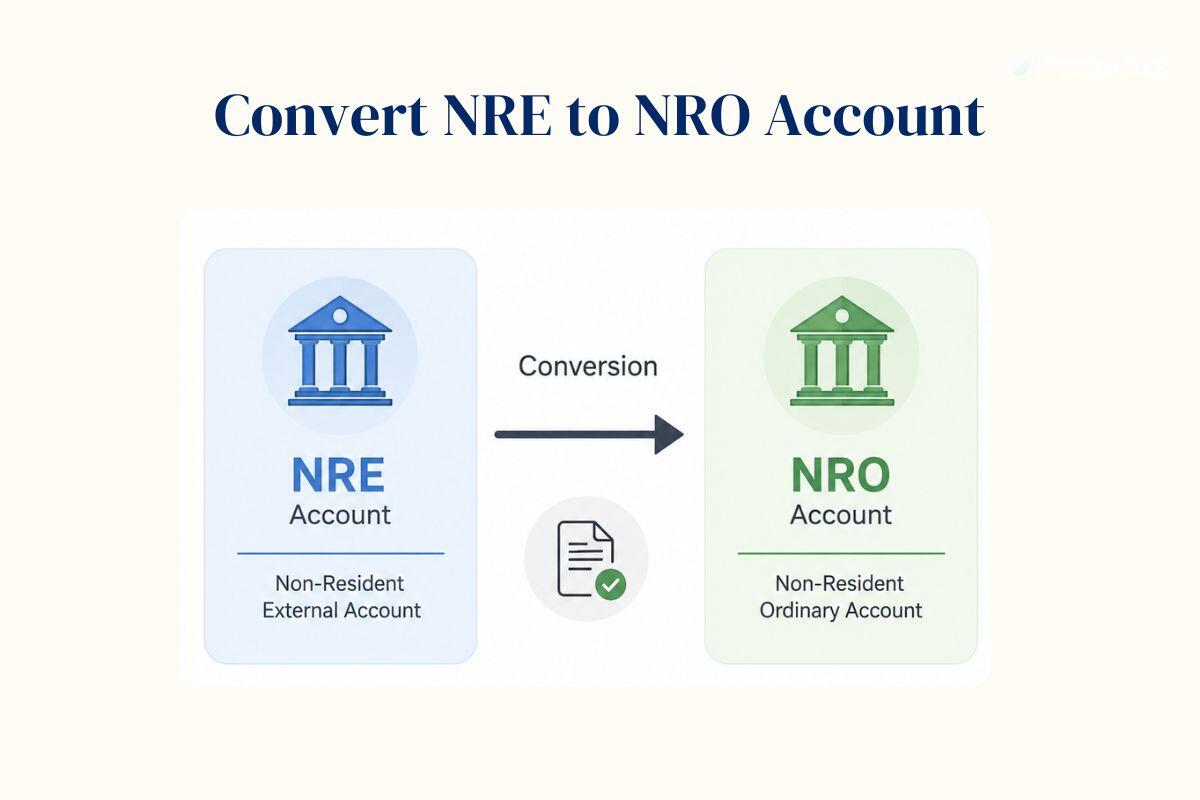
You moved back to India and someone told you to convert your NRE account to an NRO account. That advice sends you the wrong way. On return, the NRE to NRO move is not the rule. Your NRE account gets redesignated as a resident account, or the money shifts to an RFC account.
NRO conversion is what happens when you leave India, not when you come back. Get the direction wrong and you sit on a FEMA breach without knowing it. This guide clears up the confusion, gives you the timing, spells out the penalty for not converting to NRO account in the right situations, and covers the tax angle most people miss.
NRE to NRO on return is the wrong direction
This is the mistake that trips up almost every returning NRI. The phrase "convert NRE to NRO" is real, but it belongs to the opposite trip.
When a resident leaves India and becomes an NRI, the bank converts the old resident savings account into an NRO account to hold India-sourced money like rent or dividends. That is the resident to NRO direction. It happens on the way out.
When you return to India for good, you are walking back in. So the NRO step does not apply to your NRE account. Your NRE account (the one holding your foreign earnings) gets redesignated as a regular resident account, or the funds move to an RFC account.
If you already held an NRO account as an NRI, that one also gets redesignated to a resident account on return. It does not stay an NRO account either.
So nobody converts an NRE account into an NRO account when coming home. If you want a refresher on how each account works, the difference between these accounts is worth a quick read before you call your bank. Knowing which account does what saves you from acting on the wrong instruction.
What actually happens to your NRE account when you return
Your residential status under FEMA changes the moment you return to India with the intent to stay. Your accounts have to follow that status.
Two options sit in front of you for the NRE balance. You can redesignate it as a resident rupee account, or you can move the money into an RFC account if you want to hold dollars, pounds or euros instead of converting to rupees. The Reserve Bank spells this out in its rules for accounts held by non-residents: an NRE account should be redesignated as a resident account, or the funds transferred to an RFC account, immediately on your return.
You do not always have to close the account. Redesignation keeps the same account but changes its status. Some banks prefer to open a fresh resident account and move the balance across, which works too.
NRE fixed deposits follow the same rule. The Reserve Bank's instruction to redesignate or move to RFC immediately on return covers the whole NRE account, deposits included. The permission to let a deposit run to maturity at the contracted rate is written only for FCNR(B) deposits, so do not assume an NRE deposit can sit untouched until it matures. If you ask your bank to convert an NRE term deposit into an RFC account immediately on return, the Reserve Bank's directions on interest rates on deposits say no premature withdrawal penalty applies. The bank pays the contracted rate if the deposit has run for at least one year, and no more than the RFC savings rate if it has not.
To get the process right, you redesignate your NRE account to a resident account through your bank with a short set of documents. The bank handles the status change once you give them proof of your return.
NRE account: leaving India vs returning to India
The table below shows why the direction matters. Same account, opposite trips, different rules.
| Account | Leaving India (you become an NRI) | Returning to India (you become a resident) |
|---|---|---|
| NRO account | Your existing resident savings account is redesignated as an NRO account to hold India-sourced income | Redesignated as a resident account |
| NRE account | Opened fresh and funded with money remitted from outside India | Redesignated as a resident account, or the funds moved to an RFC account, immediately on return |
| NRE fixed deposits | Booked from NRE account funds | Covered by the same immediate redesignation rule, with no RBI permission to run to maturity |
| FCNR(B) deposits | Held in foreign currency | May run to maturity at the contracted rate, then convert to a resident rupee account or an RFC account |
Source: Reserve Bank of India, FAQ on Accounts in India by Non-residents (January 16, 2025).

Read the table left to right and the confusion clears. The NRO step is a leaving step. The redesignation to resident or RFC is a returning step.
Timing: how soon must you convert?
The Reserve Bank uses one word: immediately. There is no fixed number of days written into the regulations, but "immediately upon return" is the standard the Reserve Bank sets.
In practice, tell your bank as soon as you are back and start the redesignation straight away. The longer your NRE or NRO account runs after you become a resident, the longer you carry a status that no longer fits you under FEMA. There is no grace period that resets when a new financial year starts, so do not wait for April. The obligation starts the day your status changes, not the day you remember to deal with it.
Take Rahul. He returned to Pune in April 2026 after eight years in Texas. He kept using his NRE account for another seven months because nobody told him to change it. Every one of those months, he held an account meant only for non-residents while living in India as a resident. That gap is the exact thing FEMA treats as a contravention. The fix was simple once he acted, but the clock had already been running. Tell your bank about your return as soon as you settle, and start the redesignation then.
The penalty for not converting to NRO account, and for not redesignating NRE
Here is where the money risk shows up. Holding the wrong account type for your status is a breach of FEMA, and the law attaches real numbers to it.
Under Section 13(1) of the Foreign Exchange Management Act, the penalty for not converting to NRO account at the right time, or for failing to redesignate an NRE account on return, can run up to three times the sum involved where that amount can be worked out. Where the amount cannot be worked out, the penalty can go up to two lakh rupees. If the breach keeps going, a further penalty of up to five thousand rupees for every day can apply for as long as it continues. You can confirm the figures in the FEMA Act itself.
FEMA also lets you close out a contravention through compounding. You apply to the Reserve Bank, admit the contravention, and pay a compounding amount that the Reserve Bank works out under its directions on compounding of contraventions under FEMA. The Reserve Bank does not publish a fixed penalty figure for late redesignation, so the exposure depends on your facts, and it grows the longer you wait.
The same penalty logic covers the outbound case. If you turned NRI and never converted your resident savings account to an NRO account, that is the textbook "penalty for not converting to NRO account" situation. Either way, the rule is the same: your account must match your residency status.
The tax angle returning NRIs miss: NRE interest, RNOR and RFC
This part catches even careful people, because two different definitions of "resident" are in play at once.
FEMA decides your banking status. The Income Tax Act decides your tax status. They do not move together. You can be a resident under FEMA the day you return, yet still qualify as RNOR (Resident but Not Ordinarily Resident) for income tax for a limited period after you return, depending on how long you lived abroad. RNOR is the income-tax status that keeps your foreign income largely out of the Indian tax net for a window after you come back. You can see who qualifies and for how long in the rules on RNOR status.
Now the trap. NRE interest is tax-free only while you are a person resident outside India under FEMA. That exemption sat in Section 10(4)(ii) of the Income-tax Act, 1961, and from 1 April 2026 it sits in section 11 read with Schedule IV of the Income-tax Act, 2025, with the same condition. The day you become a FEMA resident on return, that exemption ends, even though you are still RNOR for tax. So you cannot keep an NRE account running tax-free just because you hold RNOR status. Once you are a resident, any interest you earn on the redesignated account is taxable, and you declare it on your Indian return.
The RFC account is the smarter play here. Interest on an RFC account stays tax-free for as long as you hold RNOR status. That exemption is Section 10(15)(iv)(fa) of the 1961 Act, which Schedule IV of the Income-tax Act, 2025 carries forward subject to the same conditions. So an RFC account lets a returning NRI hold dollars and still earn tax-free interest during the RNOR window.
Take Priya. She moved back to Bengaluru in 2026 with USD 90,000 in NRE savings and wanted to keep it in dollars. She moved the balance to an RFC account instead of forcing it into rupees. While she stays RNOR, that RFC interest is tax-free, and she avoids locking in a rupee rate she did not like. Her NRE account, left alone, would have lost its tax-free status and exposed her to currency conversion she did not want.
What to do now
You can close this out in a short, ordered run.
- Tell your bank you have returned to India and your status has changed.
- Redesignate your NRE account as a resident account, or move the funds to an RFC account.
- Redesignate any NRO account to a resident account as well.
- Ask your bank to redesignate NRE fixed deposits or convert them to RFC now. Only FCNR(B) deposits can run to maturity at the contracted rate before conversion.
- Update your tax records, since NRE interest is now taxable and RFC interest is tax-free only while you are RNOR.
Do these as soon as you are back and you stay clean on both FEMA and tax.
Conclusion
On return to India you do not convert your NRE account to an NRO account. You redesignate it as a resident account, or move the money to an RFC account, and you do it soon after you land. The penalty for not converting to NRO account belongs to the outbound trip, while the returning trip carries its own FEMA risk if you sit on a non-resident account. Act early, match each account to your new status, and speak to your bank or a cross-border advisor before the window stretches on.
Frequently asked questions
What happens if you don't convert your savings account to NRO after moving abroad?
When you become an NRI, your resident savings account must become an NRO account to hold your India-sourced income.
If you skip this and keep operating the resident account, you are in breach of FEMA. The account is also not set up for the repatriation and tax treatment an NRI needs. Convert it as soon as your status changes to avoid trouble later.
What is the penalty for not converting a resident account to an NRO account?
The penalty sits under Section 13(1) of FEMA. It can reach up to three times the sum involved where that figure can be calculated, or up to two lakh rupees where it cannot. A continuing breach can add up to five thousand rupees a day. You can also apply to the Reserve Bank to compound the contravention, which settles it on payment of an amount the Reserve Bank determines.
How soon must I redesignate my NRE account after returning to India?
The Reserve Bank says to do it immediately on your return. There is no exact day count in the regulations, but the intent is prompt action. Tell your bank and start the redesignation as soon as you are back in India. The longer you wait, the longer you hold an account that no longer matches your status.
Can I convert my resident savings account into an NRE account when I move abroad?
No. When you become an NRI, your existing resident savings account is redesignated as an NRO account, because it holds money earned in India. An NRE account has to be opened fresh and funded with money remitted from outside India. Our guide to the NRE account covers how to open one and what it can be used for.