
If you’re an Indian professional working in the US, receiving Restricted Stock Units (RSUs) can feel exciting - until the tax implications hit. RSUs vest over time and convert into company shares, but for NRIs, this comes with the complexity of taxation in both the US and India. Navigating dual tax obligations, understanding perquisite income, and planning capital gains can quickly become overwhelming without a clear roadmap.
This guide breaks down how RSUs are taxed at vesting and on sale, explains key differences between RSUs and stock options, and highlights strategies to minimize your tax liability.
From claiming foreign tax credits under the India-US DTAA to ensuring proper reporting and documentation, you’ll get actionable insights to stay compliant and make the most of your RSU compensation.
Understanding Restricted Stock Units (RSUs) for NRIs
What are Restricted Stock Units?
Restricted stock units represent your company's promise to grant you shares at a future date once specific conditions are met. You receive no actual shares at grant. Instead, you get a commitment that converts into stock ownership after vesting. This is different from immediate stock ownership because RSUs function as deferred compensation without any upfront cost to you.
Your company determines the number of shares each RSU represents and sets the vesting schedule. These units carry no voting rights. You won't receive dividend payments until the shares are earned and issued. The standard vesting period ranges from three to five years, though your specific timeline depends on your grant agreement.
RSU vs Stock Options: Key Differences
The fundamental difference lies in how you acquire ownership. Your company grants shares without requiring payment with RSUs. Stock options give you the right to purchase shares at a predetermined exercise price.
RSUs: Grant → Vesting → Receive shares → Sale
Stock Options: Grant → Vesting → Exercise (purchase) → Sale
Your tax timing is different by a lot between the two. RSUs trigger automatic taxation when they vest based on fair market value and give you no control over the tax event. Stock options allow discretion in timing your tax obligation because you choose when to exercise after vesting.
Value retention presents another difference. RSUs maintain some value unless your company's stock price drops to zero. Stock options become worthless if the stock price falls below the exercise price. If you hold options with a strike price of $50 but the stock trades at $40, exercising would result in a loss.
How RSUs Work: Grant to Vesting to Exercise
Your RSU experience begins on the grant date when your company promises restricted shares. The grant agreement outlines the total units awarded and vesting conditions. You own nothing at this stage and face no tax liability.
Vesting occurs through time-based schedules or performance milestones. A typical four-year time-based schedule might vest 25% annually. You'd receive one-quarter of your total grant each year. Performance-based vesting requires meeting specific company or individual goals before shares transfer to you.
Settlement happens when vested RSUs convert into actual shares. Some companies settle immediately upon vesting. Others batch settlements quarterly for administrative purposes. The fair market value at settlement becomes taxable income, and your employer withholds a portion of shares to cover taxes.
After settlement, you receive full ownership and can sell the shares or hold them for potential appreciation. Any price increase from the vesting date creates a capital gain. A decline might leave you with shares worth less than the taxes you paid. Your employment termination halts vesting unless your agreement specifies otherwise, such as in early retirement scenarios.
RSU Taxation in India: When and How Much You Pay
No tax applies when your company grants RSUs to you. The taxable event occurs only when these units vest and convert into actual shares. Understanding the taxation mechanics at each stage helps you plan for liabilities and avoid compliance issues.
Tax at Vesting: Perquisite Income Treatment
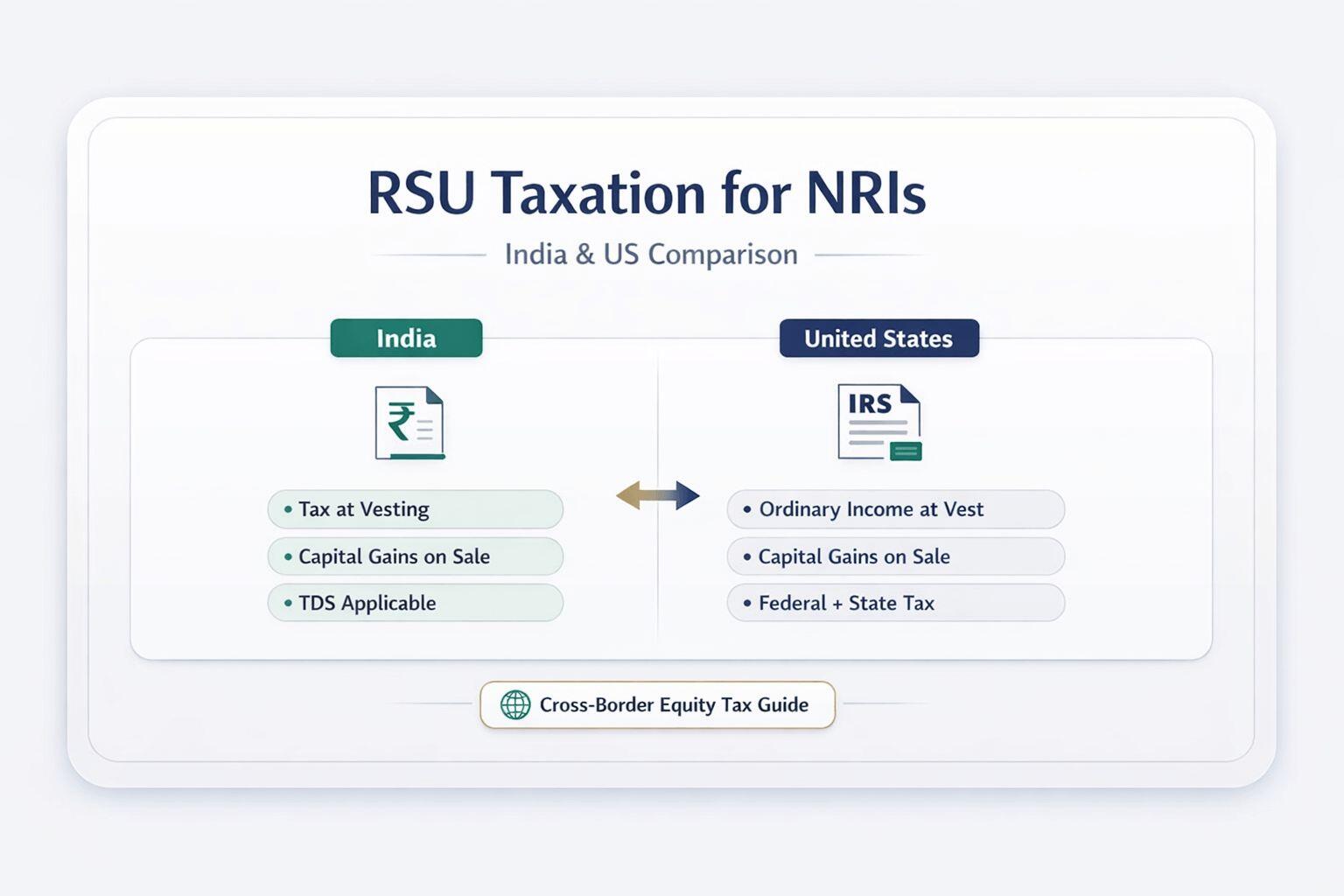
The fair market value of shares on your vesting date is taxable as perquisite income under the salary head. This amount gets added to your total salary income and taxed according to your applicable income tax slab rates. Your Indian employer must deduct TDS on this perquisite income and deposit it with the income tax department.
You face this tax liability whether you sell the shares right away or hold them. To name just one example, if 250 RSUs vest when the fair market value stands at ₹500 per share, your taxable perquisite income equals ₹1,25,000. This gets taxed at your marginal rate, which could range from 5% to 30% depending on your total income.
Three settlement scenarios affect your share receipt. Your employer withholds a portion of shares to cover TDS obligations in a sell-to-cover arrangement. A same-day sale converts all vested shares to cash after tax payment. You pay taxes from other sources and retain all shares with upfront payment.
Tax on Sale: Capital Gains Rules
Capital gains tax applies when you sell vested shares. The gain is calculated as the difference between your sale price and the FMV at vesting. Your holding period starts from the vesting date, not the grant date.
Short-term capital gains apply if you sell within 24 months of vesting for US stocks not listed on Indian exchanges. These gains are taxed at your income slab rates. Long-term capital gains are taxed at 12.5% without indexation benefits if you hold shares beyond 24 months. Take the earlier example: if you sell 250 shares at ₹600 each after vesting at ₹500, your capital gain equals ₹25,000.
How Residential Status Affects Your Tax Liability
Your residential status determines how much of this India actually taxes. Broadly: as an NRI or RNOR, RSU vesting and sale income from a US employer isn't taxable in India; once you're a full Resident, it is - added to your salary as a perquisite at vesting and taxed as capital gains at sale.
If you're navigating this transition after moving back to India, our guide to managing RSUs after returning to India breaks down the RNOR window and the one-time tax-free selling opportunity it creates.
You can check your residential status using the - Residential Status Calculator
Fair Market Value Calculation for US Stocks
FMV must be determined by a Category 1 merchant banker registered with SEBI for shares issued by companies not listed in India. The valuation must be obtained on the vesting date or within 180 days prior to that date. Use the SBI telegraphic transfer buying rate applicable on the vesting date to convert foreign currency values to INR.
US and India Tax Overlap: Avoiding Double Taxation
When US employers withhold taxes on your RSU vesting and India taxes the same income, you face double taxation. The India-USA tax treaty provides relief mechanisms to ensure you don't pay tax twice on similar income earned from restricted stock units.
Understanding the India-USA Tax Treaty (DTAA)
The Double Taxation Avoidance Agreement between India and the United States came into force on December 18, 1990. Article 25 of this treaty addresses relief from double taxation and allows Indian tax laws to provide credit against Indian tax for amounts paid to the United States.
The treaty applies to residents of both countries, though the US retains the right to tax its citizens and residents as if the treaty didn't exist. Then you must determine your residential status in both countries before claiming treaty benefits. India allows a deduction equal to the income tax paid in the United States, but such deduction cannot exceed the Indian tax calculated on that foreign income.
Claiming Foreign Tax Credit in India
Foreign Tax Credit operates under Sections 90 and 91 of the Income Tax Act. Section 90 applies when India has a DTAA with the foreign country, while Section 91 covers scenarios without a treaty. The credit amount equals the lower of two values: tax paid in the foreign country or tax payable on that income in India.
If US tax withheld equals ₹1,09,000 and Indian tax liability on the same RSU income amounts to ₹1,50,000, you can claim ₹1,09,000 as foreign tax credit. So you pay only the difference of ₹41,000 in India. The credit prevents double taxation but doesn't eliminate your obligation to report and pay the higher tax between the two countries.
Best practice is to file Form 67 before or together with your Income Tax Return, so the tax department can reconcile your Schedule FSI, Schedule TR and Form 67 figures in one pass. Under Rule 128(9), you technically have until the end of the relevant assessment year to file it - for example, March 31, 2027 for Assessment Year 2026-27 - provided your return itself was filed within the regular or belated deadline.
Filing later within that window won't automatically disqualify your claim, but once a return is processed without the credit, recovering it becomes an appeals matter rather than a simple filin.
Filing Form 67 for Tax Relief
The form has four sections: Part A with basic information and foreign income details, Part B covering refund of foreign tax, a verification section and attachments for tax payment proof.
You need a Digital Signature Certificate or Electronic Verification Code to submit Form 67. The details in Form 67 must match with Schedule FSI in your ITR. Filing after the assessment year ends disqualifies you from claiming credit, though you may apply for condonation with valid reasons.
W-2 Reporting and Indian Tax Returns
Form W-2 summarizes wages earned and taxes withheld by your US employer during the calendar year. Employers issue this form to employees earning USD 600 or more. Form W-2 confirms US income tax, Social Security tax and Medicare tax withholdings for NRIs.
Report foreign income in Schedule FSI and claim relief in Schedule TR when preparing your Indian tax return. Schedule FSI requires country code, taxpayer identification number, income earned outside India, taxes paid abroad and the relevant DTAA article. The information flows to Schedule TR where your foreign tax credit reduces overall tax liability.

Compliance Requirements for NRIs Holding US RSUs
Holding restricted stock units in US brokerage accounts triggers specific disclosure and compliance obligations in India. Your residential status determines reporting requirements, with residents facing stricter rules than non-residents.
Schedule FA: Foreign Asset Disclosure Rules
Residents must report all foreign assets under Schedule FA in their Income Tax Return. This applies to ITR-2 or ITR-3 forms, as ITR-1 and ITR-4 lack the Schedule FA section. Non-residents and those with Resident but Not Ordinarily Resident status are exempt from this disclosure requirement.
You must report RSU holdings if you held them at any point during the relevant accounting period. The accounting period follows the foreign jurisdiction's reporting cycle. The US uses a calendar year, so you report assets held between January 1 and December 31. This is different from India's April to March financial year.
Schedule FA requires disclosure whatever the income generation. Even dormant accounts or unsold RSUs with zero income must be reported. The disclosure covers foreign brokerage accounts under Table A1 and vested equity shares under Table A3.
Black Money Act and Penalty Provisions
Non-disclosure attracts a flat penalty of ₹10 lakh under the Black Money Act, 2015, whatever the asset value. This penalty applies for each year of non-reporting. Prosecution may result in imprisonment ranging from six months to seven years.
Undisclosed foreign assets face a 30% tax on their fair market value beyond penalties. Penalties can reach up to 90% of the asset value in severe cases. Non-disclosure revokes your right to claim Double Taxation Avoidance Agreement benefits and results in potential double taxation.
The Foreign Assets Investigation Unit within the Income Tax Department examines undisclosed foreign income and overseas assets. Assessment proceedings can be reopened up to 16 years for undisclosed foreign assets.
Documentation You Must Maintain
Proper documentation protects you during tax assessments or Black Money Act notices. You must maintain:
- RSU grant letters and vesting schedules
- Foreign broker statements for share sales
- Sale contract notes with transaction details
- Bank remittance proofs for funds received from abroad
- Form 16 showing TDS deductions
These records support your Schedule FA disclosures and capital gains calculations during scrutiny.
TDS Deductions and Advance Tax Obligations
Employers deduct TDS on the fair market value of vested shares. This deduction appears in your Form 26AS and Annual Information Statement. TDS covers only perquisite income at vesting.
Advance tax obligations arise when you sell RSUs and realize capital gains exceeding ₹10,000. Non-payment or delayed payment results in penal interest under sections 234B and 234C. You must pay the appropriate percentage before the nearest due date to avoid these charges.
Tax Planning Strategies to Minimize Your RSU Tax Burden
Strategic planning around your RSU sales can reduce tax liability by a lot while managing investment risk.
Timing Your RSU Sales for Tax Efficiency
Shares held beyond 24 months qualify you for long-term capital gains taxed at 12.5%. Short-term gains get taxed at slab rates. Deferring sales until after your move can deliver major savings if you anticipate relocating to a state with no income tax. A December sale versus January pushes your tax liability by a whole year. Delaying the sale pushes gains into a lower bracket if you expect lower income next year.
Sell-to-Cover vs Upfront Payment Options
Sell-to-cover sells enough shares automatically to satisfy tax withholding. Same-day sale converts all vested shares to cash right away. You pay taxes from other sources and retain all shares with upfront payment. Each method affects your stock concentration and liquidity differently.
Record Keeping Best Practices
Keep grant notices, vesting schedules, brokerage statements that show FMV at vesting, W-2 forms and tax return copies. Documentation prevents double taxation and protects you during scrutiny.
Conclusion
You now have everything you need to handle RSU taxation as an NRI working in the US. Report perquisite income at vesting and calculate capital gains on sale. Claim foreign tax credits to avoid double taxation.
Stay compliant with Schedule FA disclosures and maintain full documentation of all RSU transactions. The penalties for non-disclosure are severe, but proper record-keeping protects you.
Use the tax planning strategies above to minimize your liability. Time your sales with care, especially for long-term capital gains at 12.5%. Your RSU compensation represents substantial value, so don't let avoidable tax mistakes erode those earnings.
Frequently asked questions
When do I need to pay tax on my RSUs as an NRI?
You pay tax at two stages: first, when your RSUs vest and convert into actual shares (taxed as perquisite income based on fair market value), and second, when you sell those shares (taxed as capital gains). No tax applies at the grant stage when your company initially promises you the RSUs.
What is the difference between short-term and long-term capital gains tax on RSUs?
For US stocks not listed in India, if you sell shares within 24 months of vesting, short-term capital gains apply and are taxed at your income slab rates. If you hold shares beyond 24 months, long-term capital gains are taxed at 12.5% without indexation benefits.
How can I avoid paying tax twice on my RSUs in both the US and India?
You can claim Foreign Tax Credit under the India-USA tax treaty (DTAA) by filing Form 67 before submitting your Income Tax Return. The credit amount equals the lower of the tax paid in the US or the tax payable on that income in India, ensuring you don't pay tax twice on the same income.
Do I need to disclose my US RSUs in my Indian tax return?
Yes, if you are a resident of India, you must report all foreign assets including RSU holdings in Schedule FA of your ITR-2 or ITR-3, regardless of whether they generated income. Non-residents and RNORs are exempt from this requirement. Non-disclosure can result in a penalty of ₹10 lakh under the Black Money Act.
What is the sell-to-cover option and how does it work for RSU taxation?
Sell-to-cover is a settlement method where your employer automatically sells a portion of your vested shares to cover the tax withholding obligations (TDS). This allows you to retain the remaining shares without paying taxes from other sources, though it reduces the number of shares you ultimately receive.