

Yes, OCI cardholders can buy Indian health insurance much as residents do, and you'll need it, because Medicare and most US plans stop paying once you live in India. The catch is timing: a new Indian policy can exclude pre-existing conditions for up to 36 months. When you buy matters more than which plan.
Why your US coverage stops working in India
You've moved back, your employer plan ended with the job, and you assume something will carry you until you sort out Indian cover. Usually nothing does. Original Medicare, per its own rules, "usually doesn't cover health care while you're traveling outside the U.S."
The exceptions are narrow: an emergency inside the US where a foreign hospital is closer, a trip through Canada between Alaska and another state, or living in the US near a border. None of them fits someone who lives in India.
The Medicare rules on care abroad list them, and Part D doesn't cover drugs bought outside the US either.
Keeping or dropping Medicare Part B
If you're a US citizen over 65, the harder question is whether to keep paying the Part B premium for cover you can't use in India.
Drop it, and the late enrollment penalty is 10% for each full 12-month period you could have been enrolled but weren't, charged for as long as you have Part B.
So the call turns on one thing: how likely you are to spend your later years back in the US. If that's a real possibility, I'd keep Part B and treat the premium as insurance on that option. If the move is permanent, dropping it is usually the cleaner choice.
Buying OCI health insurance in India
An OCI card doesn't block you from Indian retail health insurance. Insurers treat OCI cardholders much like resident buyers, though each insurer underwrites on its own terms and will ask about your residency status.
What insurers ask you for
The list is short, and most of it you already hold.
- Your foreign passport and your OCI card, as identity proof.
- Address proof, which can be from your country of residence or an Indian address if you have one.
- A working Indian bank account, because claim payouts are paid into it.
- A medical check-up, which an insurer may ask for depending on your age and health history.
If a check-up is triggered, you usually have to be in India for it. That's the step to plan around if you want the policy to start before you fly.
Indian plans cover India only
Most Indian retail plans pay only for hospitalisation inside India. If you'll visit children or parents in the US, a domestic policy won't cover a hospital stay there, so you'll need separate travel cover for each trip.

The waiting periods that decide when to buy
Under the IRDAI (Insurance Products) Regulations, 2024, a new policy can make you wait up to 36 months of continuous cover before it pays for a pre-existing disease. A condition your US doctors treated for years counts, even though it was fully covered there.
The second clock is the moratorium period, now 60 months. After five years of continuous cover, the insurer can't contest a claim for non-disclosure or misrepresentation, except for proven fraud. Time with earlier Indian insurers counts toward it through portability, but years on a US plan don't.
Common mistake: assuming years of US cover shorten the Indian wait. They don't. Portability only moves credit between Indian insurers, so a new Indian policy starts both clocks at zero.
Start the clock before you land
Worked example: Arjun's diabetes cover
Arjun, 52, has managed type 2 diabetes in the US for a decade, and his insurer applies the full 36-month pre-existing disease wait.
- Buys the policy the month he lands: diabetes-related admissions are covered from month 36 in India.
- Buys the policy six months before the move: the same cover starts 30 months after he lands.
The six months of premium paid from the US buy him half a year less exposure in India.
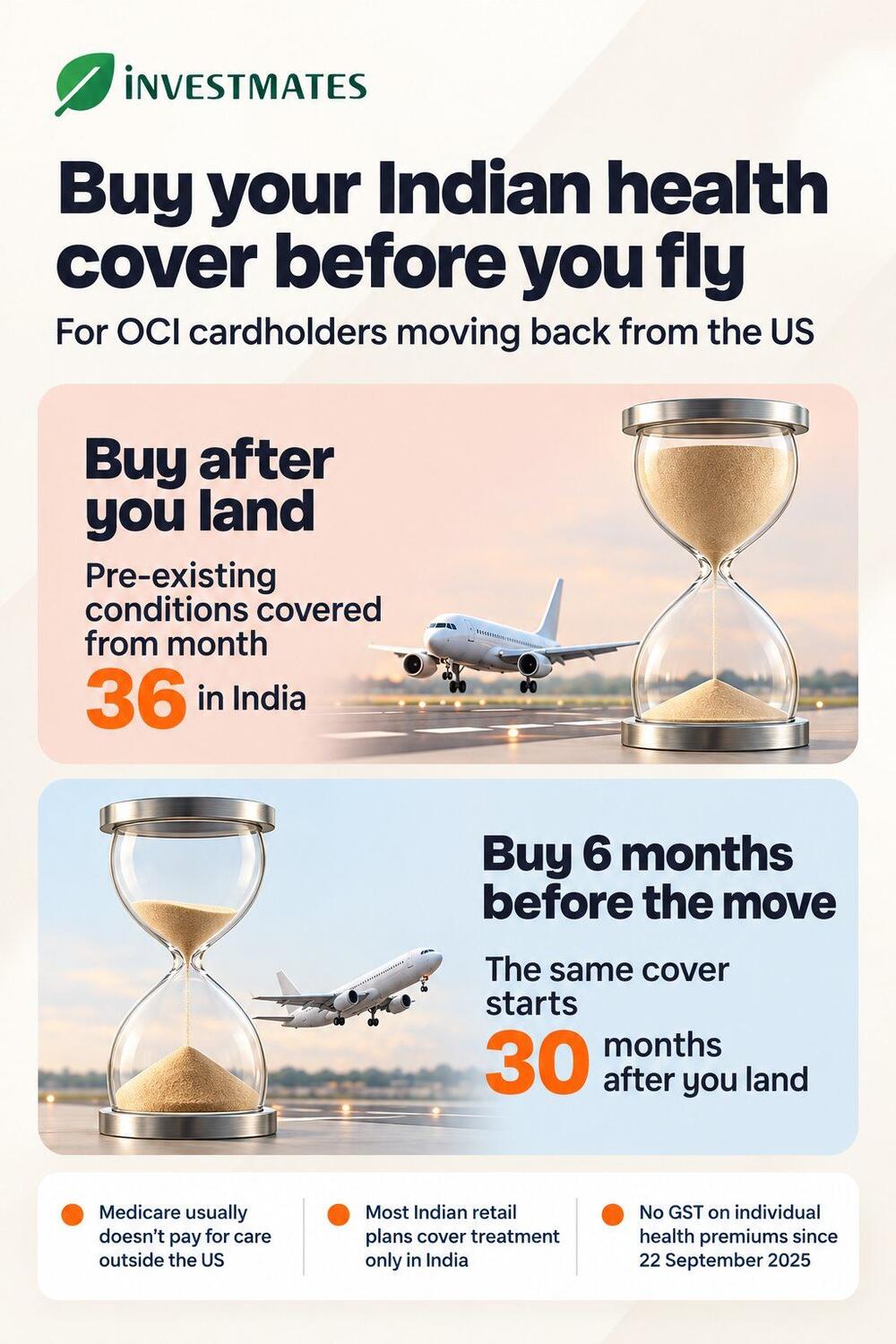
My position is simple: buy the Indian policy before you move, not after you've settled. Every month of cover you hold before the move is a month off the waiting period.
The premiums you pay while still in the US are what that head start costs, and for anyone with a chronic condition it's usually worth it.
How the premium is taxed
Since 22 September 2025, premiums on individual health insurance policies, including family floater plans, are exempt from the 18% GST that used to apply.
The exemption is for individual policies, so group cover from an Indian employer isn't part of it. If you take up a job in India, and you can work in India with an OCI card, ask whether that group policy covers your spouse and parents before you buy a separate floater.
If you have money left in a US Health Savings Account, it can still pay some medical bills after the move. The HSA rules for returning NRIs cover how withdrawals are taxed once you live in India.
What to do next
Do these in order. I'd start about six months before your move date.
- Check which pre-existing conditions you have and ask insurers how long each one will wait.
- Open or keep an Indian bank account that can receive claim payouts.
- Buy the Indian policy early enough to finish any medical check-up in India.
- Decide on Medicare Part B, if you're eligible, before your next premium is due.
- Book travel cover for every return trip to the US.
Health insurance is one line in a larger budget. The cost of living in India breaks down what a month really costs once you've moved, and a full plan for your return to India puts the insurance date next to the tax ones.
Pick your move date, count back six months, and put the health insurance purchase on that day. I'd book it before the flights, since it's the one item on the move list where buying early shortens a wait.
If you'd like the insurance date planned alongside your tax and account changes, InvestMates can map the whole move with you.
Frequently asked questions
Does Indian health insurance cover treatment in the US for OCI cardholders?
Standard Indian health insurance for OCI cardholders covers hospitalisation inside India only. If you're treated in the US during a visit, a domestic Indian policy won't pay, so buy travel medical cover for each trip.
Should I keep Medicare Part B after moving to India?
Keep Medicare Part B if there's a real chance you'll live in the US again. Drop it and re-enroll later, and you pay a 10% penalty for each full 12-month period you weren't enrolled, for as long as you have Part B.
If you won't return, Part B buys you nothing in India. Your Social Security in India is a separate question with its own rules.
Does time on a US health plan count toward waiting periods on an Indian policy?
No, years on a US health plan don't count toward waiting periods on an Indian policy. Portability credit applies when you move between Indian insurers. A new Indian policy starts its pre-existing disease wait, up to 36 months, from its own start date.
Do I need to be in India to buy health insurance as an OCI cardholder?
Often you don't need to be in India to buy health insurance as an OCI cardholder, since the documents can be sent from abroad.
If the insurer asks for a medical check-up because of your age or health history, you'll usually have to attend it in India. How NRI and OCI status differ is worth checking at the same time, since insurers ask which one you hold.