
You can get an OCI card for a newborn born in the US once the baby has a US passport, if either parent is Indian or of Indian origin. The usual snag is the birth certificate: it must be state-issued and apostilled. Follow the order below and the file won't bounce.
Who can get an OCI card for a newborn born in the US
Your baby qualifies if one parent is an Indian citizen, or if a parent, grandparent or great-grandparent was one. The MEA's OCI FAQ lists a minor child with "one of the parents" a citizen of India as eligible.
A child of an OCI cardholder qualifies through that parent's Indian origin. The adult eligibility rules are in the guide on how to apply for OCI from the US.
Three situations change the answer:
- Pakistan or Bangladesh link. If either parent, or a grandparent or great-grandparent, is or was a citizen of Pakistan or Bangladesh, the child isn't eligible.
- Baby already holds an Indian passport. If you registered the birth at the consulate and got an Indian passport, you use the "previously held Indian passport" checklist, which asks for the last Indian passport and surrender paperwork.
- Both parents are US citizens with no Indian origin. There's no route to OCI through the child.
Most US-born babies of Indian parents fall in the simplest category: a foreign national by birth who never held an Indian passport. That's the VFS checklist this guide follows.
 Step 1: Get the US birth certificate and passport
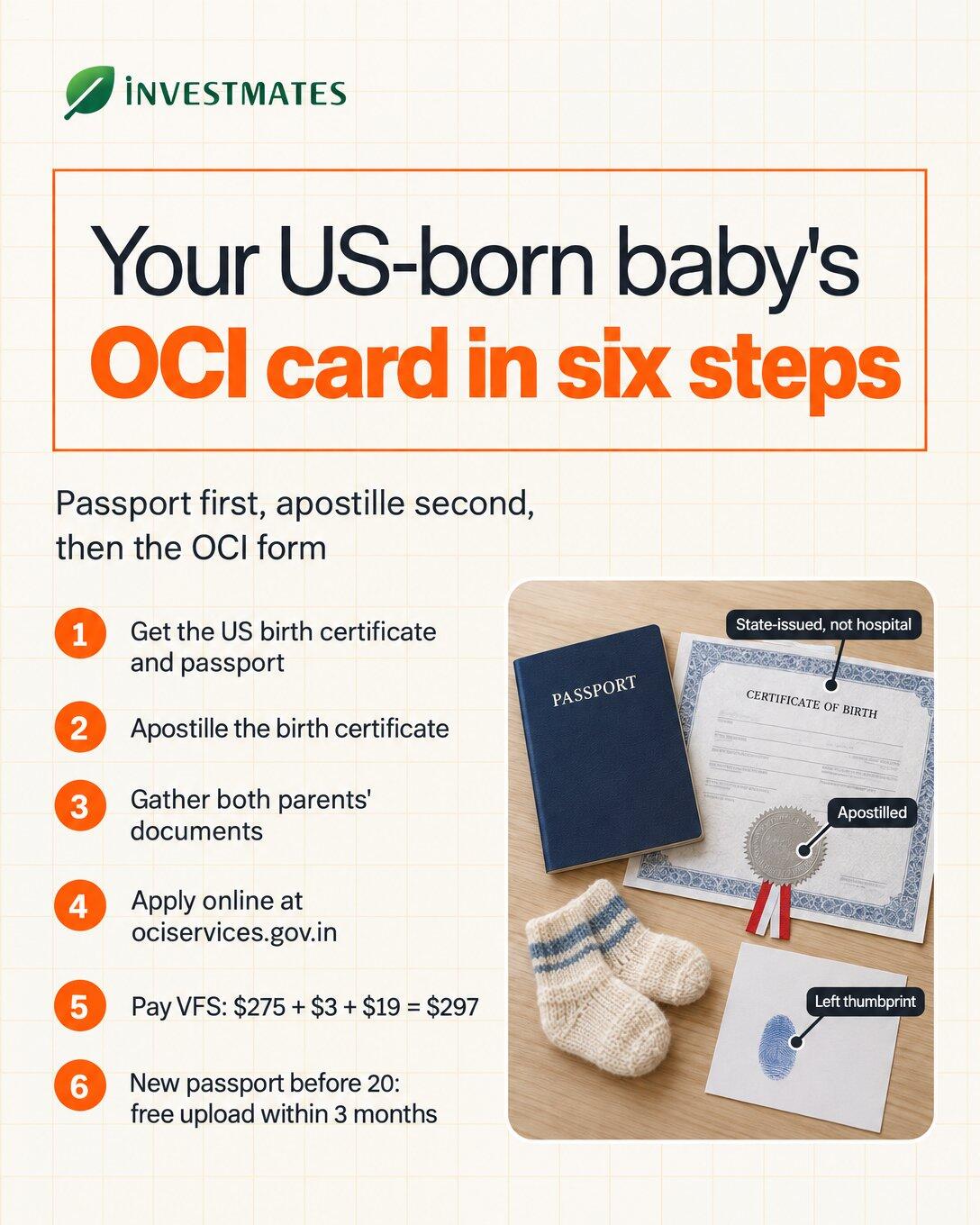
Order a certified copy of the birth certificate from your state's vital records office, then apply for the US passport. VFS rejects birth certificates issued by hospitals, and the certificate must show the names of both parents, the date of birth and nationality.
For the passport, both parents appear in person with the baby and file Form DS-11. If one parent can't attend, they sign Form DS-3053 in front of a notary. A US passport issued before age 16 is valid for only five years, which matters later in this guide.
Your OCI application quotes the passport number, so nothing else can start until it arrives. Current VFS checklists ask for six to nine months of passport validity, which a brand new five-year passport easily covers.
Step 2: Apostille the birth certificate
Send the certified birth certificate to the apostille office of the state that issued it, usually the Secretary of State, and ask for an apostille. The VFS checklist says a birth certificate issued outside India "must either be apostilled by the relevant foreign government or attested by the appropriate foreign mission."
Keep the apostilled original at home. VFS wants self-attested copies of the apostilled document, not the original.
This is the step I'd start on the same day the certified copy arrives. State apostille turnaround is outside your control, and it's the document parents most often realise they need only after the online form is done.
Step 3: Gather the parents' documents
Collect these as self-attested copies:
- Both parents' current passports. Indian passports: the first two and last two pages.
- Proof of Indian origin. An Indian passport, a parent's OCI card with the documents it was issued on, or a domicile or nativity certificate.
- Marriage certificate. If you married in India, the certificate from the Marriage Registrar. A certificate from a religious body isn't accepted. A US marriage certificate needs its own apostille from the issuing state.
- US legal status, for a parent on an Indian passport. Green card or EAD front and back, or a valid long-term visa. If an extension is pending, the I-797 with the recently expired visa.
- Proof of address. A state ID, driving licence, current lease, or a utility bill no more than three months old. PO boxes and expired documents are rejected.
Any parent who has changed their name since marriage needs the name change document too. The checklist is strict that every previous name appears on the form, "even in case of minor variation."
Step 4: Fill the OCI minor application online
Register the application at ociservices.gov.in, fill it in the baby's name, and upload every document there before you book anything at VFS. VFS says it will return applications "unprocessed" if the uploads are missing.
Photo, thumbprint and signature
Upload a square photo of the baby, between 200x200 and 1500x1500 pixels, and paste the identical print on the paper form. Uploads are capped at 1000 KB for PDFs and 500 KB for images.
For a child under five, you upload the baby's left thumbprint in place of a signature. Children five and older sign in blue or black ink.
Part B and the parental authorization form
Both parents sign Part B (Minor Child) of the form and a notarized Parental Authorization Form. Your signatures have to match your passports exactly, or the file can be delayed or rejected.
A single parent can sign alone only with a sole custody court order, a death certificate, or a single-parent adoption document.
Step 5: Pay and submit the OCI minor application to VFS
Print the completed form and post or submit the package to VFS Global with the fee. The VFS fee page for a new OCI in the US lists $275 for the card, a $3 Indian Community Welfare Fund charge, and a $19 VFS service fee, so $297 before any card surcharge.
VFS accepts Visa and Mastercard with a 3.75% convenience charge, or a money order or cashier's check payable to VFS Services (USA) Inc. Personal checks are refused. The new OCI rules for 2026 cover what else changed this year.
If VFS asks for more documents, you get seven calendar days to send them. Miss that window and processing can stop, with no refund.
Step 6: Track the card and keep it valid until 20
Track the file on the ociservices.gov.in status page once VFS forwards it to the consulate. The MEA's FAQ says issue normally takes about 30 days from acknowledgement on the online system.
Once the card is granted, the work isn't finished. Your child's OCI follows their passport, and a US child passport lasts five years.
What happens at each new passport
Since the April 2021 change, a minor doesn't reissue the card at every new passport. The rule by stage:

| When | What you do | Cost |
|---|---|---|
| Each new passport before age 20 | Upload the new passport and a fresh photo on the OCI portal within three months | Free |
| First new passport after completing 20 | Apply for a one-time OCI reissue | Paid |
| Travel at any point | Carry the current passport with the OCI card | None |
Worked example: Meera's OCI over 20 years
Priya and Arjun's daughter Meera is born in Seattle in 2026. Her US passports are issued at roughly ages 0, 5, 10 and 15, each valid five years.
- Age 0: new OCI application, thumbprint, notarized parental authorization.
- Ages 5, 10 and 15: free upload of each new passport and photo within three months.
- First passport after turning 20: one paid OCI reissue.
The OCI renewal and reissue process walks through both portal flows.
The money side parents miss
Grandparents often open an Indian account or deposit in the child's name once the card arrives. Your child is a US person, so foreign accounts totalling more than $10,000 at any point in the year trigger an FBAR.
FinCEN's instructions on filing for a child say a parent or guardian files it when the child can't.
Common mistakes on a newborn's OCI application
These are the errors the VFS checklists name as reasons for a returned or rejected file:
- Hospital birth certificate. Only a state-issued certificate is accepted.
- Birth certificate without an apostille. A US birth falls under the "born outside of India" rule.
- Part B left unsigned. The checklist lists it as a rejection reason by name.
- Signatures that don't match passports. Sign the way your passport shows it.
- Uploads skipped on the portal. The paper package alone gets returned.
Another common slip is assuming OCI makes the child an Indian citizen. It doesn't, and the full picture of what the card does and doesn't allow is in what OCI means for its holders.
Getting it done this month
Order the certified birth certificate and book the passport appointment this week, then send the certificate for its apostille the day it arrives. That sequence gets the OCI card for your newborn moving without a returned file.
I'd also put the passport renewal years in your calendar now, because a missed three-month upload is the easiest OCI problem to avoid. If family plans Indian accounts or gifts for the baby, I can help keep the US reporting clean from year one.
Frequently asked questions
Does a US-born baby's birth certificate need an apostille for the OCI card?
Yes. The current VFS checklist for minors who never held an Indian passport says a birth certificate issued outside India must be apostilled by the issuing government or attested by the relevant mission. You get the apostille from the issuing state, usually through its Secretary of State, and send VFS a self-attested copy.
Can a newborn travel to India before the OCI card is issued?
Yes, but only on an Indian visa. Until the OCI is granted, your US-born baby is a foreign national with no Indian travel status, so the baby needs a visa like any other US passport holder. Plan the first trip around that if the OCI won't arrive in time.
Can a US-born child hold both an Indian passport and an OCI card?
No. India doesn't allow dual citizenship, and registering a child born abroad as an Indian citizen requires a declaration that the child holds no other country's passport. A child with a US passport takes OCI instead, and the practical gap between the two statuses is set out in the NRI vs OCI comparison.
Does a baby need to sign the OCI minor application?
No. A child under five gives a left thumbprint, which you upload on the OCI portal, while both parents sign Part B and the notarized parental authorization form. From age five, the child signs in blue or black ink.
Does a child with an OCI card and an Indian bank account need to file an FBAR?
Yes, if the child's foreign accounts total more than $10,000 at any time in the year. The OCI card doesn't change the child's US tax status, and a parent files the FBAR on the child's behalf. The FBAR rules for NRIs apply to the child's accounts the same way.