

India's Ministry of Home Affairs and Bureau of Immigration announced significant changes to the Overseas Citizenship of India scheme starting April 2026. The revised fee structure took effect on April 1, 2026, and the Bureau of Immigration officially removed the six-month stay requirement on April 8, 2026. Postal document submissions to Indian missions abroad have also been discontinued. If you hold an OCI card or are planning to apply, these OCI new rules affect your costs, your application process, and how you travel to India. This article covers every change in detail, explains what it means for US-based NRIs, and tells you exactly what to do next.
What Changed in April 2026
The Bureau of Immigration and the Ministry of Home Affairs issued official notifications in early 2026 covering all of the below changes. Here are the facts.
New OCI Fee Structure (Effective April 1, 2026)
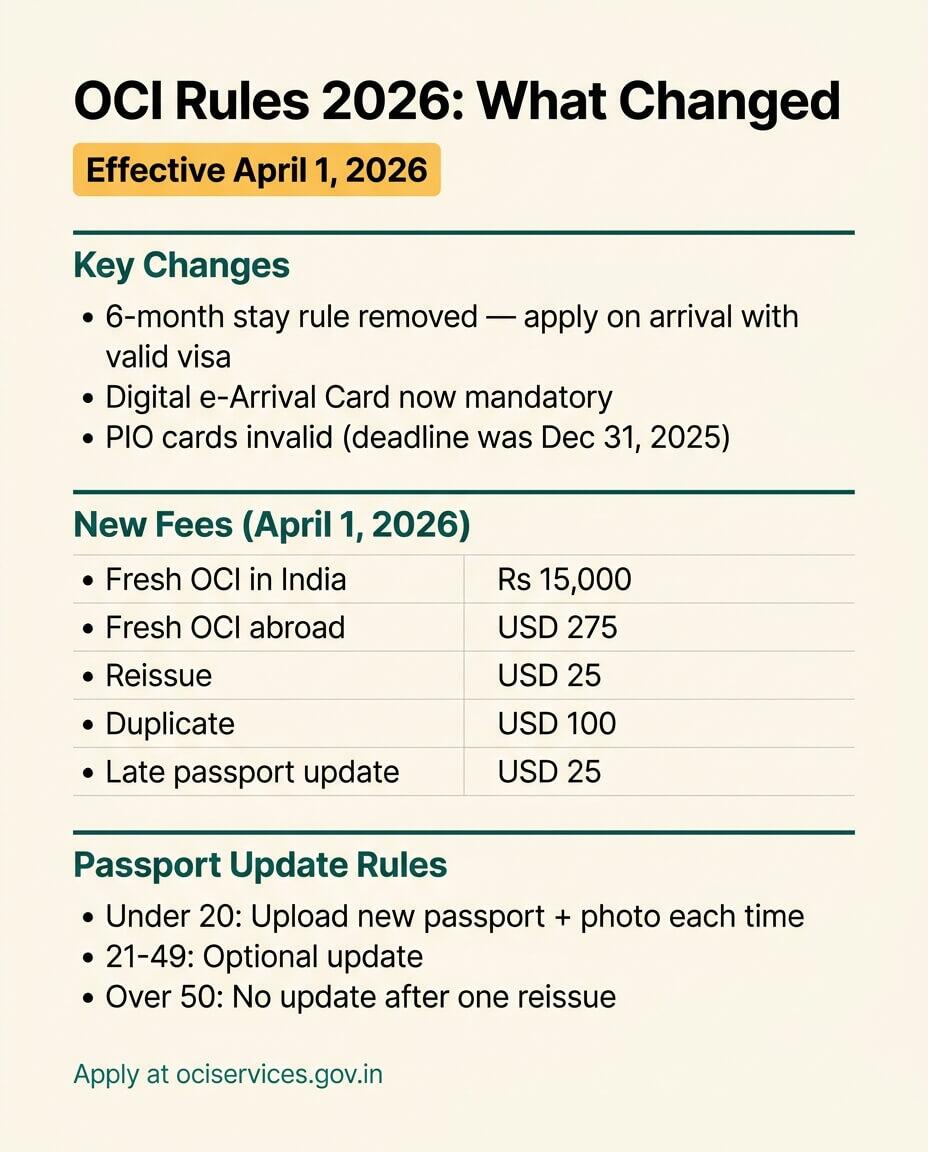
The fee for a fresh OCI application outside India has not changed. It remains USD 275, or the equivalent in local currency. For applications submitted within India, the fee is Rs 15,000 via demand draft payable to the Ministry of Home Affairs. The more significant revisions are in the fees for reissuing an existing card and obtaining a duplicate.

| Service | Fee (Outside India) | Fee (In India) |
|---|---|---|
| Fresh OCI application | USD 275 | ₹15,000 |
| Reissue with change in personal details | USD 25 | ₹2,100 (approx.) |
| Duplicate OCI card (lost or damaged) | USD 100 | ₹8,300 (approx.) |
| Late fee for passport update (after 3 months) | USD 25 | ₹2,100 (approx.) |
These fees apply at Indian consulates, missions, and authorized VFS Global centers globally. Payment methods vary by location, so check your specific center's requirements before your visit.
6-Month Stay Rule Removed (Effective April 8, 2026)
Previously, foreign nationals applying for an OCI card from within India were required to demonstrate ordinary residence, which was commonly interpreted as a minimum six-month continuous stay. This requirement caused significant confusion and delays, particularly for foreign spouses of Indian citizens who were visiting India and wanted to apply locally.
The Bureau of Immigration officially clarified on April 8, 2026, that this requirement no longer applies. If you are a foreign national in India on a valid visa with the required documents, you can now apply for OCI immediately, without any minimum stay period. This change is most relevant for spouses of OCI holders and Indian citizens, and for foreign-born children of Indian-origin parents applying from within India.
Postal Applications Discontinued (Effective April 1, 2026)
From April 1, 2026, Indian missions abroad no longer accept OCI application documents sent by post. All applications must be submitted online through ociservices.gov.in, but the physical document submission that follows must now be done in person. You must visit the nearest Indian consulate, embassy, or an authorized VFS Global center to drop off documents and complete biometric collection. Indian consulates across the US, including the Consulate General of India in San Francisco, have confirmed this change. If you live far from a VFS center or Indian mission, this requires advance planning.
Digital e-Arrival Card Now Mandatory (Effective April 1, 2026)
All travelers to India, including OCI holders, must now complete a digital e-arrival card before boarding their flight. Physical disembarkation forms at Indian airports have been permanently discontinued. You fill the card online at arrivals.mha.gov.in before departure. The form asks for basic travel details: your flight number, arrival date, accommodation address in India, and passport or OCI details. The process takes about five minutes. If you arrive without completing it, you may face delays at immigration.
How These OCI New Rules Affect US-Based NRIs
These changes may look administrative on paper, but they have direct, practical consequences if you are an NRI in the United States.
Higher costs for reissues and lost cards. If your OCI card is lost, stolen, or damaged, you now pay USD 100 for a duplicate. If you need to update personal details on your card, such as a name change after marriage, the reissue costs USD 25. For example, Priya recently got married and changed her last name. She needs her OCI card reissued to reflect the new name. She pays USD 25 for the reissue. If she had lost the card entirely, the cost would be USD 100.
In-person VFS visits are now unavoidable. This is the most operationally significant change for NRIs in the US. You can no longer mail your OCI documents to an Indian consulate and have them return the card to you. Every reissue, duplicate request, or new application requires a physical visit to a VFS Global center. Depending on where you live, the nearest center may require a half-day trip. Book your appointment early. VFS slots in major cities fill up quickly.
Easier applications for foreign spouses visiting India. If you are the foreign-born spouse of an NRI or OCI holder, the removal of the 6-month stay requirement is a genuine relief. You no longer need to wait six months before applying. Arrive in India on a valid visa, gather your documents, and apply right away. Understanding the differences between NRI and OCI status helps clarify which application category applies to your family situation.
Pre-travel prep now includes the e-arrival card. OCI holders are used to skipping the visa queue, but the digital e-arrival card is a new step before every trip. Build it into your pre-departure checklist alongside passport, OCI card, and travel documents. Missing it means delays at immigration, which is entirely avoidable with five minutes of preparation online.
What You Should Do Now
Here are the specific steps to take based on your situation.
- If you need to reissue or replace your OCI card: Check the revised fee schedule, gather your documents, and book a VFS Global appointment at your nearest center as early as possible. Slots are limited. The full OCI reissue process, including every document required for each type of reissue, is covered in detail on the InvestMates blog.
- If you recently renewed your US passport: Log in to the OCI Miscellaneous Services portal and upload your new passport copy and a recent photo taken within the last 30 days. Do this within 3 months of getting your new passport. This update is completely free and done entirely online. If you miss the 3-month window, you pay a USD 25 late fee. If you have not yet renewed your passport and it is expiring soon, our guide on renewing your Indian passport in the US walks through the process step by step. The same logistics apply to your US passport renewal, which also triggers an OCI record update.
- Before your next India trip: Register for the digital e-arrival card at arrivals.mha.gov.in before you board your flight. Do not wait until you arrive at the airport. Complete it the day before or the morning of departure. Keep the confirmation number handy.
- If your child is applying for OCI: US-issued birth certificates and marriage certificates used in OCI applications must now bear an apostille. Contact your state's Secretary of State office to obtain the apostille for each document. The apostille requirement applies to fresh applications for minors and to some reissue scenarios as well.
- If you hold a PIO card: PIO cards are no longer valid as travel documents. Apply for an OCI card at ociservices.gov.in without delay. There is no grace period. Attempting to enter India on a PIO card will result in being refused boarding or entry.
- If you are a foreign national visiting India who wants to apply: The 6-month stay requirement is gone. Apply online at ociservices.gov.in and then visit the nearest Indian mission or consulate in India with your valid visa and required documents. You can apply as soon as you arrive.
Conclusion
The April 2026 OCI new rules bring a mix of simplification and additional requirements. Removing the 6-month stay rule makes things easier for foreign spouses and visitors applying from India.
But the end of postal submissions demands more planning from US-based NRIs, and the higher duplicate card fee is a real cost to budget for. Review your current OCI status today: update your passport details within 3 months if you recently renewed, complete the e-arrival card before your next India trip, and schedule your VFS appointment if you need a reissue or duplicate. Small steps now prevent expensive delays later.
Frequently asked questions
Can I live in India permanently with an OCI card?
Yes. An OCI card gives you multiple-entry, lifelong rights to stay in India with no restriction on duration. You do not need a separate long-term visa or residency permit. However, if you are planning to relocate to India permanently, your RNOR status as a returning NRI plays an important role in your tax planning for the years immediately following your move.
Who needs to update OCI with a new passport?
Every OCI holder must upload their new passport and a recent photo on the OCI Miscellaneous Services portal each time they renew any passport linked to their OCI record. This applies to US passport renewals, renewals of Indian passports held before acquiring OCI status, and any other foreign passport tied to the OCI registration. Do this within 3 months to avoid the USD 25 late fee. The update is entirely online and free if done in time.
Do I need to reissue my OCI card when I turn 20?
Yes. If you received your OCI card as a minor, you must reissue it when you turn 20, because significant changes in appearance require updated biometrics and a new card. The reissue fee outside India is USD 25 under the April 2026 fee structure. This is an existing rule that was not changed by the April 2026 updates, so it continues to apply in full.
Are OCI holders affected by the new digital e-arrival card requirement?
Yes. All travelers to India, including OCI holders, must complete the digital e-arrival card online before boarding their flight to India. Physical disembarkation forms are permanently discontinued at all Indian airports. Complete the form at arrivals.mha.gov.in before your departure. The confirmation takes about five minutes to generate and you should keep it ready to show at immigration.