
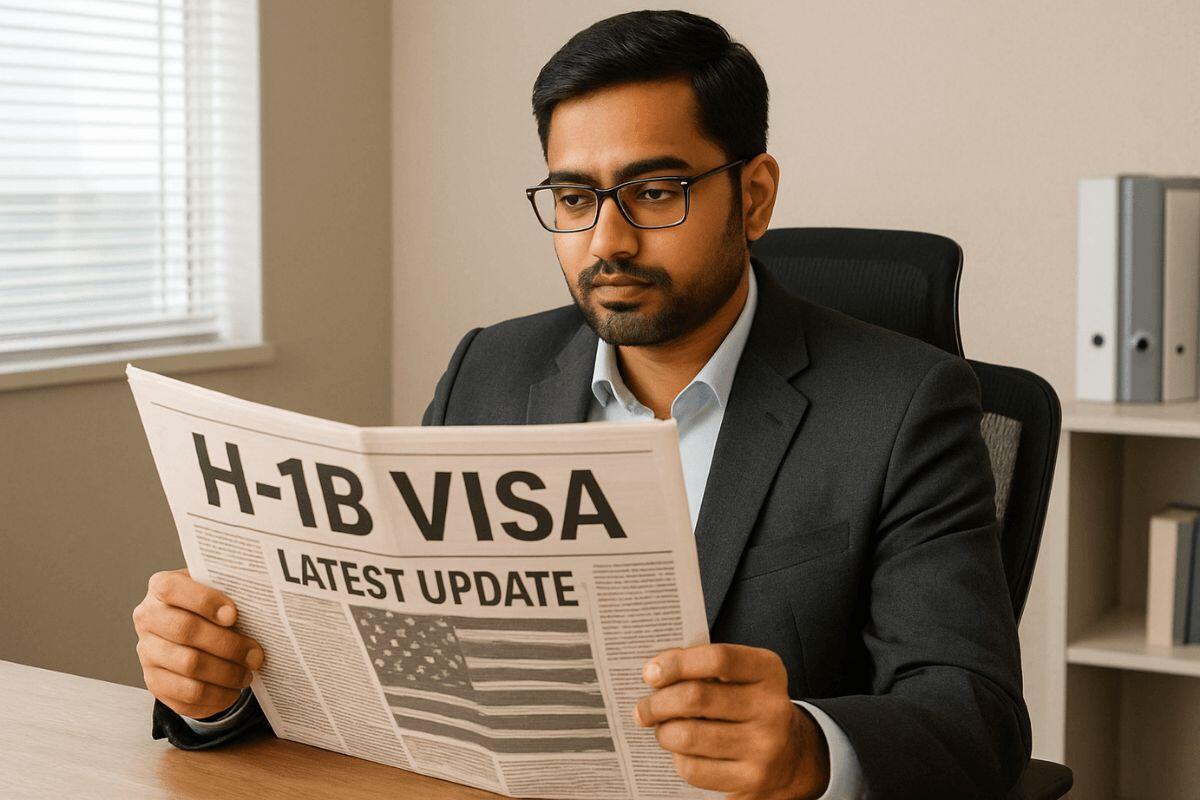
In September 2025, a presidential proclamation added a $100,000 payment to certain new H-1B petitions. A year later, the rules for Indian professionals look very different: a federal court has vacated the agency guidance that put the payment into effect, the random H-1B lottery has been replaced by wage-weighted selection, and DHS has proposed a separate $103,265 fee on cap-subject petitions.
These changes matter most to Indians. Of the H-1B petitions USCIS approved in fiscal year 2024, 71 percent were for beneficiaries born in India (283,397 of 399,395), according to USCIS's report to Congress.
This guide explains where each change stands as of October 2026, what it costs an employer to sponsor you, and what to do next whether you already hold an H-1B or hope to get one.
Where the $100,000 H-1B Payment Stands in 2026
On September 19, 2025, the President signed Proclamation 10973, which restricts entry of new H-1B workers unless their petition is accompanied by a $100,000 payment. It took effect at 12:01 a.m. Eastern on September 21, 2025, for 12 months unless extended.
Who the payment was written to cover
According to USCIS, the payment applies to certain H-1B petitions filed at or after that time:
- Petitions for beneficiaries who are outside the United States and do not have a valid H-1B visa
- Petitions that request consular notification, port of entry notification, or pre-flight inspection
- Change of status, amendment, or extension requests where USCIS finds the worker ineligible, for example because they left the US before a decision
It does not apply to H-1B visas already issued and still valid, to petitions filed before September 21, 2025, or to amendment, change of status, or extension petitions for someone inside the US when USCIS grants the request. Current H-1B visa holders can still travel in and out of the United States. Under the USCIS process, employers pay through pay.gov before filing, and the Secretary of Homeland Security grants exceptions only in what USCIS calls "extraordinarily rare" national-interest cases.
What the courts have done
On June 8, 2026, the US District Court for the District of Massachusetts vacated the agency guidance implementing the $100,000 payment in State of California v. Mullin. On July 24, 2026, the First Circuit Court of Appeals denied the government's motion to stay that order while it appeals. USCIS says DHS will comply with the court's order while it considers next steps, and that it still plans to collect the payment if the order is later lifted.
The September 2026 extension
On September 18, 2026, the President signed Proclamation 11069, which renews the $100,000 restriction from September 21, 2026, for another 12 months unless extended again. Because the payment depends on litigation that is still ongoing, check the USCIS H-1B page for the current position before any petition is filed for you.
A separate $103,265 fee has been proposed
On August 25, 2026, DHS published a proposed rule that would add a $103,265 fee, payable at filing, to all H-1B cap-subject petitions, including those under the master's cap. Cap-exempt employers such as universities and nonprofit research organizations would not pay it. DHS says this fee rests on different legal authority than the proclamation and would be in addition to any proclamation payment. The comment period closed on September 24, 2026, and the fee does not apply unless DHS publishes a final rule.
What It Costs to Sponsor an H-1B in 2026
Your employer files the petition and pays the USCIS fees. These are the main H-1B fees on the current USCIS fee schedule (Form G-1055, edition 10/01/26):
| USCIS fee (paid by the petitioning employer) | Amount |
|---|---|
| H-1B registration (cap cases only) | $215 per beneficiary |
| Form I-129 for H-1B | $780 paper or $730 online; $460 for small employers and nonprofits |
| Asylum Program Fee | $600; $300 for small employers; $0 for nonprofits |
| Fraud Prevention and Detection fee | $500 for an initial H-1B or a change of employer |
| ACWIA fee | $1,500 or $750, depending on employer size, unless exempt |
| Public Law 114-113 fee | $4,000 if the employer has 50 or more US employees and more than half are in H-1B or L status |
| Premium processing (optional) | $2,965 |
| Proclamation payment | $100,000 on the fee schedule; implementing guidance vacated by a court on June 8, 2026 |
If you apply for your visa stamp in India, the State Department's application fee for H visas is $205. Check travel.state.gov for the current amount and any other charges before your interview.
How Does the New Wage-Based Selection Work?
The H-1B selection is no longer a simple random lottery. DHS published the weighted selection final rule on December 29, 2025. It took effect on February 27, 2026, and first applied to the FY 2027 registration season in March 2026.
How registrations are weighted
When registrations exceed the annual cap of 85,000 (65,000 regular plus 20,000 for holders of a US master's or higher degree), each registration enters the selection pool based on the highest OEWS wage level the offered salary meets for that occupation and work location:
- Level IV (highest paid) registrations enter four times
- Level III registrations enter three times
- Level II registrations enter twice
- Level I (entry-level) registrations enter once
In the final rule, DHS estimated that a beneficiary's chance of selection under the old random process was just under 30 percent. Under weighting, it estimated that a Level I registration's chance falls to about 15 percent, a 48 percent reduction, while a Level IV registration's chance rises to over 61 percent.
The Department of Labor has also proposed revising prevailing wage levels for H-1B and some employment-based green card cases (March 27, 2026). That rule is a proposal and is not final.

What does this mean if you're an early-career professional?
If your offer sits at Level I, your registration now has one entry against up to four for senior roles, so your odds are lower than under the old lottery. Holders of a US master's or higher degree still have the separate 20,000 cap, but weighting applies to those registrations too.
Wage levels are set for each occupation and area of intended employment, so the same job title can fall into different levels in different cities. Before your employer registers you, ask which OEWS wage level your offered salary meets for your role and work location. The Department of Labor publishes prevailing wage information through its Office of Foreign Labor Certification.
Indian IT Firms and the Early Results
The September 2026 proclamation reports early effects of these changes. According to its text:
- The largest IT staffing and outsourcing firms cut their combined H-1B registrations from 24,946 to 2,055, a 92 percent decrease, since the 2025 proclamation and the weighted selection rule
- Registrations for beneficiaries with at least a US master's degree rose from 45.1 percent of registrants for FY 2026 to 66.1 percent for FY 2027
- Job offers at the two highest wage levels accounted for about 46.3 percent of registration selections, while the lowest wage level accounted for 17.8 percent
For Indian professionals, the practical result is that entry-level roles at large outsourcing firms are a much smaller route into the H-1B than they used to be.
How many people apply now
Demand still exceeds the cap. USCIS data shows 343,981 eligible registrations for FY 2026, down from 470,342 for FY 2025, with 120,141 registrations selected. For FY 2027, the first season under weighted selection, USCIS announced on March 31, 2026 that it had received enough registrations to reach the cap, and selected petitioners could file from April 1, 2026.
What Current H-1B Holders Should Know
Extensions, amendments and changing employers
If you are in the US in valid H-1B status and your employer files an extension, amendment, or change of employer petition that USCIS grants, the $100,000 proclamation payment does not apply, and you can keep traveling on your current visa. You can start working for a new H-1B employer once it properly files a non-frivolous petition for you, or on the start date in that petition, whichever is later.
If you lose your job
Under current rules, if your H-1B employment ends you may have up to 60 consecutive days, or until your authorized stay ends if that is sooner, to find a new employer, change status, or leave the US. On September 11, 2026, DHS proposed removing this grace period. Comments are open until November 10, 2026, and the current rule stays in place unless a final rule is published. Our H-1B layoff checklist and H-1B grace period calculator walk through what to do in those days.
Looking beyond the H-1B
Some Indian professionals are also weighing work visas in other countries. Those rules change too, so check each country's official immigration website before you plan around them. For bills in Congress that target the H-1B program, see our EXILE Act explainer.
Conclusion
The H-1B picture for Indian professionals in 2026 is split. Wage-weighted selection is settled and already shaping who gets picked. The $100,000 payment is tied up in court, has been renewed by a new proclamation, and sits alongside a separate proposed $103,265 fee that is not yet final.
If you are already on an H-1B in the US, extensions and employer changes that USCIS grants fall outside the proclamation payment, so focus on keeping your status clean and knowing your grace-period rights. If you hope to be sponsored, ask your employer about your wage level and check the USCIS H-1B page for the current fee position before any filing.
If you are also on the green card path, see how India's EB-2 visa backlog and recent green card rule changes affect your timeline.
Frequently asked questions
Do employers still have to pay the $100,000 H-1B fee?
The proclamation's $100,000 payment applies to certain new H-1B petitions filed from September 21, 2025, mainly for workers outside the US. On June 8, 2026, a federal court in Massachusetts vacated the guidance implementing it, and on July 24, 2026 the First Circuit denied the government's request to stay that order. DHS says it is complying with the order but plans to collect the payment if the order is lifted. A September 2026 proclamation renews the restriction for 12 months, so check the USCIS H-1B page before filing.
How does the new wage-based selection system work for H-1B visas?
Since the FY 2027 registration season, higher-paid registrations get more entries in the selection pool. Level IV registrations are entered four times, Level III three times, Level II twice, and Level I (entry-level) once. DHS made this final in a rule effective February 27, 2026.
Are H-1B extensions and renewals affected by the $100,000 fee?
No, when the petition asks for an extension, amendment, or change of employer for someone inside the US and USCIS grants it. The payment can apply if USCIS finds the worker ineligible for that change or extension, for example because they left the US before a decision.
Is the H-1B visa only for Indians?
No. The H-1B is open to qualified workers of any nationality in a specialty occupation. Indians receive most approvals: 71 percent of H-1B petitions approved in fiscal year 2024 were for beneficiaries born in India, followed by China at about 12 percent.
How much does an H-1B visa cost for Indians?
The employer pays the USCIS fees. For a new cap case these usually include the $215 registration fee, the $780 Form I-129 fee ($460 for small employers and nonprofits), the $600 Asylum Program Fee ($300 for small employers, $0 for nonprofits), the $500 fraud prevention fee and a $750 or $1,500 ACWIA fee, plus $2,965 if premium processing is used. Some large H-1B-dependent employers pay a further $4,000. The $100,000 proclamation payment is subject to the court order described above.