
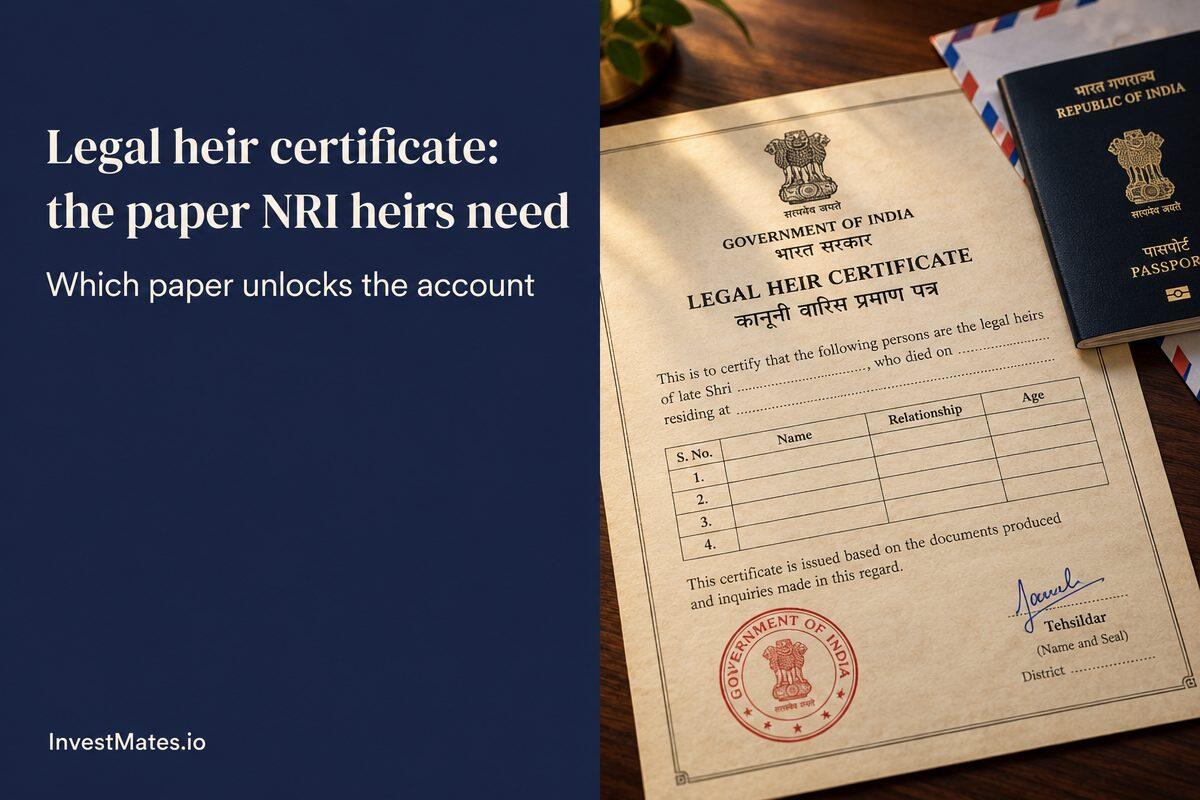
You're an NRI heir to someone who died in India and need to prove who the heirs are. A legal heir certificate in India, issued by a revenue office, does that, and you can apply from the US. It doesn't prove ownership, so which paper a holder wants depends on the amount.
What a legal heir certificate in India proves
A legal heir certificate names the people who inherit from someone who has died and records how each is related to them. A revenue authority issues it, usually at Tahsildar level, after a local inquiry.
No single national law sits behind it, so forms, fees and processing times differ by state. Check your state's revenue department site for the application form before anything else.
Institutions accept it as proof of who the heirs are for:
- Pension, provident fund and other employer dues
- Bank accounts, insurance claims and utility connections
- Shares and fund units above the quick-claim limits covered below
It's administrative proof, not a court's finding, so it isn't conclusive evidence of succession and it doesn't prove ownership of land or a flat.
Legal heir certificate or succession certificate: which one fits
The two get confused because both name heirs. They differ in who issues them and what they cover.
When you need a succession certificate in India
A succession certificate comes from the District Judge under Part X of the Indian Succession Act, 1925. It lets the holder collect the dead person's debts and securities, such as bank deposits, shares and fund units, and it's valid across India.
You apply to the court where the deceased lived at death, or where their property sits if there was no fixed home. The petition names the relatives, the debts and the securities, and the court gives notice so others can object.
The court decides in a summary proceeding and can ask the holder for security. It can't cover land or buildings, because the Act limits it to debts and securities.
What changed for wills and probate
If the person left a will, the route is probate or letters of administration, not a succession certificate. Until recently, Section 213 barred heirs under certain wills from asserting rights in court without probate when the property sat in Mumbai, Kolkata or Chennai.
The Repealing and Amending Act, 2025 omitted that section after Presidential assent on 20 December 2025, so probate is no longer a precondition there. Probate itself remains available, and a grant still binds everyone, so a holder can still ask for it.
Which document the bank, broker or fund house will accept
A succession certificate is the slowest route, and it's often not the one a holder requires. I'd ask each holder for its written claim checklist before filing anything in court, because RBI and SEBI now set value limits below which no court order is needed.
Bank deposits under RBI's 2025 Directions
The Reserve Bank of India (Settlement of Claims in respect of Deceased Customers of Banks) Directions, 2025, issued on 26 September 2025, told banks to implement them by 31 March 2026. In practice:
- With a nominee or a survivor on the account, the bank pays that person and can't ask for a succession certificate, probate or a surety, whatever the amount.
- Without a nominee or a will, claims below ₹15 lakh at a commercial bank (₹5 lakh at a co-operative bank) follow a simpler route. The papers are a claim form, death certificate, ID, indemnity bond, no-objection from the other heirs and proof of heirship.
- Above those limits, banks ask for a succession certificate, a legal heir certificate or a magistrate-sworn affidavit, and may seek sureties.
- Banks must settle deposit claims within 15 calendar days of receiving complete papers.
The Directions exclude government schemes such as PPF and SCSS. Ask your bank in writing how its limit applies to NRE and NRO accounts.
Shares and fund units under SEBI's 2026 framework
SEBI's circular of 23 July 2026, effective 30 days after issue, sets three tiers by value. Each tier asks for more paper than the last.
- Quick tier: up to ₹10,000 in physical holdings or ₹30,000 in demat, immediate relatives only, with a plain-paper undertaking and proof of relationship.
- Simplified tier: up to ₹10 lakh in physical form and ₹30 lakh in demat, with a notarised indemnity bond and an affidavit-cum-NOC from every heir.
- Above that, the heirs' NOC is needed, plus one of three papers. The options are a will with indemnity bond, a legal heirship certificate (Tahsildar rank or higher) with indemnity bond, or a court-issued succession certificate, letters of administration or decree.
- Entities must process a complete claim within 21 calendar days.
Say Priya in Austin and her brother Arjun are the only heirs to a ₹12 lakh Pune savings account and a ₹25 lakh demat account, with no nominee or will on either. Both sit under the simplified limits.
An indemnity bond, a no-objection from Arjun and proof of heirship can do the job at both. No court petition is needed.
Land and flats
A succession certificate can't cover them, and a legal heir certificate doesn't prove ownership. Title follows the will or the succession law that applies, and the land records are then updated through mutation. Once title is clear, selling it in India brings its own NRI tax and TDS rules.
Who this applies to
Succession law follows the deceased person's religion, not your passport or residence. Hindus, Sikhs, Jains and Buddhists fall under the Hindu Succession Act, 1956, Muslims under personal law, and Christians, Parsis and Jews under the Indian Succession Act, 1925.
Being an NRI doesn't disqualify you as an heir. A US citizen can inherit too, and FEMA Section 6(5) lets a person resident outside India hold Indian property inherited from someone who lived in India.
You can skip the court entirely in two cases:
- The account has a nominee or a surviving joint holder.
- The holder's value limit covers your claim.
A will with a named executor also changes the route. If your parents are still alive, the legal documents for parents are far easier to arrange now than after a death.

How to apply from the US without travelling
You don't need to be in India for the application, only someone there you trust.
Documents to gather
- The deceased's death certificate from the municipal office
- Your ID and address proof, plus passport and visa copies to show NRI status
- Date-of-birth proof for every heir
- Proof of each heir's relationship to the deceased
- An affidavit on stamp paper listing all legal heirs
- A signed application listing every heir with address and relationship
Steps from the US
- Sign a power of attorney naming a relative or lawyer in India, and have it notarised in the US.
- Get the apostille from your state's apostille office, usually the Secretary of State. An Indian consulate accepts an apostilled document without further attestation.
- Without an apostille, the consulate attests the notarised signature instead.
- Your agent files the application at the revenue office or on the state's online portal where one exists.
- A revenue inspector verifies the papers, and some states publish a notice so others can object.
- Collect the certificate and order several certified copies, because each bank, broker and fund house keeps one.
After the certificate: your US filings
A legal heir certificate names the heirs, and the IRS asks a separate question once the money is yours.
If you inherit more than $100,000 from a foreign person in a year, you report it on Part IV of Form 3520, even though no tax is due. The penalty for missing it can reach 25% of the amount.
Inherited accounts can also pull you into Form 3520 and Form 8938 reporting. Two other rules apply:
- The FBAR applies once your foreign accounts together exceed $10,000 at any point in the year.
- Property gets a stepped-up US basis under IRC Section 1014, while India keeps the deceased's original cost, so the two countries compute different gains on a later sale.
Three misreadings that send heirs to court
- A legal heir certificate transfers the property. It doesn't. It names the heirs, ownership follows the will or succession law, and the land records change separately through mutation.
- Every account needs a succession certificate. It doesn't. A nominee, a surviving joint holder, or a claim under the RBI and SEBI limits can finish without one.
- A will covering Mumbai, Kolkata or Chennai property must go through probate first. That rule, Section 213, was omitted in 2025.
Your next step
Before filing anything in court, ask each bank, broker and fund house for its written claim checklist and the value limit it applies. I'd also start the apostilled power of attorney now, since most Indian filings wait on it. If you want the Indian paperwork and the IRS reporting planned together, InvestMates can map both.
Frequently asked questions
What is an alternative for a legal heir certificate?
The court-issued alternatives are a succession certificate, probate or letters of administration, and a registered nominee skips the process entirely. Below the RBI and SEBI limits, a notarised indemnity bond with a no-objection from the other heirs often replaces both. A registered will and estate planning for NRIs avoid the problem for the next generation.
How much does it cost to get a legal heir certificate in India?
Each state sets its own fee for a legal heir certificate, so there's no single national figure. Budget separately for notarising and apostilling the power of attorney, stamp paper for affidavits, courier, and a local lawyer or agent. Ask the revenue office or the state portal for the current fee before you plan.
How much time will it take for a legal heir certificate?
The time for a legal heir certificate depends on the state, on whether the revenue office publishes a notice for objections, and on how clean your papers are. A document from abroad that needs correcting adds more.
Can an OCI cardholder apply for a legal heir certificate?
An OCI cardholder can be named as an heir, because succession follows the deceased's religion and personal law, not the heir's citizenship. Use your passport and OCI card as identity proof. OCI cardholders count as foreign nationals under FEMA rather than NRIs, which matters when you later buy, sell or repatriate.