
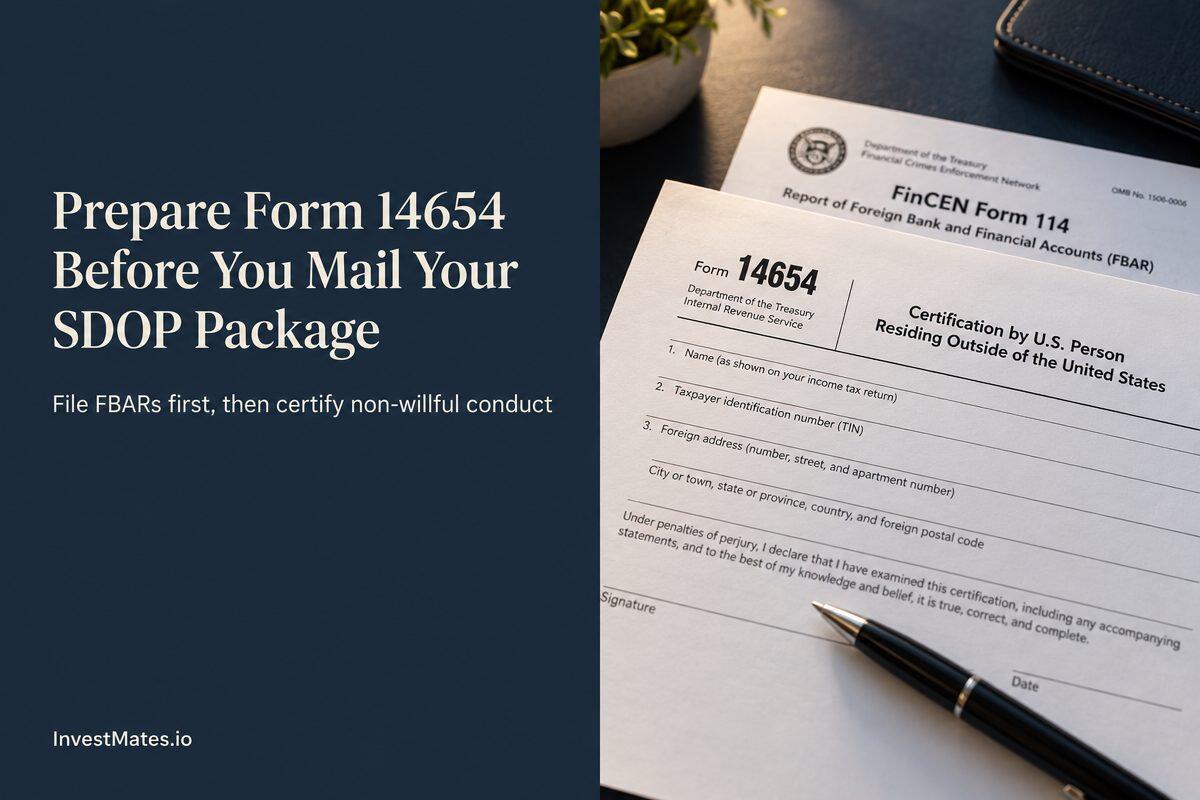
Form 14654 is the signed statement that your missed reporting on Indian accounts was non-willful, and it only works once the amended returns, FBARs and penalty figure behind it are finished. An incomplete statement sends the whole package into normal processing. Build it in this order.
Before you start: confirm the Streamlined Domestic Offshore Procedures fit you
The certification belongs to the Streamlined Domestic Offshore Procedures (SDOP), the domestic streamlined route for non-willful filers who don't pass the foreign residency test. Which route applies to you is a separate decision, and the catch-up options guide walks through it.
H-1B holders who meet the substantial presence test and green card holders can file under SDOP. PFIC compliance for H-1B holders covers the fund reporting that usually sits inside the package.
I plan for SDOP until foreign residence is confirmed for the catch-up years, because a US-based NRI rarely passes that test. For a package filed in late 2026, the covered years are 2023, 2024 and 2025 for returns, and 2020 through 2025 for FBARs.
Step 1: Check your return history and the years outside SDOP
List the three covered tax years, then confirm each return is filed. SDOP takes amended returns, not delinquent originals, so a covered year with no filed return can't go through it. File that return the normal way first, with its information returns, and it's compliant when the package goes in.
Years older than the three covered ones stay outside SDOP. A required Form 8938 or Form 8621 for an earlier year keeps that return open until it's filed (IRC 6501(c)(8)), and a missing Form 8938 also carries a $10,000 penalty.
I handle those years separately, with a reasonable cause statement, and your CPA decides how they're filed.
Step 2: Finish the amended returns, information returns and FBARs
Prepare a Form 1040-X for each covered year and attach every information return you missed. For Indian holdings that usually means Form 8938 and, for mutual funds, Form 8621 for each fund.
The 5% penalty sits on top of the tax. It doesn't replace the tax and interest on your amended returns, including PFIC tax on Indian mutual funds.
File the missing FBARs for all six years before you sign the certification, which states they're done. The FBAR guide for NRIs covers the filing steps, and the right FBAR exchange rate converts each balance.
Step 3: Calculate the SDOP penalty
Add up the year-end value of every affected foreign asset for each covered year, then take 5% of the highest total. An asset is affected for a year only if one of these applies:
- It should have been on your FBAR that year, and wasn't.
- It should have been on Form 8938 that year, and wasn't.
- It was reported, but the income from it wasn't.
An asset reported properly, with its income, stays out, and a fully compliant year is entered as zero. Value each asset at December 31 using any reasonable method, with no valuation discounts.
An illustration with Priya
Worked example with made-up numbers
Priya's affected assets: an NRO account, two mutual fund folios and a ULIP.
Year-end total, 2020: $52,000
Year-end total, 2024: $95,000, her highest year
Year-end total, 2025: $91,000
Base: the highest single year, $95,000
Penalty: 5% of $95,000 = $4,750
The penalty isn't a sum across years, and it isn't the latest balance.
Two rules I apply when I build the base
- A ULIP policy counts once, at its year-end statement value. I don't replay its fund units as a PFIC.
- An FBAR you already filed sets a floor. Its stated maximum value is a documented lower bound for that year, so I use the larger of it and my own rebuild, never the sum.
Keep your workings. You certify the amount is accurate, and you may have to show how you got it.

Step 4: Write your statement of non-willful conduct
Write the narrative part of the SDOP certification of non-willfulness as a factual account, with the unfavorable facts in it. The IRS defines non-willful conduct as conduct due to negligence, inadvertence or mistake, or a good-faith misunderstanding of the law's requirements. Cover these points, taken from the IRS's own instructions:
- Your personal and financial background.
- The source of funds in each account, such as an inheritance or an account opened while you lived in India.
- Your contact with each account: deposits, withdrawals and investment decisions.
- Any advisor you relied on: name, address, phone number, a summary of the advice, how you met and how often you spoke.
- Any inadvertent "No" on Schedule B, line 7a, and whether you or your preparer gave it.
- Separate reasons for each spouse, if the reasons differ.
The IRS asks for the whole story, favorable and unfavorable. Your earlier returns, bank statements and preparer are all on record, so the statement has to match them.
Where I stop
I won't tell you whether your conduct was non-willful, and no template can. If anything in your history suggests you knew the rules and chose not to report, speak to a tax attorney before you sign. The IRS points those taxpayers to its Criminal Investigation Voluntary Disclosure Practice.
Step 5: Complete and sign Form 14654
Complete the identification details, the schedules of affected assets, the penalty computation and the narrative portion, then sign. By signing, you state that you're eligible, that all required FBARs have been filed, that your failures resulted from non-willful conduct, and that the penalty amount is accurate.
Send one original signed certification and attach a copy to each amended return and information return. Don't attach it to your FBARs. Keep your records of asset values.
Step 6: Label, pay and mail the package
Assemble the package in this order:
- Write "Streamlined Domestic Offshore" in red at the top of the first page of each amended return and each information return.
- Include payment for the tax due, the interest and the 5% penalty, with your taxpayer identification number on the check.
- Mail the package on paper to the IRS in Austin, Texas, at the address on the IRS SDOP page, marked "Attn: Streamlined Domestic Offshore".
- Keep complete copies of everything you send.
Skip the red label and the IRS processes your returns the normal way. Electronic submissions aren't accepted.
What the IRS can check after you mail it
Submissions may go through verification against information from banks, financial advisors and other sources. If what you certified doesn't match, the IRS says the returns may face examination, additional civil penalties and, where appropriate, criminal liability. I treat the file as one an examiner will read, with every statement traceable to a record.
Conclusion
Start with the asset list: every Indian account, fund and policy you've held in the last six years, with its year-end value. I'd build it before writing a word of the statement, because the penalty and the facts both come from it. For a second opinion on your Form 14654, talk to an InvestMates advisor.
Frequently asked questions
Can you provide an example of an IRS Form 14654 statement?
There's no approved wording, and copied wording weakens the statement. A strong one gives dated, checkable facts, such as "I opened an NRO account in Hyderabad in 2014, while living in India." Add who handled your Indian filings and when you first learned the US rules applied, using only facts true for you.
Is the SDOP certification the same as Form 14653?
No. Form 14653 certifies non-willful conduct for the foreign streamlined route, which requires passing the non-residency test, and the domestic route uses the form this guide covers instead. If you pass the test, the foreign streamlined route applies to you.
Does the IRS acknowledge an SDOP submission or send a closing letter?
No. The IRS doesn't acknowledge receipt of streamlined submissions, and the process doesn't end with a closing agreement. Your returns aren't audited automatically, but they can be selected under normal audit selection, so keep your records.
What if I find a mistake after I've mailed my SDOP package?
You can correct an SDOP submission, as long as the returns you submitted aren't under examination. File corrected amended returns, an amended certification marked "amended" in red, or both, and e-file amended FBARs if an FBAR was wrong. If you've already received an IRS notice, get advice before you file anything.