

If you bought Sovereign Gold Bonds while living in India and later moved to the US, you can keep holding them until maturity or the next RBI early-redemption window. No one forces a sale.
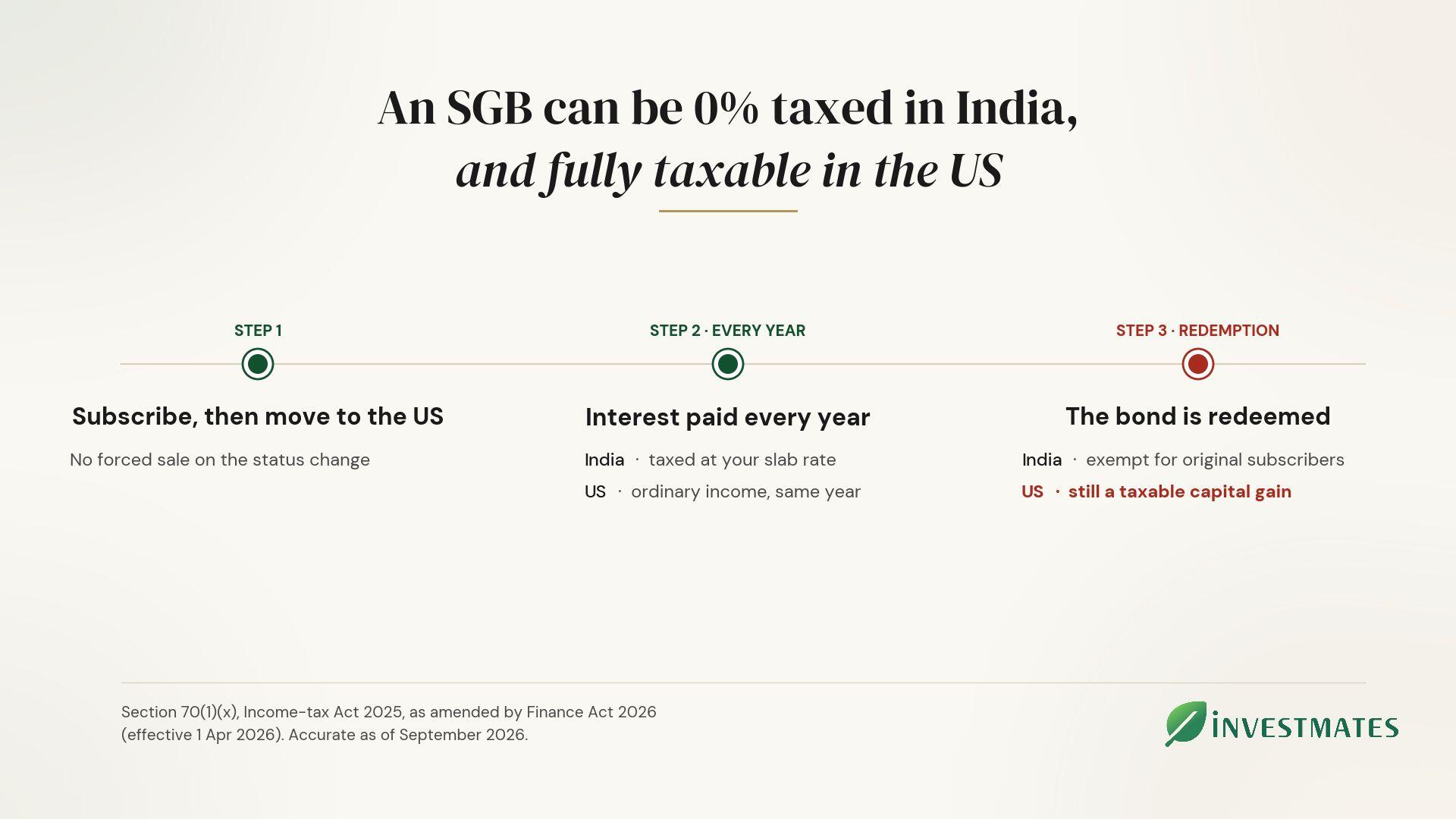
What changes is the tax: the 2.5% annual interest and the redemption gain are both taxable in the US every year, even in the exact case where India's own rules say you owe nothing at all.
Can you keep a sovereign gold bond after you become an NRI?
Only Indian residents can subscribe to a new Sovereign Gold Bond tranche. The RBI gold bond scheme runs under the Foreign Exchange Management Act, 1999, and its eligibility list doesn't include non-resident Indians.
You can't open a fresh SGB position after your status changes, and you can't buy into a tranche as an NRI even when one is running.
What you already hold is a different question. If you subscribed while you were a resident and your status later changed to NRI, RBI lets you keep the bond. You're not required to sell, transfer, or redeem it early just because you moved.
You hold it through to the early-redemption window that opens after the fifth year, or straight through to the eight-year maturity date, same as any other holder.
There's a practical wrinkle worth knowing before you get there: RBI hasn't opened a new SGB tranche since February 2024. If you're searching for a fresh issue to add to an existing holding, there isn't one open right now, and no relaunch date has been confirmed.
Meera is a good example of the situation this article is written for. She subscribed to the 2019-20 Series IV tranche while she lived in Pune, moved to the US on an H-1B in 2021, and still holds the bond today. Nothing about her move changed her SGB. It changed what she owes on it, in a country RBI's rules never touch.
How India taxes the bond, and where that stops mattering for the IRS
India taxes an SGB at three separate points, and the rules shifted meaningfully in 2026.
The 2.5% annual interest is taxed as income from other sources at your slab rate. RBI doesn't deduct tax at source on it, so it's on you to report and pay.
The gain at redemption depends entirely on how you got the bond and how long you held it. Section 70(1)(x) of the Income-tax Act, 2025, as amended by the Finance Act 2026 (effective 1 April 2026), exempts the maturity gain only if you were the original subscriber at issue and held the bond continuously through to redemption.
Buy the same bond on the stock exchange, even if you then hold it eight years, and the exemption doesn't apply. Redeem early in one of RBI's windows, even as the original subscriber, and it doesn't apply either.
Before this amendment, the exemption's scope was genuinely unclear, and plenty of investors assumed any SGB held to term qualified. It doesn't anymore, if it ever fully did.

| When | India tax | US tax |
|---|---|---|
| Annual interest (2.5%) | Taxable at your slab rate as income from other sources | Taxable as ordinary income the year it's paid |
| Redemption at maturity, original subscriber | Exempt under Section 70(1)(x) | Taxable as a capital gain, India's exemption has no US counterpart |
| Early redemption, exchange sale, or maturity of a secondary-market purchase | 12.5% LTCG without indexation if held over 12 months, otherwise your slab rate | Taxable as a capital gain, long term if held over a year |
That last column is the one that catches people. The IRS doesn't ask whether India exempted the gain. It asks what you received and what you paid, converted to dollars at the relevant exchange rates, and taxes the difference as a capital gain under ordinary US rules.
Meera's bond, issued in the 2019-20 tranche, matures fully exempt in India roughly eight years after issue. On her US return, she still reports the gain and still owes US tax on it, because Section 70(1)(x) is a rule the IRS has no obligation to recognize and doesn't.
What the IRS actually does with your SGB
Two misreadings come up often enough to name directly.
Not a PFIC
The first is treating the gain as a PFIC. It isn't one. PFIC rules under IRC Section 1297 apply to foreign corporations that meet a passive-income or passive-asset test, the same reason Indian mutual funds are PFICs.
An SGB is a sovereign debt instrument issued directly by the Reserve Bank of India, not a corporation. There's no foreign corporation in the structure, so Section 1297 has nothing to attach to.
No Form 8621, no excess-distribution regime. I wouldn't spend a minute running PFIC tests on a bond once the structure rules it out this cleanly.
Not a 28% collectible
The second is assuming gold-linked means gold-taxed, specifically that the IRS applies its 28% collectibles rate the way it would to physical bullion or a gold ETF. It doesn't.
The collectibles definition under IRC Section 408(m)(2) covers tangible personal property, coins, bullion, metals, gems, and a short list of similar physical assets. A bond is a debt instrument, not tangible property, even when its redemption value tracks the gold price.
Your SGB gain gets ordinary long-term capital gains treatment, 0%, 15%, or 20% depending on your income, the same as any other long-term capital gain, not the 28% rate.
What the SGB still triggers
What the SGB does trigger is reporting. The demat account or Bond Ledger Account holding it is a foreign financial account, and if your aggregate foreign accounts exceed $10,000 at any point in the year, you file an FBAR.
Depending on your filing status and where you live, you may also cross the Form 8938 threshold for FATCA. Neither filing is optional because the underlying asset happens to be exempt in India.
The interest adds a second layer worth planning around: India taxes it, and the US taxes the same rupee. The US-India DTAA doesn't exempt the interest in either country.
It gives you a foreign tax credit route through Article 23, so you're not paying the full rate twice, but you do need to claim it, and the credit is capped at the US tax attributable to that income.
Who this applies to
This covers NRIs who are also US tax residents, green card holders, US citizens, and anyone who meets the Substantial Presence Test, and who subscribed to a sovereign gold bond while they were an Indian resident.
It doesn't cover someone still resident in India: your India-only tax position is a different, simpler calculation that doesn't touch the IRS.
It also doesn't cover physical gold. If you're asking about jewelry or bars rather than a bond, the rules on carrying gold into India are a separate topic entirely, with their own customs and duty framework.
It also doesn't cover a fresh purchase. There's no version of this article where you buy an SGB as a current NRI, because the scheme doesn't let you.
What to do about it
Pull your Bond Ledger Account or demat statement and confirm two things: whether you're the original subscriber on record, and your purchase price in the currency you paid it in. Both determine whether India's exemption applies to you at all, and neither determines your US liability, which you owe either way.
Report the interest on Schedule B the year it's paid, not the year you eventually convert or remit it. Track your cost basis in US dollars using the exchange rate on your purchase date.
File FBAR and, if you cross the threshold, Form 8938 for the account holding the bond, every year you hold it, not just the year it matures.
If India withholds or assesses tax on the interest, claim the foreign tax credit on Form 1116 rather than eating the tax twice.
If your bond is approaching its five-year mark and an RBI early-redemption window is opening, decide before that window whether redeeming early is worth losing the India-side exemption. Compare your general NRI capital gains position before you commit either way, since the SGB decision doesn't sit in isolation from the rest of your India portfolio.
Conclusion
I'd tell any client in Meera's position to stop treating the India exemption as the answer to the US question, because it was never designed to be one.
Pull your Bond Ledger Account statement this week, confirm your original-subscriber status and your USD cost basis, and get ahead of the FBAR and interest reporting before your bond's next payout date arrives. If the numbers get complicated once an early-redemption window opens, that's the moment to bring in someone who files both returns.
Frequently asked questions
Is an SGB treated as a PFIC?
No. PFIC rules under IRC Section 1297 apply to foreign corporations, and an SGB is a sovereign bond with no corporate entity behind it, so Section 1297 doesn't apply and no Form 8621 is required.
Do I need to report my SGB on FBAR?
Yes, if your aggregate foreign accounts, including the demat or Bond Ledger Account holding the SGB, exceed $10,000 at any point in the year. See the FBAR filing rules for NRIs for the full threshold and deadline detail.
What happens to my SGB's India tax exemption if I sell before maturity?
You lose it. Section 70(1)(x) only exempts the gain for an original subscriber who holds to maturity. Sell early or hold a bond bought on the secondary market, and India taxes the gain at 12.5% LTCG (no indexation) for a hold over 12 months, or your slab rate for a shorter one.
Can I claim a foreign tax credit for Indian tax on my SGB interest?
Yes. The interest is taxable in both countries, and Article 23 of the US-India DTAA lets you claim a foreign tax credit on Form 1116 for tax India actually assessed, up to the US tax attributable to that same income.