
If you hold an OCI card, you don't have to link your PAN with Aadhaar, because you're not an Indian citizen and the rule exempts non-citizens without an Aadhaar number. That exemption hasn't stopped the department from switching off OCI holders' PANs. The fix is a records update, not a link.
How PAN-Aadhaar linking works for OCI holders and NRIs
Section 139AA of the Income-tax Act, 1961 requires anyone eligible for Aadhaar to quote it and tie it to their PAN. Miss that and the PAN becomes inoperative: it still exists, but the tax system stops honouring it. The last date to link without consequences was 30 June 2023.
Four groups were carved out by Notification 37/2017 (read the notification), dated 11 May 2017 and in force from 1 July 2017. The rule doesn't apply to an individual who doesn't hold an Aadhaar number or enrolment ID and who is:
- residing in Assam, Jammu and Kashmir or Meghalaya
- a non-resident under the Income-tax Act
- 80 or older at any time during the year
- not a citizen of India
Why OCI holders sit in the non-citizen group
India doesn't allow dual citizenship, so an OCI card is issued only to someone who holds a foreign passport. Under FEMA, OCI holders are treated as foreign nationals rather than NRIs, which puts every OCI holder in the "not a citizen of India" category.
If you're unsure where your status sits, NRI vs OCI status is worth getting straight first.
That distinction matters more than it looks. The non-resident exemption ends the year you become a resident of India for tax. The non-citizen exemption doesn't, so an OCI holder who moves to India and turns resident still isn't required to link.
The condition most OCI holders miss
Read the notification again: it exempts people who don't possess an Aadhaar number. Plenty of OCI holders got Aadhaar while still Indian citizens living in India. Aadhaar enrolment needs 182 days of residence in the 12 months before applying, so getting Aadhaar as an NRI is rare, but holding an old one is common.
The department's own published lists of exempt groups say "not a citizen of India" without repeating the condition. I don't rely on that shorter wording. If you hold an Aadhaar number, I'd link it and pay the fee, because the notification text is what an assessing officer reads when your refund is held up.
What an inoperative PAN costs you
Rule 114AAA of the Income-tax Rules, 1962 spells out what happens when a PAN goes inoperative. None of it stops you from filing, but all of it costs money or time:
- You get no refund on any return filed against that PAN.
- You earn no interest on the refund for the period the PAN stayed inoperative.
- Payers deduct TDS at the higher no-PAN rate, at least 20% (Section 206AA of the 1961 Act).
- Sellers collect TCS at the higher no-PAN rate (Section 206CC of the 1961 Act).
On an NRO account, a rented flat or a share sale, that higher deduction lands every time money is paid to you. Brokers have also blocked or restricted trading on accounts tied to inoperative PANs, which can be the first sign anything is wrong.
Why exempt OCI holders got switched off anyway
The department never asked anyone to declare an exemption. It mapped residential status from income tax returns filed in the last three assessment years, or from status already reported to the jurisdictional assessing officer. Anyone missing from both lists was treated as someone who should have linked.
That caught a predictable group. Many OCI holders got their PAN as Indian citizens, before naturalising abroad, and the PAN record still shows an Indian citizen.
If you didn't file an Indian return in those three years, perhaps because TDS on your NRO interest already covered the tax, nothing in the system said you were exempt.
A worked example
Priya became a US citizen in 2015 and carries an OCI card. She got her PAN in 2010 through Form 49A as a resident Indian citizen and never updated it. Her only Indian income is NRO fixed deposit interest, and she hasn't filed an Indian return since 2019.

| Priya's situation | What the system saw | What happened on 1 July 2023 |
|---|---|---|
| Foreign citizen, no Aadhaar | Indian citizen, no Aadhaar linked | PAN marked inoperative |
| No Indian return in three years | No residential status on record | No exemption applied |
| NRO deposit interest | Payee with an inoperative PAN | Bank deducted TDS at the higher rate |
Linking was never the answer for Priya, because she can't enrol for Aadhaar without 182 days in India. Her fix was to send her assessing officer the documents that prove what the record got wrong.
Who these rules apply to
The non-citizen exemption covers you if you hold a foreign passport, which includes:
- OCI card holders of any age, resident in India or not
- PIO card holders, since the PIO scheme merged into OCI in 2015 and PIO holders are also foreign citizens
- Foreign-born children of Indian parents who hold a PAN
It doesn't cover an NRI who still holds an Indian passport, including a green card holder. You're exempt only as a non-resident, and that exemption falls away the year you qualify as a resident, which for many people means an RNOR year after moving back. From that year, linking Aadhaar becomes mandatory.
What to do about it, in order
Start by checking whether your PAN is operative, then work through these steps.
- Check your status. Use the "Verify Your PAN" or "Link Aadhaar Status" quick link on the e-filing portal, both open without a login, or look at whether recent TDS was deducted at a higher rate.
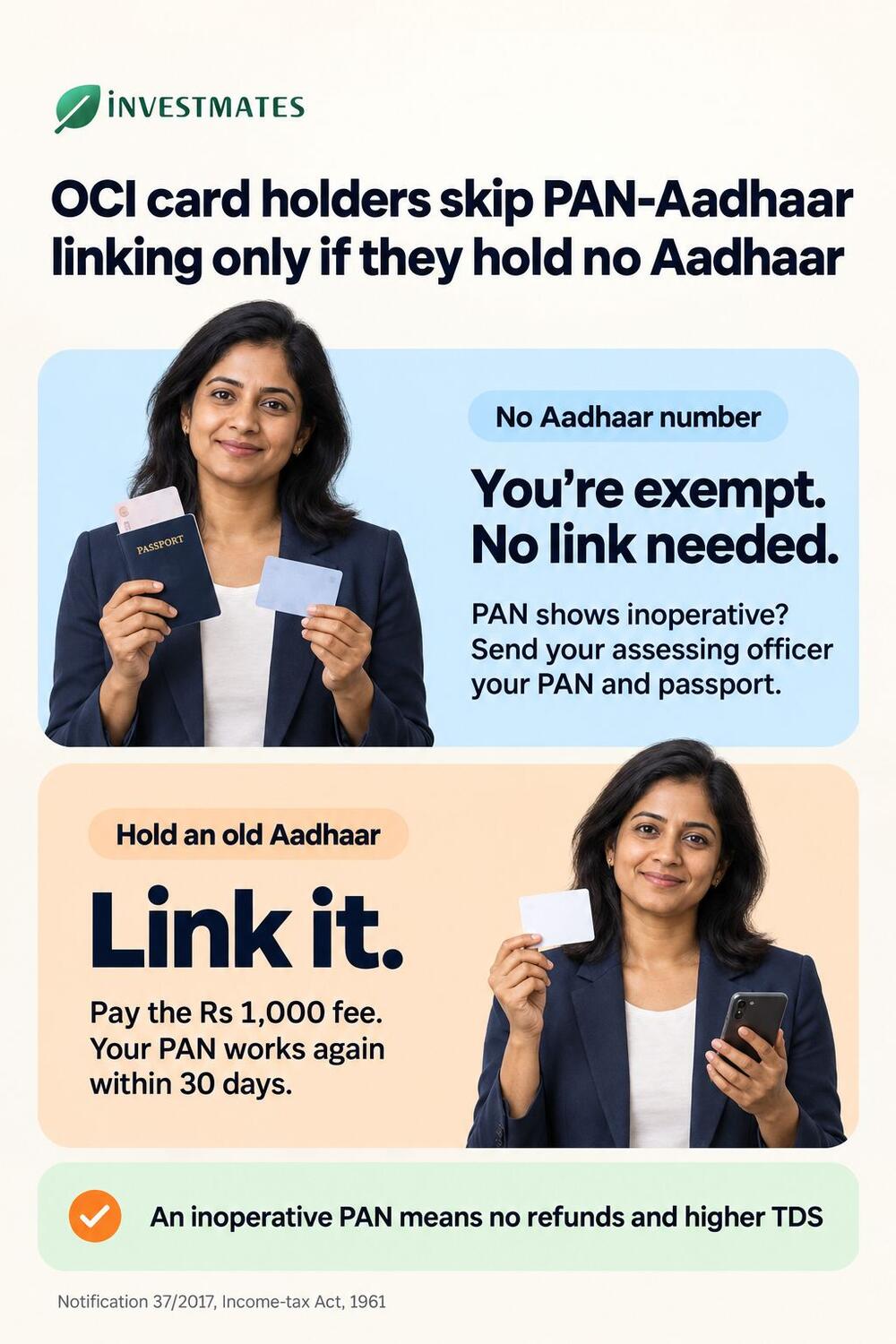
- Decide which group you're in. No Aadhaar means you're exempt and need a records fix. An Aadhaar from your resident years means you should link it.
- If you hold no Aadhaar, write to your jurisdictional assessing officer. Attach a colour scan of your PAN and a copy of your passport showing the period you've lived outside India. Ask for your residential status to be updated in the PAN database.
A request you can adapt for your assessing officer
Subject: Request to update residential status in the PAN database, PAN [your PAN]
I am a citizen of [country] and hold OCI card [number]. I have lived outside India since [year] and I don't hold an Aadhaar number. My PAN has been marked inoperative, although Notification 37/2017 exempts individuals who are not citizens of India and hold no Aadhaar number. I attach a colour scan of my PAN and a copy of my passport showing my period of residence outside India. Please update my residential status in the PAN database.
- If you hold Aadhaar, link it. Use the "Link Aadhaar" option on the e-filing portal after paying the Rs 1,000 late fee (Section 234H of the 1961 Act). The PAN becomes operative within 30 days of intimating the Aadhaar number.
- File your Indian return as a non-resident. The department maps status from returns, so a filed non-resident return puts your status on record.
I'd also check the citizenship field on your PAN record if you applied before taking foreign citizenship. That record drives how the system treats you. If your PAN application history is unclear, how NRIs apply for PAN shows which form applies to whom, and OCI holders should be on Form 49AA.
Getting the higher TDS back
TDS already deducted at the higher rate isn't lost. Once your PAN is operative, you claim the excess as a refund in your Indian return.
CBDT Circular 9 of 2025 gives payers some relief. For a payment made from 1 August 2025, the payer isn't liable for the higher rate if your PAN is made operative through Aadhaar linkage within two months from the end of that month.
If you're fixing the record through your assessing officer instead, the refund route in your return is the one that applies.
Check your PAN status today, before your next deposit renewal or share sale triggers a higher deduction. If your record still shows you as an Indian citizen, or you're unsure whether an old Aadhaar changes your position, I can help you sort out the right fix and the assessing officer request.
Frequently asked questions
Is PAN-Aadhaar linking mandatory for OCI card holders who become tax residents of India?
No. An OCI card holder who becomes a tax resident of India is still not a citizen, and Notification 37/2017 exempts non-citizens who don't hold an Aadhaar number. If you do hold an Aadhaar number, link it, since the exemption text covers only people without one.
Can an OCI card holder file an income tax return with an inoperative PAN?
Yes. The Income Tax Department confirmed in July 2023 that people with an inoperative PAN can still file their return. Any refund and its interest are held back until the PAN is operative, and the higher no-PAN deduction on top of normal TDS rates for NRIs keeps applying until then.
Does an OCI card holder have to pay the Rs 1,000 fee to link PAN and Aadhaar?
Only if the OCI card holder chooses to link. An exempt OCI holder with no Aadhaar number pays nothing and asks the assessing officer to update their status instead. An OCI holder who links voluntarily pays the Rs 1,000 fee first.
How can an OCI card holder check whether their PAN is inoperative?
An OCI card holder can check through the "Verify Your PAN" quick link on the income tax e-filing portal, which works without a login. A sudden jump in TDS on an NRO account is the other common signal, and it's worth confirming against your NRO account statement.