

Net unrealized appreciation lets you pull company stock out of a 401(k) and pay tax only on the price you paid for it. The rest is taxed later, at the capital gains rate, once you sell. Most NRIs lose the option before they know it exists, by rolling the stock into an IRA on autopilot. Here is what qualifies, and where it collides with the DTAA rules once you move to India.
What net unrealized appreciation actually does to your tax bill
If you're holding company stock inside an old 401(k), this is the number that decides whether the election is worth pursuing.
The math on Arjun's stock
Say Arjun has worked at a public company for eleven years and holds $450,000 of that company's stock inside his 401(k).
He paid $150,000 for those shares through payroll contributions over the years. His cost basis is $150,000, and his NUA, the gap between what he paid and what the stock is worth today, is $300,000.
If Arjun rolls the whole account into an IRA, that $300,000 gain eventually comes out as ordinary income, taxed at whatever bracket he's in when he withdraws it, up to 37%. If he instead takes the stock out in kind, directly into a taxable brokerage account, he owes ordinary income tax only on the $150,000 basis this year.
The $300,000 stays untaxed until he actually sells the shares. When he does, it's taxed as a long-term capital gain, currently 0%, 15%, or 20% depending on his income that year.
On a $300,000 gain, that gap between the top ordinary rate and the top capital gains rate runs past $50,000, as the chart below shows.
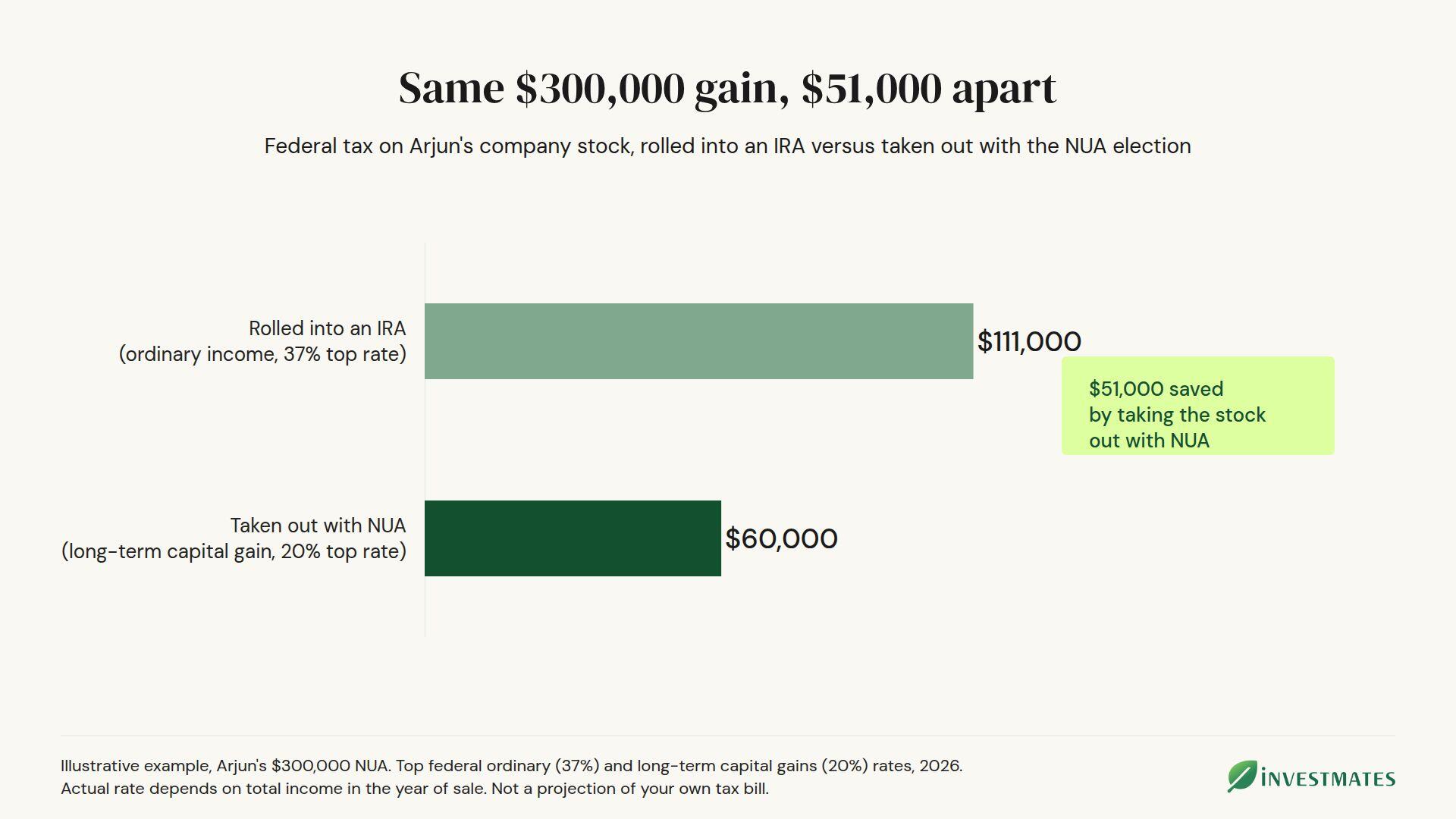

| Rolled into an IRA | Taken out with NUA | |
|---|---|---|
| How the $300,000 gain is taxed | Ordinary income, on withdrawal | Long-term capital gain, on sale |
| Top federal rate that applies | 37% | 20% |
| Federal tax on the $300,000 (illustrative, top bracket) | $111,000 | $60,000 |
| Difference | $51,000 saved |
The early withdrawal penalty exception
One thing a qualifying event doesn't automatically fix: if you separate from your employer before 59½, the cost basis portion can still trigger the standard 10% early withdrawal penalty on top of ordinary income tax, unless the Rule of 55 or another exception applies.
NUA changes how the appreciation is taxed. It doesn't waive the early withdrawal penalty on the rest.
The five conditions that decide whether you qualify
All five have to be true. Miss one, and the IRS treats the whole distribution as ordinary income, no exceptions.
- Qualifying event: separating from the employer, turning 59½, total disability, or death. You can't elect NUA while you're still actively working there, with rare exceptions written into a handful of plans.
- Full plan distribution: the plan has to empty in a single tax year, across every plan your employer sponsors that holds the same stock. A partial withdrawal this year and the rest next year forfeits the election entirely.
- Actual shares, not cash: if the plan liquidates the stock and hands you cash, there's nothing left to elect NUA on.
- No prior RMD: you can't have taken a required minimum distribution in a prior year on this account. A current-year RMD is fine as long as it's satisfied by year end.
- No IRA rollover: the moment you roll a share into an IRA, whether by accident or to simplify paperwork, you've converted its entire future gain back into ordinary income. This is a common way people lose the election without meaning to.
IRS Publication 575 lays out the mechanics for lump-sum distributions in more detail, including how the NUA figure shows up in Box 6 of your Form 1099-R.
Why net unrealized appreciation tax treatment gets complicated once you move to India
Here's where the NRI angle changes the calculation. Staying in the US is the default assumption baked into how this election usually gets explained, and that's the part that gets skipped.
The DTAA treats a lump sum worse than a pension
The DTAA between the US and India treats a periodic pension differently from a lump-sum distribution. A steady stream of payments from a US retirement account to an India resident has an argument, under Article 20(1), for being taxed only in India.
A lump sum doesn't get that treatment. It falls under Article 23, "other income," where both countries can tax it and you claim relief through a foreign tax credit rather than an exemption.
NUA, by definition, requires a lump sum. So the same election that saves you tax inside the US system puts you in the less favorable treaty bucket the moment India is in the picture.
In my experience this catches people by surprise. Everything they've read about pension income assumes the friendlier periodic treatment, and NUA simply doesn't qualify for it.
The NRA capital gains opening
There's a second piece that works in your favor, and it's the one worth planning around.
Once you're genuinely a non-resident alien, meaning you've established a foreign address, filed Form W-8BEN with your broker, and you're not present in the US 183 days or more in the year you sell, capital gains on US stock generally aren't taxed by the US at all. That rule doesn't care where the shares came from.
If you take the NUA distribution, hold the stock, and sell it after your NRA status is solid rather than before, the appreciation that was going to be taxed at 15% or 20% can escape US tax entirely.
Time the sale inside your RNOR window
The window that makes this work is your RNOR window. India doesn't tax foreign income you receive while you're Resident but Not Ordinarily Resident.
A sale timed inside that window, after your US NRA status is settled and before you become Ordinarily Resident in India, is the closest thing to a free pass this strategy gets.
Sell too early and you're still a US resident for tax purposes. Wait too long and India starts taxing your worldwide income, including this gain.
Who this applies to
This is narrow. It applies if you hold actual shares of your employer's own stock inside a traditional 401(k) or similar qualified plan, not a stock fund that happens to include your employer among dozens of holdings.
It also requires you to be facing or planning a genuine qualifying event: leaving the job, turning 59½, or a move back to India that will coincide with one of those.
It doesn't apply to a Roth 401(k) holding company stock, since qualified Roth withdrawals are already tax-free and there's nothing for NUA to improve. It doesn't apply if your plan doesn't offer company stock as an investment option, which is increasingly common outside a handful of legacy plans.
And it doesn't help if the stock has actually lost value since you bought it. NUA only pays off when there's real appreciation to shift into the lower rate.
This piece is narrowly about the stock inside the plan. The broader question of what to do with the rest of the account once you leave the US is its own topic, and I've covered it separately in 401(k) withdrawal strategy for NRIs.
Holding the shares as a non-resident alien isn't purely a tax break either. Appreciated US stock still sitting in your name at death runs into the same $60,000 NRA estate tax exemption that trips up RSU holders, so this isn't a position to leave open indefinitely without a plan.
What to do before you touch the distribution
Get the numbers in writing before you request anything.
- Ask your plan administrator for the exact cost basis and current market value of the company stock inside your account, in writing. That gap is your NUA figure, and it's what tells you whether this is worth pursuing.
- Confirm the distribution can be structured as a full, in-kind transfer of shares to a taxable brokerage account in one tax year, with any remaining non-stock balance rolling separately into an IRA.
- If a move to India is part of the plan, work out the sequence with a cross-border CPA before you distribute: whether you'll still be a US resident when the stock comes out, and how the RNOR day count works against your target sale date.
- File Form W-8BEN with the brokerage holding the shares once your foreign address is established, so dividends and any future distributions get treaty withholding instead of the default 30%.
Two ways people lose the election without realizing it
"I'll roll most of it to an IRA and just keep a bit of stock out." That's not how it works. NUA treatment applies only to the specific shares that come out in kind.
Anything that goes into an IRA, even in the same transaction, permanently loses the benefit on that portion. Mixing the two in one distribution is the most common way people give away part of what they were entitled to without ever deciding to.
If you're weighing a full rollover instead of splitting the stock out, the mechanics of rolling a 401(k) over after a move to India are worth reading first, since undoing an IRA rollover isn't possible.
"NUA means I don't have to think about capital gains again." The NUA amount itself gets long-term treatment no matter how long you then hold the shares, because the holding period inside the 401(k) counts.
But any appreciation after the distribution, the stock going up further while it sits in your brokerage account, runs on its own separate holding period. Sell within a year of the distribution and that additional gain is short-term, taxed at ordinary rates.
Get the cost basis figure before you decide anything
If you're holding company stock inside an old 401(k) and a move back to India is somewhere on the horizon, ask your plan administrator for the cost basis and current value in writing before you touch that account, not after. That single number is what tells you whether the election is worth the paperwork.
I'd rather work through that math with you before the distribution happens than after you've already rolled the stock into an IRA and closed the door on it.
Frequently asked questions
Is a company stock fund inside a 401(k) eligible for NUA treatment?
No. NUA only applies to actual shares of your employer's own stock held directly in the plan. A diversified stock fund that includes your employer's shares alongside other companies doesn't qualify, even if your employer happens to be one of the larger holdings.
Can you use the NUA election while still working for the company?
Generally no. NUA requires a qualifying event: separation from service, turning 59½, disability, or death. A handful of plans allow in-service distributions at 59½ that can support an NUA election, but check your specific plan document rather than assuming it applies to yours.
Does the mandatory 20% withholding on 401(k) distributions apply to an NUA election?
Yes, on the taxable cost basis portion. Your plan withholds 20% of that amount for federal tax, the same as any eligible rollover distribution. The NUA portion itself isn't part of this year's taxable income, so it isn't subject to that withholding.
Can I still claim NUA if I already rolled part of my 401(k) into an IRA?
Only on the shares that never touched the IRA. If your employer stock is still sitting inside the 401(k) and hasn't been rolled over, you can still elect NUA on that specific stock, even if the rest of the account has already moved. If you're still deciding what to do with what's left, the mechanics of rolling a 401(k) over after a move to India cover the sequencing.
Do I owe tax in both the US and India on an NUA stock sale after I move back?
Potentially, yes. A lump-sum NUA distribution falls under Article 23 of the DTAA, where both countries have taxing rights and relief comes through a foreign tax credit rather than an exemption. Your exact exposure depends on your residency status in both countries at the time of the sale.