

Getting laid off is hard on its own, and doing it on H1B, with a visa clock now running too, can feel disorienting on top of everything else.
Take a breath.
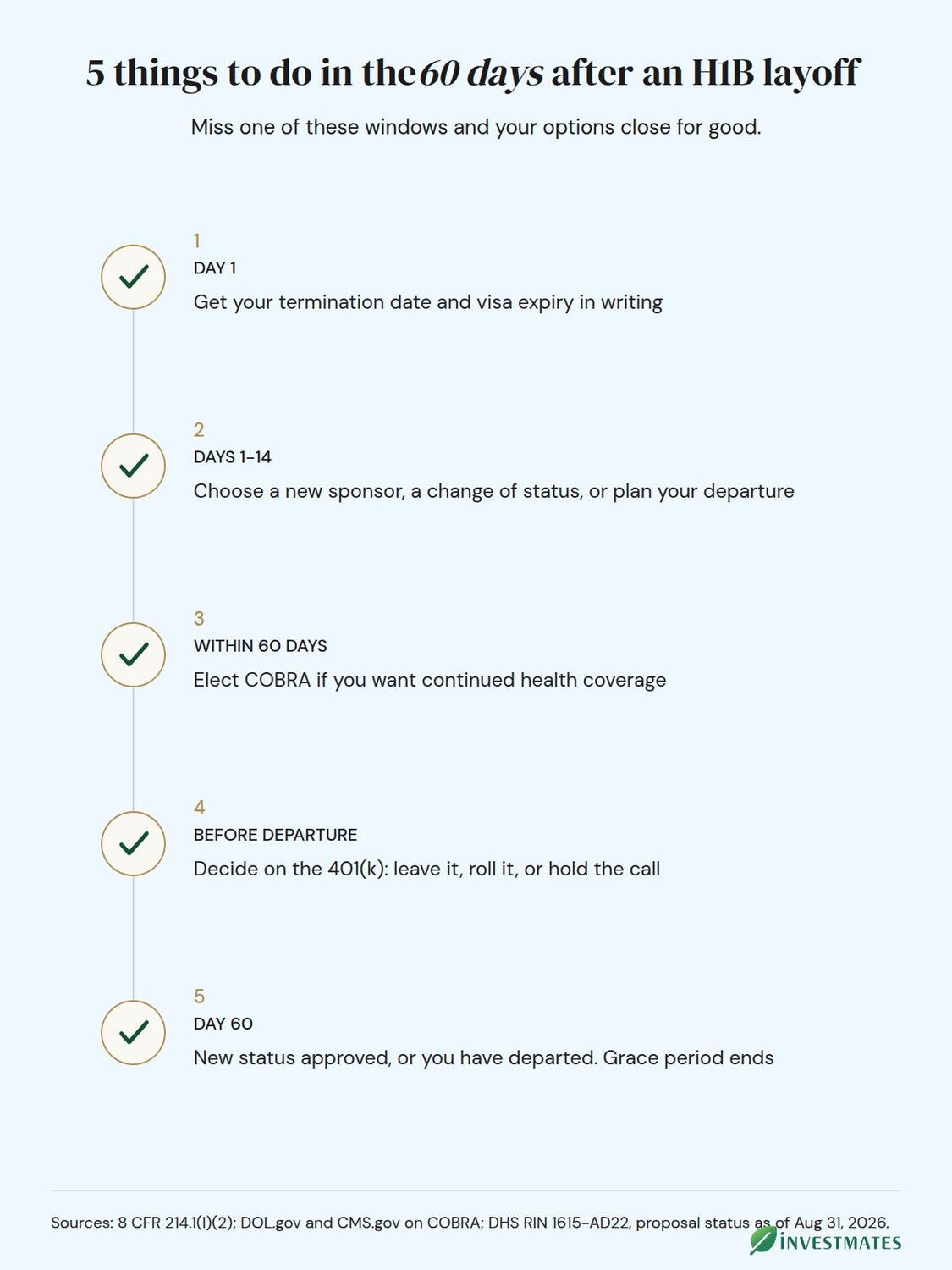
This is manageable, and there's a clear order to work through it. If you were laid off on H1B today, you have 60 days, or until your visa's end date, whichever comes first, to find a new sponsor, change status, or leave the country, and that grace period is currently under a federal proposal to be eliminated outright.
Don't touch your 401(k) yet, don't assume unemployment insurance will help, and don't wait to sort out health coverage. Work through everything else in this order, including what to actually do with the retirement account, in the days you have left.
Day one: Get the dates that actually govern your options
The clock that matters most isn't your lease or your kid's school year. It's your last day of active employment on payroll, because that's when your 60-day grace period starts counting under 8 CFR 214.1(l)(2).
Ask HR, in writing, for the exact termination date and whether your I-94 or visa stamp expires before that window closes; whichever is shorter controls.
That 60-day cushion is not guaranteed to exist much longer.
DHS submitted a proposed rule, RIN 1615-AD22, "Eliminating the Discretionary 60-Day Grace Period," to the White House for regulatory review on August 6, 2026. It cleared that review in late August.
It hasn't been published in the Federal Register, there's been no public comment period, and no effective date has been set, so the 60-day grace period is still the law today.
If you're reading this after it's finalized, verify your own timeline with an immigration attorney before assuming any of the below still applies to you.
During the grace period, you're allowed to stay in the US without falling out of status, but you generally can't work.
That single fact rules out one option people reach for instinctively: taking a short-term or contract job to bridge the gap.
You can look for a new H1B sponsor, apply for a change of status (commonly to B-2 to extend your search, or H-4 if your spouse holds status that supports it), or start preparing to leave.
You can't do paid work on any of those tracks until the new status or petition is approved.
Weeks one and two: Settle your immigration path before anything else
Your 401(k), your lease, and your kid's school all wait. Your immigration status doesn't. Three real paths exist inside the 60 days, and each one changes every other decision on this list.
Transfer to a new H1B sponsor
Under AC21 portability, you can start working for a new employer as soon as they file a new I-129 petition on your behalf, before it's even approved.
This is the fastest way to stay employed and skip the rest of this checklist.
If you have interviews in flight, tell every recruiter your exact grace period deadline; a petition filed on day 55 still counts, but it removes any margin for error.
File for a change of status
Filing to B-2 visitor status is the most common route for a straightforward extension while you decide.
It buys more time in the US without requiring an employer, but it doesn't authorize work, and USCIS processing can run past your original 60 days.
File early in the window, not on day 50.
Plan the departure deliberately
This is the one to take seriously if a return to India is the likely outcome. Book it deliberately rather than defensively.
The date you leave sets your RNOR (Resident but Not Ordinarily Resident) clock in India.
Returning before December 31 versus waiting until after it can change how many financial years of RNOR protection you get on foreign income, including your 401(k).
Health insurance: don't let this wait past week two
Your employer coverage typically ends the day your employment does, sometimes the last day of the month.
You have 60 days from whichever is later (the date coverage ends or the date you receive your COBRA election notice) to elect continuation coverage, and up to 18 months of coverage after that under a standard job-loss qualifying event.
COBRA isn't cheap. Employers can charge up to 102% of the full group premium (100% of the actual cost plus a 2% administrative fee), since you're no longer splitting it with them.
For a lot of people it still beats going without coverage for a month while shopping the ACA marketplace, especially if you or a dependent has an active prescription or a scheduled procedure.
If you're leaving the US within the 60-day window regardless, COBRA still matters: it covers you for the weeks you're still here, and you can drop it once you land in India and set up local coverage.

The one thing you can't count on: unemployment insurance
I've had more than one client assume they'd qualify for state unemployment benefits after an H1B layoff, the same way a colleague on a green card might.
Most states require you to be "able and available" for any job, which legally means you'd need to be free to accept an offer from any employer immediately.
Your H1B status is tied to a sponsor who has to file paperwork before you can start; that alone typically disqualifies you, and the grace period itself doesn't fix it, since you're not authorized to work during it either.
It's a frustrating gap in the system, and it isn't a reflection of anything you did wrong. Plan your 60-day survival budget around the real numbers instead of a benefit check that likely isn't coming.
The 401(k) decision: don't cash it out under pressure
This is where the checklist becomes a genuine financial decision, not just a deadline to hit, and it's the one most people get wrong first, specifically because of the timing.
A 401(k) rollover or withdrawal decided calmly, years into retirement planning, and the same decision made in week one of an H1B layoff are not the same decision, even though the tax mechanics behind them are identical.
Most people laid off on H1B, staring at a move and a gap in income, want to cash the account out immediately. I almost always tell them not to, at least not yet.
A withdrawal before age 59½ carries a 10% early withdrawal penalty on top of ordinary income tax, and once you're a non-resident alien, the plan withholds a flat 30% at the point of distribution.
Do that math on a $150,000 balance and you've handed the IRS a third of it before you've even landed, and you've done it at the exact moment you can least afford to.
Worse, you're giving up the RNOR window before you've even used it.
If you wait until you're settled in India and file Form 10-EE under Section 89A in your first resident year, India won't tax that account's growth or eventual withdrawal until you actually take the money out.
During your RNOR years, foreign income like this isn't taxed by India at all.
Whether to leave the account with the former employer, roll it to an IRA, or take periodic withdrawals under DTAA Article 20 instead of a lump sum under Article 23 is a real comparison with real numbers behind it.
my guide on 401(k) withdrawal strategy guide and 401(k) vs IRA vs early withdrawal comparison walk through all three options and the DTAA treatment in full.
The only thing this checklist adds to that comparison: don't make the call in the first panicked week, and don't let the other 59 days of your grace period slip by while you avoid deciding either.
None of this replaces a real conversation about your specific balance, age, and timeline; it's the reasoning to walk into that conversation with instead of a panic withdrawal.
Take the time to have that conversation. The deadline that matters here is real, but it isn't tomorrow.
Before you land: the accounts and documents to line up
- Bank accounts: NRE and NRO accounts need to convert to resident accounts once you're back in India; FCNR deposits can run to maturity first. Decide which US accounts to keep open before you lose a US mailing address.
- Employment and termination paperwork: termination letter with the exact last-day date, final pay stub, COBRA election notice, and your I-94 printout. You'll want all of these on hand for both the immigration timeline and any future US tax filing.
- 401(k) and brokerage statements: current balances and custodian contact details, since some restrict trading or new investments once your address changes to India.
- A real number for your runway: with unemployment benefits off the table and COBRA costing more than you paid as an employee, add up how many months your savings cover rent, insurance, and the move, before deciding on the 401(k).
You don't have to do this alone
A layoff on H1B forces a lot of decisions into a short window, on top of everything else you're processing. That's genuinely hard, and it's fair to feel overwhelmed by it.
You don't have to hold all of it in your head at once. Loop in your spouse or family if you have them nearby, and talk to former colleagues who've been through a layoff or a visa transition themselves.
Treat the 60 days as a sequence of small decisions rather than one giant one. Get the dates right first. Everything else can wait a day or two while you catch your breath.
What to do this week
Get your exact termination date and grace period deadline in writing today, then work backward from it.
If a return to India is the likely outcome, the repatriation checklist for returning NRIs covers the account conversions and compliance steps once you land, and the RNOR status guide explains the window you'll want to use before touching that 401(k).
If your timeline or balance is complicated enough that you want a second opinion before you file anything, that's a conversation worth having with an advisor before the 60 days run out, not after.
Either way, you have more room to make a good decision here than it feels like right now.
Frequently asked questions
How long can I stay in the US after being laid off on H1B?
Up to 60 consecutive days from your last day of employment, or until your visa or I-94 expires, whichever is shorter. That window currently lets you look for a new sponsor, apply for a change of status, or prepare to leave without falling out of status, though it doesn't authorize you to work during those days.
Can I collect unemployment benefits after an H1B layoff?
Almost never. Most states require you to be able and available for any job immediately, and H1B work authorization depends on a specific employer sponsoring you, which fails that test in nearly every state's rules.
What happens to my 401(k) if I get laid off on H1B and move back to India?
You can leave it with the former employer's plan, roll it into an IRA, or withdraw it, and each has different tax consequences.
Does COBRA cover me if I lose my job on H1B?
Yes. COBRA eligibility doesn't depend on immigration status, only on your employer's group health plan and size. You get 60 days to elect it and up to 18 months of coverage, at up to 102% of the full premium.
Can I keep my US bank account after moving back to India from H1B?
You can keep US accounts open in most cases, but any Indian bank accounts you held as an H1B holder (NRE or NRO) need to convert to resident accounts once you're back, and FEMA treats the timing as your responsibility, not the bank's.
Should I withdraw my 401(k) before I leave the US or wait until I'm settled in India?
For most people, waiting is worth more than the convenience of cashing out immediately. Filing Form 10-EE under Section 89A in your first year as an Indian resident defers Indian taxation to the point of actual withdrawal, and using your RNOR years for any large withdrawal keeps it out of India's tax net entirely; a full walkthrough of that timing is in the 401(k) vs IRA vs early withdrawal comparison.