
Let's discuss the FSA deadline today. If your plan runs on the calendar year, you have until December 31 to use your FSA money, and whatever's left after that is usually lost.
NRI families on H-1B have one more thing to check. If your H-4 spouse had no earned income this year, your dependent care FSA gives you no tax saving, even though you still get the money back. Here's how the deadline, the carryover and the H-4 rule work, and what to do before the year ends.
How the FSA deadline works for your health FSA
A health FSA (flexible spending account) is a use-it-or-lose-it account. IRS Publication 969 says money left at the end of the plan year generally can't move into the next year, and your employer isn't allowed to refund the balance to you. If your plan year matches the calendar year, the cutoff lands on December 31.
The plan year is the detail people skip. Some employers run benefits on a July or October cycle, so check the dates in your benefits portal or your summary plan description before you start spending.
FSA rollover: the carryover option
Your employer may let you carry part of the balance forward. For plan years beginning in 2025, the maximum carryover is $660, so up to $660 of unspent 2025 money can move into 2026. For 2026 plans the cap rises to $680 under Rev. Proc. 2025-32.
Anything above the cap is gone. With $1,000 left over and a $660 carryover, you forfeit $340.
FSA grace period: the extra two and a half months
Instead of a carryover, a plan can give you a grace period of up to 2½ months after the plan year ends. On a calendar-year plan, that means care you receive through March 15 can be paid from last year's balance.
A health FSA can't offer both. If a colleague says you can use your FSA until March, that's only true when your plan picked the grace period.
The claims deadline is a different date
The run-out period is the window to send receipts for expenses you already incurred. Your plan sets its length, and it doesn't extend the spending deadline. A dentist visit on January 10 won't touch last year's money unless your plan has a grace period.
Spending the balance before December 31
Health FSA money covers expenses that would qualify for the medical and dental deduction, plus over-the-counter medicine whether or not it's prescribed. Glasses, dental work and copays you'd pay for anyway are the easy year-end uses.
Many NRI families spend part of December in India. If you plan to get treatment there and claim it from your FSA, ask your plan administrator before the trip whether it reimburses a foreign invoice. Keep an itemised bill showing the date, the service and the amount paid.
Dependent care FSA rules that catch NRI families on H-1B
A dependent care FSA pays for the care of a child under 13 so you, and your spouse, can work. The limit is $5,000 for 2025 ($2,500 if married filing separately), rising to $7,500 for 2026 ($3,750 separately) under the One Big Beautiful Bill Act, signed on July 4, 2025.
Your employer doesn't have to adopt the higher limit. Check your 2026 election screen before you assume $7,500 is available.
The H-4 spouse problem
The amount you can keep out of tax can't exceed your earned income or your spouse's, whichever is smaller. That's the rule in IRS Publication 503, and on an H-4 visa without an EAD, your spouse's number is usually zero.
When the smaller income is zero, every dollar you ran through the dependent care FSA gets added back to your taxable income through Part III of Form 2441. You still get the reimbursements. You just lose the tax break you signed up for.
Take Arjun, an engineer in Seattle on H-1B, and Meera, his wife on H-4 without an EAD. They put $5,000 through Arjun's dependent care FSA in 2025 to pay for daycare.
Because Meera had no earned income, the full $5,000 goes back into their taxable income on Form 2441. At a 24% federal bracket, that's about $1,200 of federal income tax they may have expected to save.
There's one exception. A spouse who was a full-time student, or physically or mentally unable to self-care, counts as earning $250 a month with one qualifying child. With two or more, it's $500 a month, for the months that applies.
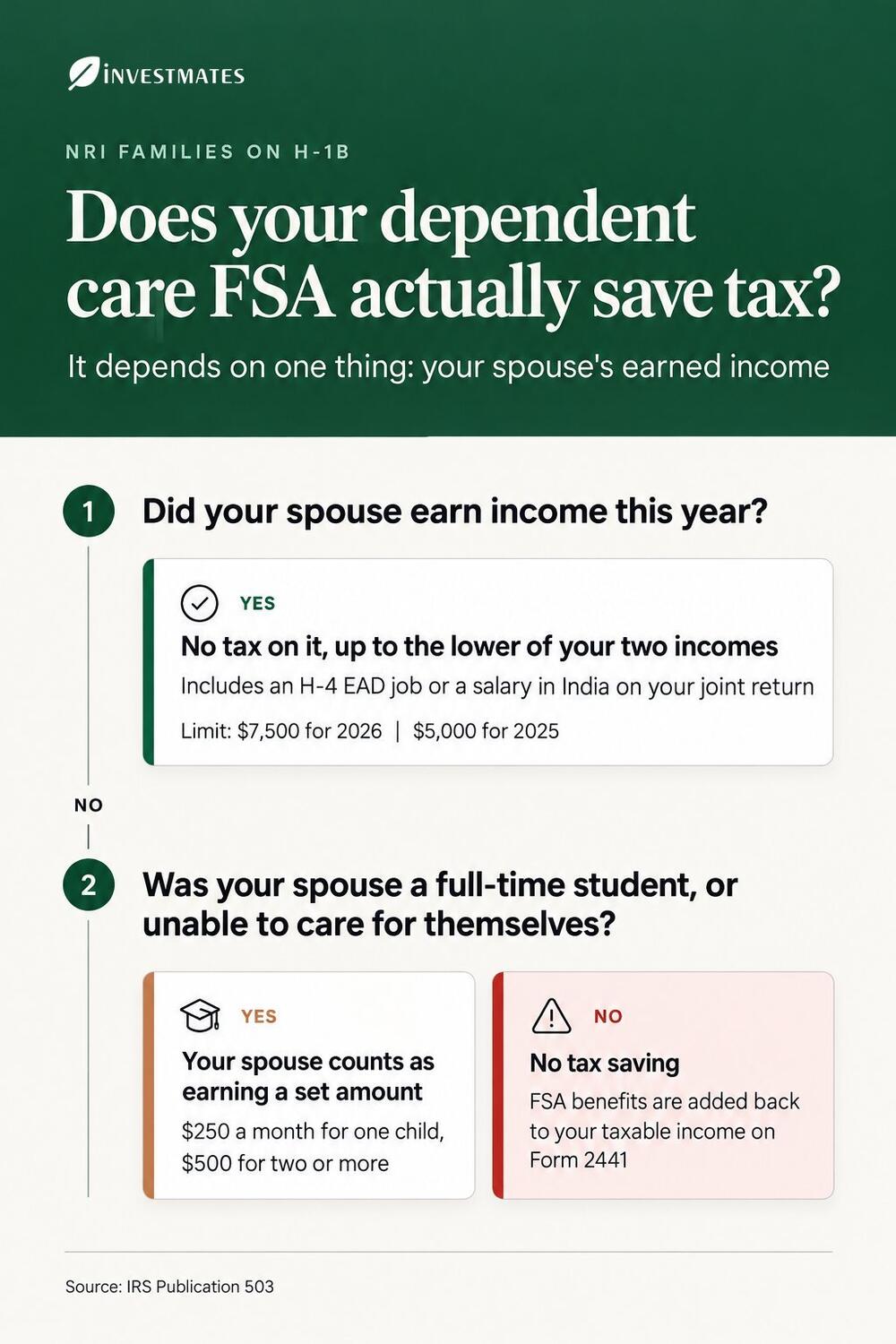
- An H-4 EAD spouse who worked part of the year: their actual wages set the cap.
- A spouse earning a salary in India while you file jointly: that salary counts as earned income. If the work is for an Indian company while on H-4, check the H-4 work rules first.
- Filing separately: the exclusion limit is halved, and the credit generally needs a joint return.
This is where a split adviser setup misses things. A US preparer who never asks about your spouse's visa or Indian salary can get Form 2441 wrong in either direction, and your Indian CA won't see the form at all.
Paying grandparents visiting from India
Paying your parents to look after your kids can count as a work-related expense, as long as you can't claim them as your dependents. IRS Publication 503 allows payments to relatives who aren't your dependents, even if they live in your home.
There are two catches. Form 2441 asks for each carer's taxpayer ID, and a parent visiting from India usually has no SSN or ITIN, so you'd need to show you made a good-faith effort to get it.
Being paid can also raise a question about your parents' visitor visa. I'd get advice on that before you set it up.
The FSA and the child care credit share the same dollars
Dependent care FSA benefits reduce the expenses you can claim for the child and dependent care credit on Form 2441, so one daycare bill can't count twice. With two children the credit's expense limit is $6,000, which means a $7,500 FSA election leaves nothing for the credit.
This is where family plans go wrong, and here's a real one.
In a 2026 plan I reviewed for a family with two school-age children, the first draft assumed the full $5,000 limit. Their 2025 return showed about $5,500 of care costs, with roughly $480 already run through payroll.
That left about $4,500 of usable room. The FSA saving then had to be netted against the roughly $500 credit they'd give up.
My rule: elect what you'll actually spend on qualifying care, not the maximum. Summer day camp can count, but overnight camp doesn't, and neither does tuition from kindergarten up.

Who this applies to
This applies to NRI professionals whose US employer offers a health FSA, a dependent care FSA, or both. Your visa doesn't change the account rules. It changes the facts around them, mainly your spouse's work status and whether you're leaving your job or the country.
- H-1B with an H-4 spouse and no EAD: the dependent care FSA saving is zero unless the student or disability rule applies.
- Laid off before December 31: your FSA coverage can end with your job, so book appointments and file claims early, alongside the H-1B layoff checklist.
- Moving back to India next year: your FSA ends with your job, so fold it into your exit-year tax planning.
If you have an HSA rather than an FSA, the forfeiture rules don't apply. An HSA stays with you when you change employers, and the HSA after moving back has its own India tax questions.
Moving back to India next year
If you plan to leave your job and move back next year, set your FSA elections with that date in mind. The health FSA makes your full annual election available at any time during the coverage period, regardless of how much you've contributed, so you can use it before your last day.
A dependent care FSA works differently. The rule that makes the full election available up front doesn't apply to it, so elect only for the months your kids will be in US care. Your summary plan description sets what happens to any balance when you leave.
What to do before December 31
- Open your benefits portal and note your plan year end, your balance, and whether you have a carryover or a grace period.
- Spend any health FSA balance above the carryover on qualifying expenses you'd buy anyway.
- Submit receipts for this year's expenses before the run-out deadline.
- Total this year's dependent care costs and compare them with your election.
- Check your spouse's 2025 earned income before you file, so Form 2441 matches reality.
- If you're moving back to India next year, set next year's elections around your last day.
If your spouse's work status changed during the year, or you're leaving the US, the dependent care FSA and the credit need to be worked out together on one Form 2441. That calculation is worth doing before you file, not after a notice.
Your move this week
Open your benefits portal and note your plan year end, your balance, and your carryover or grace period. If your spouse earned little or nothing this year, I'd cut next year's dependent care FSA election. InvestMates can check how your FSA and Form 2441 fit together through its NRI tax planning and filing service.
Frequently asked questions
Can I pay my parents visiting from India for childcare through a dependent care FSA?
Payments to your parents can count as dependent care expenses if you can't claim them as your dependents. You'll still need their taxpayer ID, or proof of a good-faith effort to get it, and being paid may raise a question about their visitor visa, so get advice first.
Do I have to pay back my FSA if I quit my job?
Spending more than you've contributed before you leave is how a health FSA is designed, because your full annual election has to be available from the first day of the plan year. Your summary plan description sets the rules for leaving mid-year, so read that section before your last day.
What is the FSA rollover from 2026 to 2027?
If your plan offers a carryover, up to $680 of unspent 2026 health FSA money can roll into 2027 under Rev. Proc. 2025-32. Your plan has to choose the carryover, and a plan with a grace period can't also offer it.
Can an H-4 spouse without an EAD benefit from a dependent care FSA?
A dependent care FSA gives no tax saving when an H-4 spouse without an EAD had no earned income, because the exclusion is capped at the lower earner's income. A full-time student spouse is the exception. Filing separately instead of jointly doesn't fix it, and the married filing separately route also halves the limit.
Can I use a dependent care FSA and the child and dependent care credit together?
You can use a dependent care FSA and the child and dependent care credit in the same year, but not on the same dollars. FSA benefits reduce the expenses Form 2441 lets you claim. The child tax credit is a separate credit and isn't reduced by your FSA.