

If you own a rental property in the US and you're tired of being the landlord, a Delaware Statutory Trust lets you sell it, defer the capital gains tax through a 1031 exchange, and end up owning a fractional, professionally managed interest in institutional real estate instead.
No tenants to chase, no roof to fix, no 2 a.m. call about a burst pipe. The catch is that you have to clear an accredited-investor bar to get in, and the mechanics shift once you're no longer a US tax resident. Here's what actually changes for an NRI, and when to move.
What a Delaware Statutory Trust actually is
A Delaware Statutory Trust is a separate legal entity, formed under Delaware law, that holds title to one or more properties on behalf of many investors. A sponsor raises the trust's capital, buys an institutional-grade asset, and sells fractional beneficial interests to investors. You don't own a slice of a building directly.
You own a beneficial interest in the trust, but the IRS treats that interest as direct real estate ownership for 1031 purposes. That's the only reason this works as an exchange target at all. A 1031 exchange requires "like-kind" property, and the IRS settled in 2004 that a properly structured DST interest qualifies.
The seven restrictions that keep it passive
Revenue Ruling 2004-86 lists seven things a DST trustee cannot do, informally called the Seven Deadly Sins:
- Accept new capital contributions after the offering closes
- Renegotiate or refinance the property's debt
- Renegotiate existing leases, except in bankruptcy or insolvency
- Reinvest sale proceeds into a new asset
- Hold cash reserves anywhere but short-term government securities
- Spend on anything beyond routine repairs and normal capital expenditures
- Retain cash rather than distribute it to investors on a current basis
Read those together and the pattern is clear: a DST can't grow, pivot, or reinvest. It collects rent, pays expenses, and distributes what's left. You give up the upside of an active investor who can refinance or redevelop, and in exchange you get an asset that runs itself.
How the exchange timeline works
The 1031 clock is unforgiving. Once you close on the sale of your relinquished property, you have 45 days to identify replacement property in writing and 180 days to close on it, through a Qualified Intermediary who holds the sale proceeds. Miss either deadline and the exchange collapses, the gain becomes taxable in the year of sale.
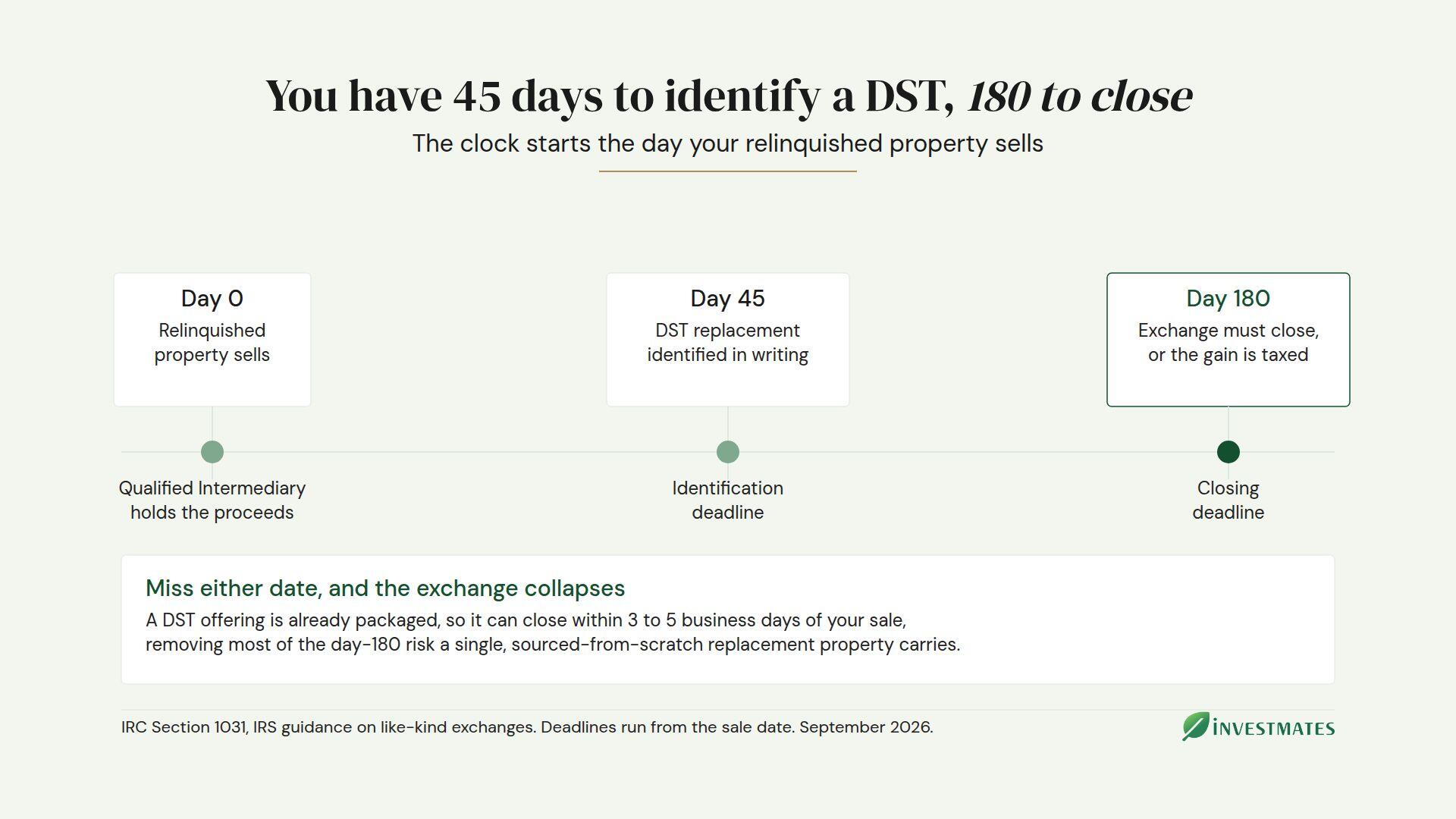
This is where a DST earns its keep. Sourcing and closing on a single replacement property inside 180 days is genuinely hard, especially from another country. A DST offering is already packaged and ready to close, often within three to five business days of your sale.
Typical DST minimums run around $100,000 per offering, though some sponsors accept $25,000. Cash-on-cash returns generally land in the 4% to 9% range, and holding periods run 5 to 10 years.
None of that is guaranteed. Distributions can be cut, and DST interests are illiquid: you're generally holding until the sponsor sells the property, not exiting on your own schedule. The IRS's own guidance on like-kind exchanges covers the mechanics above, worth reading once before you sign anything.

Who this applies to
Two gates decide whether this is even available to you, and neither one is about your visa.
The accredited investor test
DST offerings are sold under SEC Regulation D, Rule 506(c): a net worth over $1 million excluding your primary residence, or income over $200,000 individually ($300,000 with a spouse) for the last two years. A lot of readers clear this without noticing, since home equity plus a stable H-1B or green-card income adds up fast. Some don't, and no paperwork changes that.
The FIRPTA question
FIRPTA withholding under Section 1445 applies to a "foreign person" disposing of US real property, generally 15% of the gross sale price withheld at closing. A US resident alien, meaning you hold a green card or pass the Substantial Presence Test, counts as a US person, not a foreign person. Most readers doing this while still living and filing in the US fall into that category, so FIRPTA simply doesn't apply at that point.
It becomes relevant later, specifically if you give up the green card or drop below the Substantial Presence Test and then dispose of a US real property interest as a nonresident alien. I cover the general mechanics of that withholding, and how to reduce it with a Form 8288-B, in a dedicated FIRPTA guide.
The estate tax angle
Your DST interest doesn't stop being a US-situs asset just because you're Indian. If you're a nonresident non-citizen for estate tax purposes, a test based on US domicile rather than income-tax residency, your estate gets a $60,000 exemption on US-situs assets instead of the roughly $15 million exclusion a US citizen gets. A green card holder planning a move back to India can be a US income-tax resident today and still non-domiciled for estate purposes.
I've written more on how that trap plays out for NRIs with other US assets. A DST doesn't remove your property from your estate, though some fractional interests get appraised with discounts that can reduce the taxable value. That's a case-by-case question the IRS scrutinizes closely.
This doesn't suit everyone: the Seven Deadly Sins rule out control over refinancing or your own exit timing by design, and if you need your capital back inside five years, the illiquidity will hurt.
What to do about it
If you're planning a move back to India and you still own a rental property here, sequence the exchange before you leave, not after. I'd tell any client in this position the same thing: accredited-investor verification and any FIRPTA analysis are simpler to clear while you're still a US tax resident. Once you've relocated, gathering that paperwork from India against a 180-day clock adds risk for no benefit.
In practice, the order runs: line up a Qualified Intermediary before your property goes on the market, not after you've accepted an offer. Confirm your accredited-investor documentation while your US income records are current. Start reviewing DST sponsors as soon as your property is under contract, so you're not sourcing a replacement inside a shrinking 45-day window.
If a repatriation is part of the picture, my repatriation checklist for NRIs returning to India covers the sequencing questions this exchange sits inside of. And treat a DST as one piece of your allocation. My guide to asset allocation for NRIs covers where passive real estate income fits alongside everything else you hold.
Common misreadings
"The exchange eliminates the tax." It defers it. The gain you didn't recognize carries over into your DST basis, and it comes due when the trust sells the property, unless you exchange again or hold until death, when a step-up in basis can erase it for your heirs.
"Any NRI can do this." The accredited-investor bar is real and it excludes a meaningful share of readers. No sponsor can legally sell you a DST interest if you don't clear it.
Where to go from here
Talk to a Qualified Intermediary before you list the property, not after you've signed a purchase agreement. If a move back to India is part of your timeline, get the sequencing right while you're still a US resident, it's the one decision that gets harder to undo later. If you want a second opinion on the timing, that's a conversation worth having with InvestMates first.
Frequently asked questions
Can I do a 1031 exchange into a Delaware Statutory Trust?
Yes. The IRS confirmed in Revenue Ruling 2004-86 that a beneficial interest in a properly structured DST counts as like-kind real property, subject to the standard 45-day identification and 180-day closing deadlines.
Who cannot do a 1031 exchange?
You can't exchange a primary residence, property held mainly for personal use, or property you hold as a dealer. Foreign real estate doesn't qualify either. It has to be exchanged for other US real estate.
What are the tax implications of investing in a Delaware Statutory Trust?
The exchange defers your capital gains tax, but the deferral isn't permanent. Your gain rolls into your DST basis and comes due when the trust sells the property, and the interest stays part of your estate at your death; I go through that scenario in how the $60,000 estate tax exemption trap works for NRIs.
Do I need to be an accredited investor to buy into a Delaware Statutory Trust?
Yes, without exception. DST offerings are sold under SEC Regulation D, which requires a net worth over $1 million excluding your primary residence, or income over $200,000 individually ($300,000 jointly) in each of the last two years.
Does FIRPTA withholding apply when I exchange US rental property into a Delaware Statutory Trust?
Usually not while you're still a US resident alien, since FIRPTA only reaches "foreign persons." It becomes a live question only after you're a nonresident alien; I cover the withholding rate and how to reduce it with Form 8288-B in a full FIRPTA breakdown for NRIs.