

No, not if your parent has never established US residency. Every dependent must be a citizen, national, or resident of the US, Canada, or Mexico.
A parent in India who has never visited can't be claimed, regardless of support. That costs you the $500 Credit for Other Dependents.
The way around it depends on how many days your parent spends here this year, not how much you send home.
What actually blocks the claim
The IRS states it plainly: a dependent "must be a U.S. citizen, U.S. national, or U.S. resident, or a resident of Canada or Mexico."
That's true for every dependent on every return, not something specific to NRIs or India.
Most NRIs on H-1B or a green card file Form 1040 as resident aliens themselves, but that status is yours. It doesn't transfer to a parent who has never independently met a US residency test.
There's a narrower exception worth ruling out. Filing as a nonresident alien on Form 1040-NR only lets you claim dependents if you're a US national, or a resident of Canada, Mexico, or South Korea.
The exception also covers Indian students or business apprentices under Article 21(2) of the tax treaty. It doesn't extend to a working NRI on H-1B claiming a parent back home, or waive the parent's own residency requirement.
The one path in
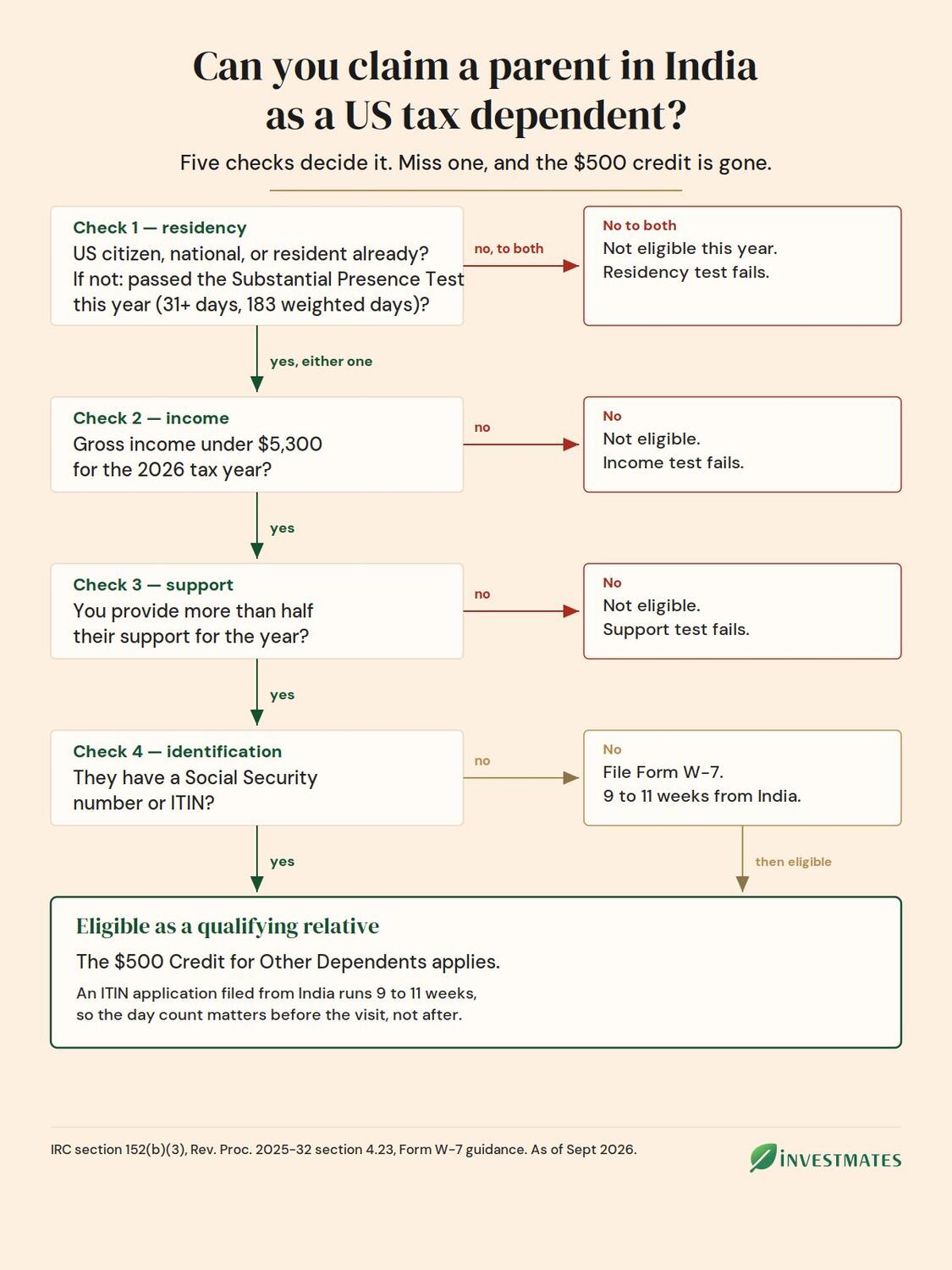
Your parent doesn't need a green card to clear the residency test. They need to pass the Substantial Presence Test during a visit long enough to make them a resident alien for that one tax year.
The formula: at least 31 days in the US this year, and at least 183 "weighted" days counting this year's days in full, last year's at a third, and the year before at a sixth.
Passing that test only clears the residency leg. Three more parts of the qualifying relative test still apply before you can claim your parent:
- Gross income under $5,300 for the 2026 tax year (Rev. Proc. 2025-32)
- You provide more than half their support for the year
- They aren't the qualifying child of anyone else, and they have a Social Security number or ITIN
Miss any one of those and the claim doesn't go through, even with a long enough visit.
The Child Tax Credit works differently here: it now requires an SSN for both you and the child after 2025's rule change, while the Credit for Other Dependents still accepts an ITIN-holding dependent.
That distinction matters because a parent applying for an ITIN for the first time will never have an SSN to fall back on.

Why it's worth doing right
The Credit for Other Dependents is $500 per dependent, nonrefundable, phasing out above $200,000 in income for single filers and $400,000 for joint filers.
Losing it to a two-week shortfall in the day count is an avoidable loss. I'd rather see a client plan a parent's visit around the Substantial Presence Test than find out in March that they missed it.
Head of Household status raises the stakes further for some filers. A parent is the one dependent who doesn't have to live with you to support HOH.
Paying more than half the cost of maintaining their home, even in India, is enough. But that only kicks in once the parent has already cleared the citizenship or residency test above.
It's not a second way around that test, even though the two rules sit close enough together to blur.
If the day count doesn't work out this year, the money you send is still just a gift, with its own gift tax rules separate from anything about dependency.
Who this applies to
This applies to any US taxpayer trying to claim an elderly parent who hasn't independently established US tax residency.
It doesn't apply if your parent already holds a green card, or already passes the Substantial Presence Test some other way, such as an existing long-term stay with you.
An OCI card doesn't change any of this. It's an Indian immigration status, with no bearing on the Substantial Presence Test or Green Card Test, the only two routes to US tax residency.
What to do about it
If your parent isn't visiting this year, there's nothing to file on their behalf yet.
If a long visit is planned, count the days before you book the return flight, not after, so you know where the trip lands against the 183-weighted-day threshold while you can still adjust it.
Once the test is met, file Form W-7 for the ITIN with your return rather than separately, and budget 9 to 11 weeks from India, not the standard 7.
For support that doesn't clear the residency bar this year, what actually helps day to day is a separate question worth planning on its own terms.
Common misreadings
"I sponsor their visit, so they're my dependent." Sponsorship, or covering the cost of the trip, has nothing to do with the citizenship or residency test. Only the day count and the other tests decide it.
"I send them money every month, so that covers it." Sending money satisfies the support test, not the residency test, and residency is what actually stops most NRI parents from qualifying.
Where this leaves you
If a parent's visit this year might brush past the Substantial Presence Test threshold, count the days before you book the return flight, not after.
That's the lever that turns a lost $500 credit into a claimed one, and I'd rather work through the day count with a client before the trip than explain after filing why the credit didn't apply.
Frequently asked questions
Can I claim a parent as a dependent if they live with me?
Yes, if your parent is a US citizen, US national, or resident (through a green card or the Substantial Presence Test).
They also need gross income under $5,300 for 2026, more than half their support from you, and a Social Security number or ITIN.
Living with you helps show the support test is met, but it isn't a separate requirement for a parent.
Can I claim my parents as dependents if they live in another country?
Only if they pass the Substantial Presence Test during a visit long enough to make them a US resident alien for that tax year.
Short of that, a parent living permanently in India fails the citizenship or residency test regardless of income or support.
What proof do I need to claim my mom as a dependent?
Keep the day count for any US visit, such as boarding passes and entry stamps.
Also keep records showing you covered more than half her support, and her Social Security number or ITIN.
If she doesn't have either yet, file Form W-7 once the residency test is met.
Does an OCI card make my parent a US tax resident?
No. An Overseas Citizen of India card is an Indian immigration status. It has no effect on the US Substantial Presence Test or Green Card Test, which are the only two ways a parent becomes a US tax resident.
Can I get the Credit for Other Dependents for a parent with only an ITIN?
Yes. Unlike the Child Tax Credit, which now requires a Social Security number for both you and the child, the Credit for Other Dependents still accepts a dependent whose only identification is an ITIN.