
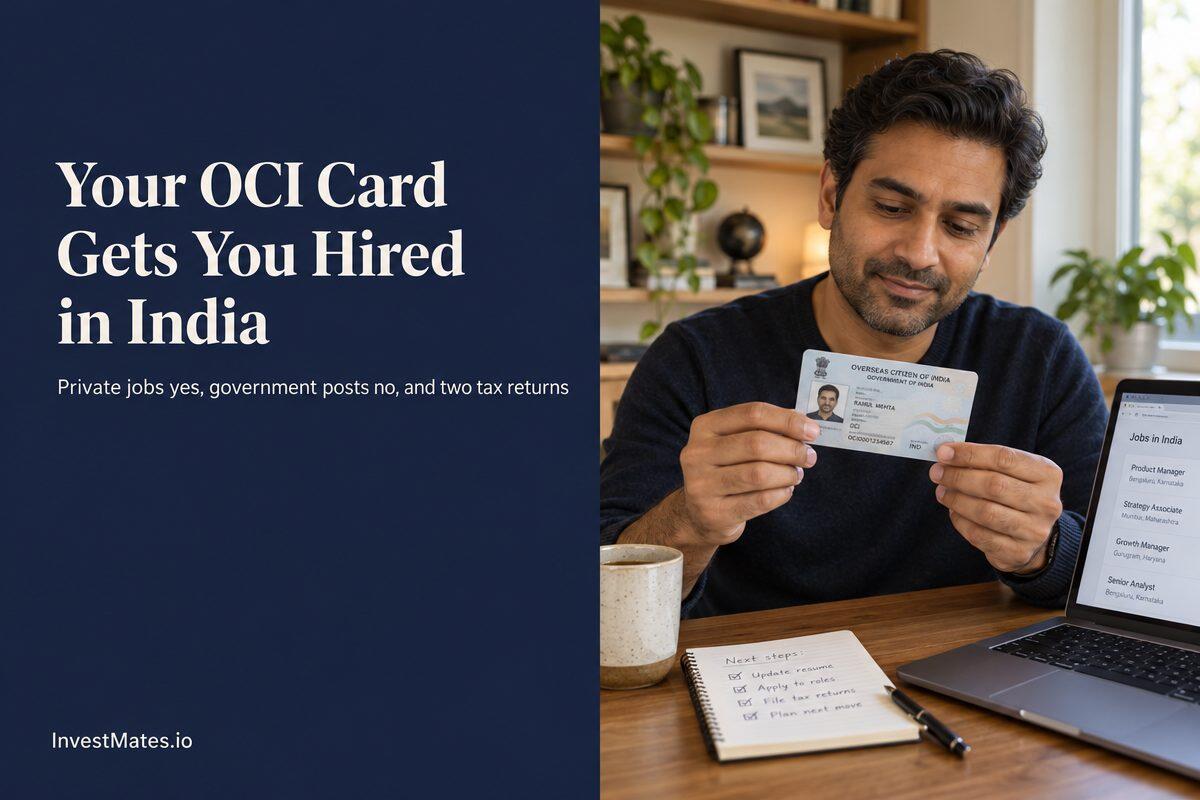
Yes. An OCI holder can take a private-sector job in India on the OCI card alone, because the card is a lifelong visa for any purpose, but government posts stay closed. The card settles where you can work, not how your salary is taxed, and that's where an Indian offer can lose value.
Where an OCI holder can work in India
You hold a foreign passport, an OCI card and maybe an Indian offer letter. That card decides which jobs you can take.
Two documents set the rules. Section 7B of the Citizenship Act, 1955 lists what an OCI cardholder can't do, and the Home Ministry notification of 4 March 2021 (S.O. 1050(E)) lists what you can.
If you still need the basics of who qualifies for the card, the OCI card explained covers eligibility.
 Private-sector jobs need nothing beyond the card
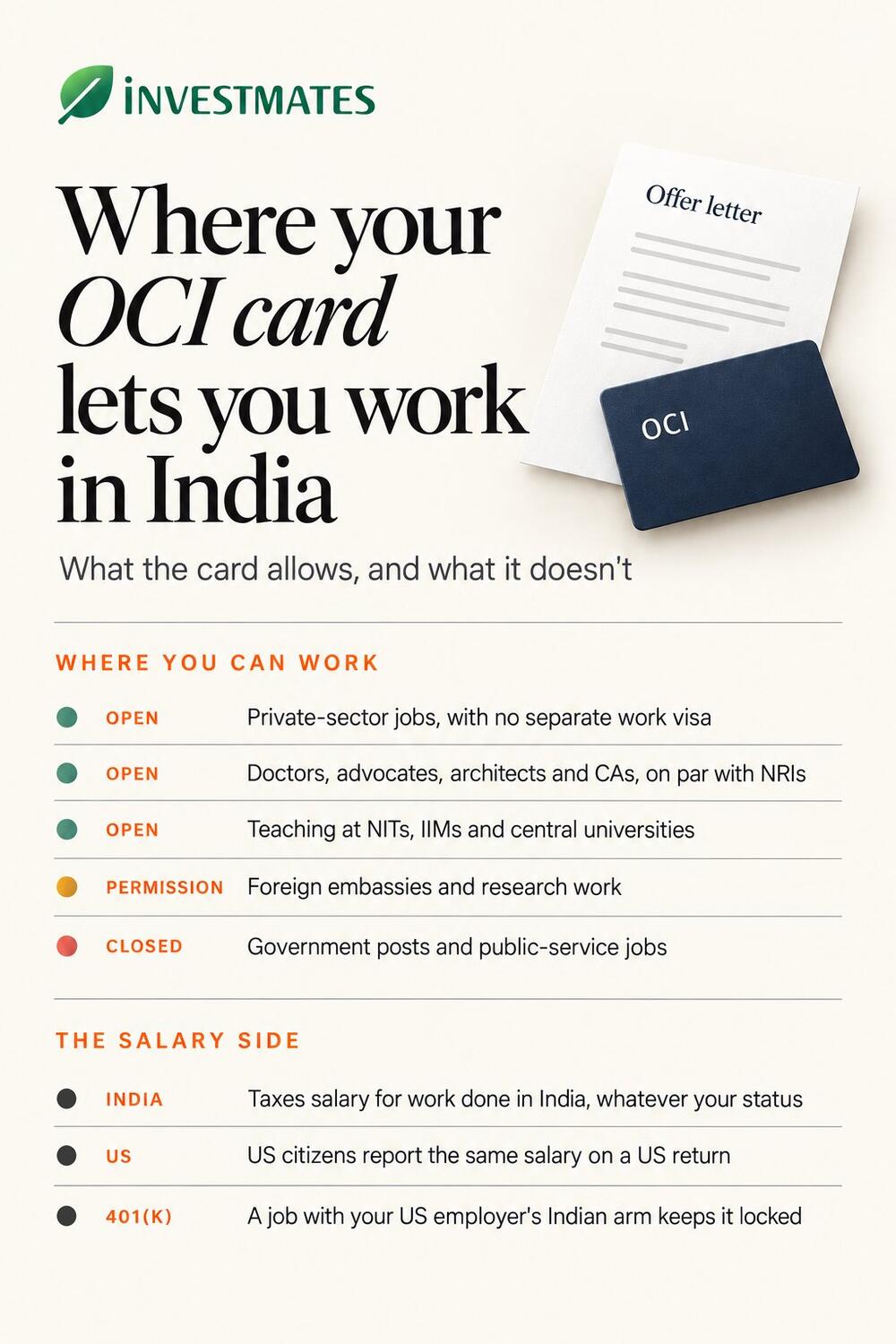
The 2021 notification grants a "multiple-entry life-long visa for visiting India for any purpose." It then names the activities that need special permission: research, missionary or journalistic work, mountaineering, work at a foreign diplomatic mission, and visits to protected areas. An ordinary job with an Indian company isn't on that list.
So you don't apply for an employment visa, and you don't need your employer to sponsor one. Your passport plus your OCI card is the work authorisation an Indian HR team should ask for.
Government jobs stay closed
Section 7B(2) withholds two employment rights a citizen has. You get no equality of opportunity in public employment under Article 16 of the Constitution.
You also can't be appointed to "public services and posts in connection with the affairs of the Union or of any State," unless the central government opens a specific post by special order.
In practice that rules out central and state government jobs and the civil services. Before you apply anywhere with a government link, read the eligibility clause in the advertisement. If it asks for Indian citizenship, the OCI card doesn't meet it.
Professions, foreign missions and research

| Type of work | Open to an OCI holder? | What you need first |
|---|---|---|
| Job with a private Indian or multinational company | Yes | Nothing beyond the OCI card and passport |
| Central or state government post | No, unless opened by special order | Not available |
| Doctor, dentist, nurse, pharmacist, advocate, architect, chartered accountant | Yes, on par with NRIs | Registration under the statute that governs the profession |
| Job at a foreign embassy or consulate in India | Only with permission | Special permission from the competent authority |
| Research work | Only with permission | Special permission from the competent authority |
The professions row is the one that trips people. Parity with NRIs means the right to practise "as per the provisions contained in the applicable relevant statutes," so the medical, bar or CA council rules still decide whether your foreign qualification counts.
What changes on a job application when you hold an OCI card
You apply as a foreign citizen. The Home Ministry's own FAQ calls OCI "only a life-long visa," and your passport stays the primary document, so the nationality field on the form is your passport country, not India.
Expect three practical asks from HR:
- A PAN. Payroll can't run tax deductions without one, so apply early using the PAN process for NRIs, which works for OCI holders too.
- Proof of the right to work. A copy of your passport and OCI card covers it.
- Provident fund forms. A foreign passport holder may be enrolled as an "international worker" under the EPF scheme, and High Courts have reached different views on those rules, so ask HR how they apply them.
How an Indian salary is taxed when you hold an OCI card
The OCI card has no tax meaning at all. Your Indian tax depends on your days in India, and your US tax depends on your US status.
India taxes the salary whatever your status
Salary for work done in India counts as income arising in India under section 9(3) of the Income-tax Act, 2025 (section 9(1)(ii) of the 1961 Act). India taxes that income whether you're a non-resident, RNOR or fully resident.
That surprises people who plan around RNOR status, because the RNOR window shields foreign income, not a Bengaluru paycheck.
Your employer deducts tax from salary under section 392 of the 2025 Act (section 192 of the 1961 Act). You still file an Indian return each year, and once you cross into resident status, the rest of your income comes into view too.
A US citizen files on the same salary
If your passport is American, the IRS taxes your worldwide income wherever you live, as IRS Publication 54 sets out. Your Indian salary goes on your Form 1040 every year.
You avoid paying twice in one of two ways: the foreign earned income exclusion on Form 2555, or a credit for Indian tax on Form 1116.
I usually lean towards the credit on a salaried Indian job, since Indian tax on that salary is often the higher of the two. The trade-offs are in this FEIE vs foreign tax credit comparison. Two filings follow the paycheck too:
- An FBAR, once your Indian accounts together pass $10,000 at any point in the year.
- Form 8938, which for a single filer living abroad starts above $200,000 at year end or $300,000 at any time.
The offer you accept decides what happens to your 401(k)
This is the part of an India job decision I'd look at before signing, not after. Two offers with the same salary can leave your US retirement money in very different places.
If the offer comes from your current employer's India subsidiary, you haven't left the employer for 401(k) purposes. Treasury Regulation 1.401(k)-1(d)(2) needs a real severance from employment, and the employer includes the whole controlled group, foreign subsidiaries included. So an internal move keeps the 401(k) locked, however HR papers it.
An offer from a genuinely unrelated Indian company is a separation, and the plan opens. Resigning and rejoining inside the same group isn't, and the details are in this guide to a 401(k) after an India transfer.
Worked example. Rahul, a US citizen with an OCI card, has two Bengaluru offers. One is from his US employer's Indian arm, the other from an Indian firm with no link to it. Only the second lets him roll over or withdraw his 401(k), and that may decide which offer comes out ahead.
Who this applies to
This applies to anyone holding an OCI card who takes a job in India, most often a US citizen of Indian origin moving back. The tax section above assumes a US passport; another passport changes the home-country side but not the Indian rules.
It doesn't apply if you're still an Indian citizen. An NRI can apply for any job a resident can, government posts included, because none of the Section 7B limits apply.
Staying on your US employer's payroll while living in India works differently, with its own rules set out in this comparison of W-2, 1099 and employer of record.
What to do before you accept an India offer
- Check the job advertisement for a citizenship requirement. If the post is a government or public-service one, stop there.
- For a regulated profession, contact the governing council about registering your qualification.
- Apply for a PAN so your first payroll isn't held up.
- Ask HR in writing whether the Indian employer belongs to the same group as your US employer, and check what that means for your 401(k).
- After you join, report the change of occupation, as the Home Ministry asks every OCI cardholder to do.
- Plan your US return for the year: Form 2555 or Form 1116, plus the FBAR.
Before you reply to an Indian offer, ask whether the employer sits in the same corporate group as your US one. I'd get that answer in writing, because it changes your 401(k) access and your first year's tax plan. For help pricing the offer across both tax systems, InvestMates can work through it with you.
Frequently asked questions
What is the disadvantage of an OCI card?
The main disadvantage of an OCI card for work is that it bars you from government posts and public-service jobs. An OCI cardholder also can't vote, can't buy farmland, and needs permission for research or journalism. If you're weighing whether to keep Indian citizenship instead, see how NRI and OCI status compare.
Can an OCI cardholder work from India on a US company's payroll?
Yes, the OCI card doesn't stop an OCI cardholder working from India for a US company. India still taxes the pay for days worked in India, even in a US account. A US employer rarely deducts Indian tax, so you pay advance tax by 15 June, 15 September, 15 December and 15 March.
Do OCI cardholders have to report a job change in India?
Yes. The Home Ministry asks OCI cardholders to report a change in permanent residential address and in occupation. Keep your OCI details current in the same way when you get a new passport, as the OCI reissue process explains.
Can an OCI cardholder teach at an IIM or a central university?
Yes. The Home Ministry's OCI FAQ makes OCI cardholders eligible for appointment as teaching faculty at institutions including the NITs, IIMs and central universities. Selection then follows the institution's normal process.