
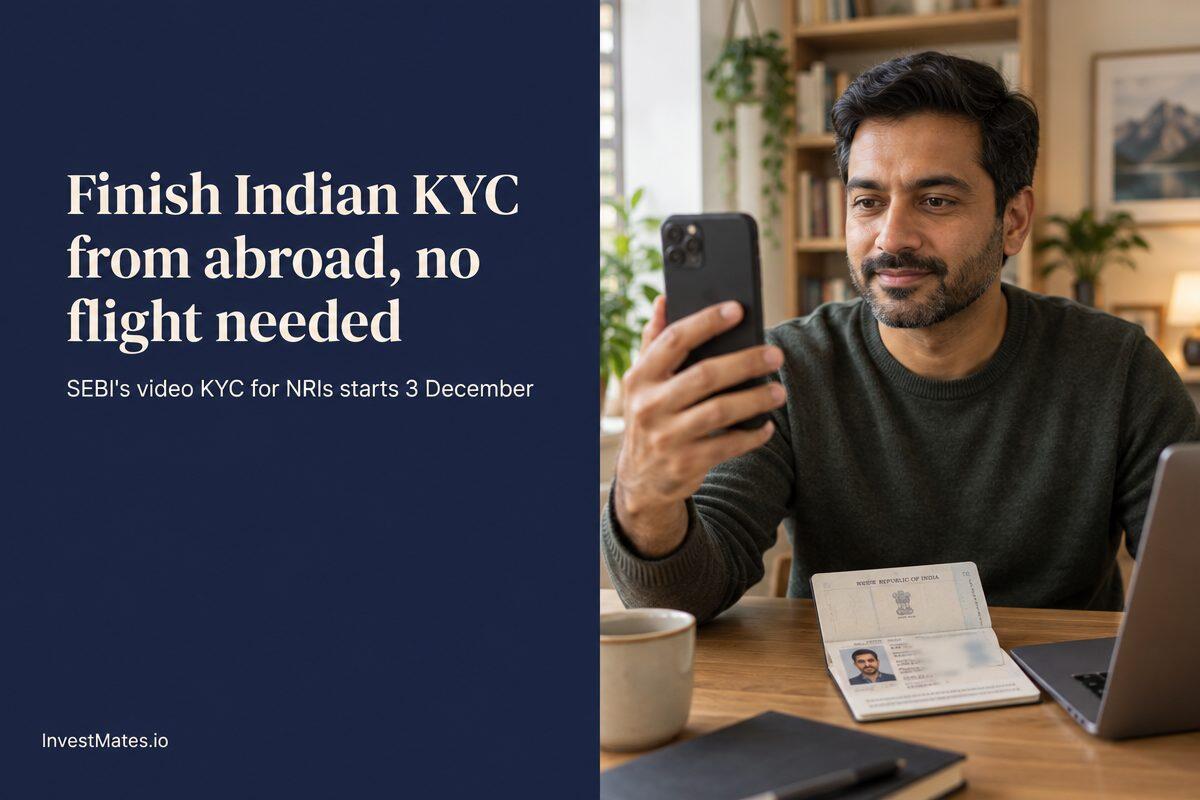
From 3 December 2026, NRIs, OCI cardholders and foreign nationals living in a FATF-compliant country can complete SEBI digital KYC with a broker, depository participant or fund house without being in India. Until now, digital KYC needed you physically in India. The new freedom comes with a strict video call and precise document rules.
What SEBI changed in the KYC rules
If you live abroad and have tried to open or update an Indian investment account online, one SEBI rule probably blocked you. SEBI issued its KYC circular on 4 November 2026, and it takes effect from 3 December 2026 for every SEBI-registered intermediary, exchange, clearing corporation and depository.
The rule it relaxes comes from SEBI's KYC Master Circular of 12 October 2023. That rule made the intermediary confirm your physical location was in India during digital KYC. So if you lived in Seattle or London, you couldn't finish online onboarding with a new broker.
The new circular covers an individual PROI client, meaning a person resident outside India who is an NRI, an OCI cardholder or a foreign national. If you're located in a country that complies with the Financial Action Task Force (FATF), the global anti-money-laundering standard setter, the India location rule no longer applies to you.

| Your situation | Rules that apply | Can you finish digital KYC from abroad? | What to do |
|---|---|---|---|
| Living in a FATF-compliant country, KYC done on or after 3 December 2026 | New PROI process | Yes | Prepare documents and a clean video call |
| Living in a FATF non-compliant country | Existing KYC process | No, the India location rule stays | Plan KYC around a trip to India |
| KYC already completed before 3 December 2026 | Old provisions continue | Already done | Nothing, unless an update is triggered |
It also replaces SEBI's December 2025 circular, which had only eased geo-tagging for NRI re-KYC. Fresh onboarding and re-KYC now follow one process.
How SEBI digital KYC for NRIs works in practice
The process is the same whether you're opening a new account or updating an old one. What changes is where you can be, and what the intermediary has to check.
The documents you'll need
- PAN: checked against the Income Tax database, so you don't send a copy.
- Passport copy, plus your OCI card if you hold one.
- One officially valid document (OVD) for identity and address, showing your overseas address.
- A mobile number, Indian or international, and an email, both verified by OTP where feasible.
If you're a foreign national and your OVD carries no address, a foreign government document or a letter from a foreign embassy in India can stand in. Any document not in English needs an English translation, attested by a certifying authority, before you submit it.
If you can't show the originals
The intermediary normally sees your original OVD and keeps self-attested copies. If you can't produce the original, the circular accepts a DigiLocker e-document, an e-document the issuer can verify, Aadhaar e-KYC by OTP, biometric or face check, or an attested copy.
Attestation can come from a notary public, an Indian embassy or consulate in your country, a court magistrate or judge, or an authorised official at an overseas branch of an Indian scheduled commercial bank. Branches of overseas banks that have a relationship with Indian banks also qualify.
The attested copy must show the date, the place, and the attester's name with a licence number or employee code. If a detail is missing, the copy doesn't meet the circular, so check the stamp before you post or upload anything.
The video call is stricter than you might expect
Physical in-person verification is still the default. Video in-person verification (VIPV) applies when a physical meeting isn't feasible, which describes almost anyone onboarding from abroad. The circular sets these safeguards:
- Your consent is recorded so it can be audited and can't be altered.
- Random prompts during the call prove the video isn't prerecorded.
- The video carries live GPS coordinates and a timestamp.
- VPNs, proxy servers and spoofed IP addresses are blocked.
- Your IP address must come from India or a FATF-compliant country, matching the country on your form and OVD.
- Face liveness checks run, and your face is matched to your document photo.
If you submitted the form digitally, you'll also sign by hand on camera so the official can match it.
My advice: switch off any VPN you use for Indian apps before the call, and join from the country on your KYC form. The circular tells intermediaries to block VPN connections and to match your IP country to the one you declared.
What the change means for you
The biggest gain goes to people who need a new relationship with an Indian intermediary and live far from India.
Opening a new investment account from abroad
Priya lives in Seattle and wants a demat account with a second broker. Before 3 December, digital onboarding needed her in India. From 3 December she can do it from home, with her PAN, passport and a US address document, if her broker confirms the US qualifies and offers the video call.
The account itself still follows the usual route: an NRI demat account linked to her NRE or NRO account, and a PIS account for repatriable share trades where her bank asks for one.
Updating an account you opened as a resident
Arjun moved to Toronto and still holds a resident demat account. He has to convert the resident demat account to NRI status, and the KYC update can happen from Canada if his intermediary confirms Canada qualifies and offers the video call. The same applies to your mutual fund KYC with a fund house.
Clients in countries that don't qualify
If you live in a FATF non-compliant country, nothing changes. The existing process, including the India location rule, continues for you. The circular doesn't define "non-compliant" beyond pointing to FATF's published details, so ask the intermediary to confirm your country before you start.
What you should do now
- Check your KYC record with a KYC registration agency (KRA) using your PAN. A new intermediary can rely on a record another SEBI-registered intermediary already uploaded.
- Ask your broker or fund house whether your country of residence qualifies, and when its VIPV process goes live.
- Gather your PAN, passport, OCI card if you have one, and an overseas address document in English.
- Book attestation early if you can't show originals, and check the stamp carries every required detail.
- Plan the video call from your country of residence, on a normal connection with no VPN.
If a broker has stalled your onboarding because you're abroad, I'd wait for 3 December rather than book a flight to India just for KYC.
What to watch after 3 December
The intermediary must send your KYC details to the KRA within three working days of finishing the process. Each detail gets tagged "validated" once checked, and the record works across intermediaries even if some details aren't yet validated.
Intermediaries still carry full responsibility for your KYC, including enhanced due diligence based on your risk profile. That means one may ask for more than the minimum list, and building a compliant video process takes time, so not every platform may be ready on day one.
Conclusion
SEBI digital KYC from abroad opens on 3 December 2026. I'd start by checking your KYC record against your PAN, since an intermediary can reuse a record already on file. If those Indian holdings also raise FBAR or PFIC questions on the US side, InvestMates can help you get both sides right.
Frequently asked questions
Does SEBI's digital KYC relaxation apply to OCI cardholders?
Yes, SEBI's relaxation covers OCI cardholders registered under Section 7A of the Citizenship Act, 1955, if they live in a FATF-compliant country. You'll be asked for your OCI card along with your passport. If you're unsure which status you hold for investing, the difference between NRI and OCI matters for which accounts you can open.
Can I complete SEBI KYC with Aadhaar e-KYC while living abroad?
Aadhaar e-KYC by OTP, biometric or face authentication is one accepted alternative when you can't show your original OVD. It only helps if you hold an Aadhaar and can complete the check from abroad. Your PAN as an NRI is still required, because the intermediary verifies it against the Income Tax database.
Can I sign SEBI KYC forms electronically from abroad?
Yes, the circular accepts a scanned physical form with an e-signature or a digitally completed form with an e-signature. Your specimen signature can be a wet signature or a cropped image of your e-signature. If you submit digitally, you still sign by hand on camera during the video verification.
Do foreign nationals who aren't NRIs or OCI cardholders qualify for SEBI digital KYC?
Yes, SEBI's relaxation covers foreign nationals who live in a FATF-compliant country, not only NRIs and OCI cardholders. A foreign national seeking registration as a foreign portfolio investor is pointed to the separate FPI framework instead. The circular doesn't define "foreign national", so confirm your status with the intermediary.