
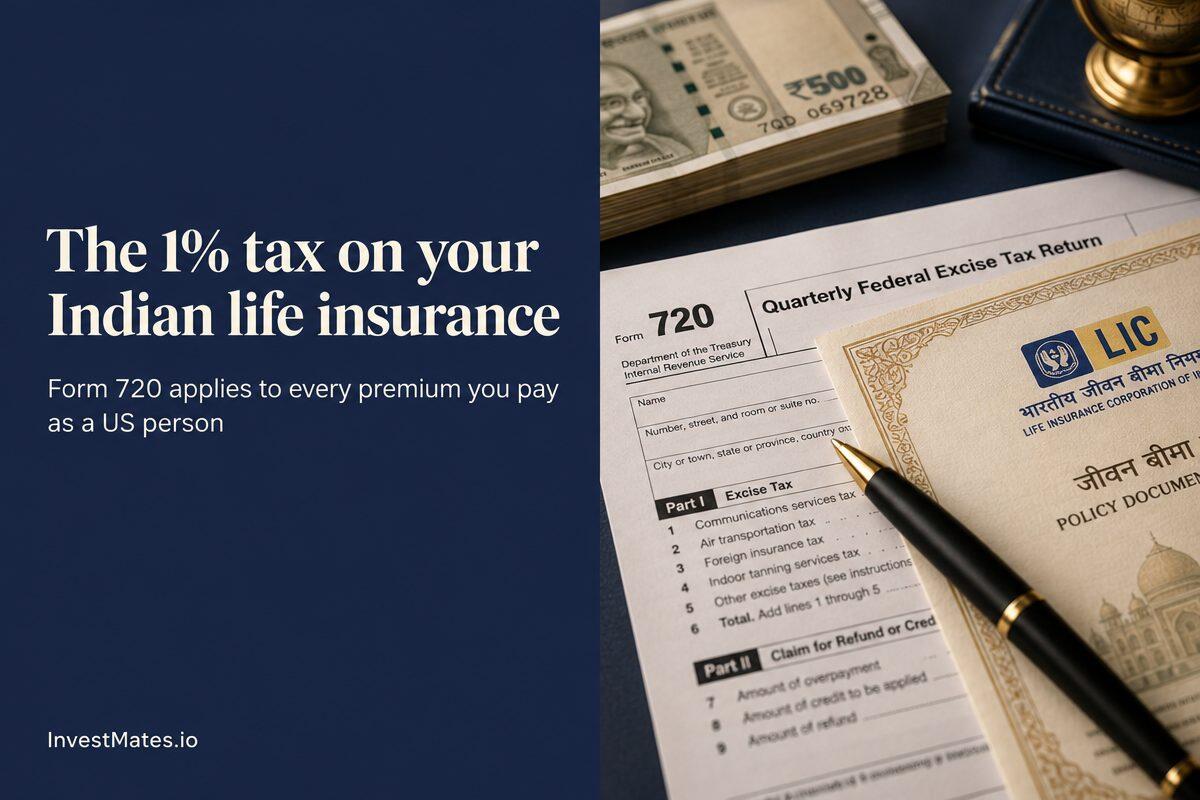
If you're a US citizen, green card holder or US resident paying premiums to an Indian insurer, you owe a 1% Form 720 excise tax on every premium, filed for the quarter you pay it. The tax is often a few dollars, but an unfiled quarter stays open to the IRS indefinitely.
What the 1% excise tax on foreign insurance premiums covers
Section 4371 of the Internal Revenue Code charges 1 cent per dollar, or fraction of a dollar, on premiums paid to a foreign insurer for a life, sickness or accident policy, or an annuity. The next section of the Code limits it to policies on the life of a US citizen or resident.
So the type of policy doesn't matter. An LIC endowment, a money back plan, a pure term plan and a ULIP all qualify, and the Section 4371 excise tax applies to every renewal premium, not only the first.
India's tax treaty doesn't switch it off
Article 2 of the US-India tax treaty lists this excise tax, and the treaty's Technical Explanation treats Indian insurers covering US risks as effectively exempt.
The catch sits in Revenue Procedure 2003-78. You can treat a premium as exempt only if, before you file, you know the insurer has signed a closing agreement with the IRS.
I checked the IRS closing agreement lists between June and September 2026, and no Indian insurer appeared on them. Until your insurer shows you one, I'd treat every premium as taxable.
India's own exemption is a separate question
Your policy's payout may be tax-free in India under Section 10(10D) of the Income-tax Act, 1961, which became Schedule II of the Income-tax Act, 2025 from tax year 2026-27. That exemption is an Indian rule, and it does nothing to the foreign life insurance excise tax or to US income tax on the policy.
Who has to file Form 720 excise tax
The person who pays the premium to the foreign insurer files the return and pays the tax, under the Treasury regulations for this excise tax. If nobody in the payment chain does, the liability falls on whoever issued the policy or is insured under it.
Whether there's any tax at all depends on the insured's status on the day each premium reaches the insurer. That test produces some results people don't expect:
- Your parents pay the premium from India on a policy covering your life. The premium is still taxable, and in practice you, as the insured, are the one who files.
- You pay the premium on a policy covering your spouse, who is a nonresident alien. There's no tax, because the insured isn't a US person.
- Your spouse is treated as a resident only through a joint-return election under Section 6013(g). That election covers income tax, not this excise tax, so the ordinary residency test in Section 7701(b) still decides.
Policies you bought before moving to the US
The tax starts with the first premium paid after the insured becomes a US person: the green card date, or the day the substantial presence test is first met. Premiums paid before that are outside it.
A US citizen has been a US person since birth. Every premium on a policy covering a citizen is caught, however long ago it was bought in India.
How Form 720 works on a real premium
Form 720 is a quarterly return. Foreign insurance premiums go on the line for IRS No. 30. For 2026 the returns are due April 30, July 31 and October 31, then February 1, 2027 for October to December, because January 31 falls on a Sunday.
Worked example. Priya holds a green card and pays her annual LIC endowment premium in March 2026. In dollars it comes to $1,400 (an illustrative figure), so her excise tax is $14.
She reports it on Form 720 for the January to March 2026 quarter, due April 30, 2026, and pays the $14 with the return.
The mechanics that catch people out, all from the IRS instructions for Form 720:
- You need an EIN to file Form 720, even as an individual, and you can apply for one online.
- With $2,500 or less of Part I tax in a quarter, you don't make deposits. You pay the tax with the return instead.
- Once you've filed, the IRS expects a return every quarter until you file one marked Final. With a once-a-year premium, that means zero returns for the quiet quarters while you still hold the policy.
How the excise tax sits next to FBAR, Form 8938 and Form 8621
Form 720 is one of four filings a foreign policy can touch, and the policy's design decides the rest. I don't treat the policy itself as PFIC stock, so there's no Form 8621 on it, though a ULIP that lets you pick funds sold to the public is a different case.
The four filings line up like this for the common Indian policy types:

| Form 720 | FBAR | Form 8938 | Form 8621 | |
|---|---|---|---|---|
| Pure term, no cash value | Yes, each premium | No | No | No |
| LIC endowment, money back or whole life | Yes, each premium | Yes, at surrender value | Yes, Part VI, at surrender value | No |
| ULIP investing in insurer-only funds | Yes, each premium | Yes, at surrender value | Yes, Part VI, at surrender value | No |
A pure term life insurance plan has no cash value, so it stays off the FBAR and Form 8938, but never off Form 720.
The other policies still depend on each form's threshold. The FBAR starts at $10,000 across all foreign accounts, and Form 8938 at $100,000 at year end or $150,000 at any time for a married couple filing jointly in the US.
Who this applies to, and who it doesn't
It applies to you if you're the insured on a policy from a non-US insurer, and you're a US citizen, a green card holder or a substantial presence resident when the premium is paid.
It doesn't apply when:
- you live in India and aren't a US citizen, green card holder or US resident
- you're on a visa and are still a nonresident alien for US tax that year
- the insured is a spouse or parent who isn't a US person, whoever pays the premium
- the premium was paid before the insured became a US person
Annuity contracts from a foreign insurer fall under the same section. Pension-type products such as NPS need a separate analysis.
What to do if you've missed quarters
At a 1% rate the tax is usually small, so catching up costs little. Work through it in this order:
- Pull every premium receipt since the insured became a US person, with the payment date and amount.
- Convert each premium to dollars and group the premiums by calendar quarter.
- Apply for an EIN if you don't have one.
- File a Form 720 for each quarter with a premium, completing the IRS No. 30 line and paying the tax.
- When the penalty notice arrives, reply asking for abatement for reasonable cause.
Penalties under Section 6651 run at 5% a month for filing late and 0.5% a month for paying late, each capped at 25%. On a $14 tax, that adds only a few dollars plus interest.
I'd file the late quarters even when each one is $10, because Section 6501(c)(3) lets the IRS assess an unfiled return at any time.
Before the next quarter closes
Find your 2026 premium receipts and note each payment date. If one fell between October and December, that quarter's return is due February 1, 2027, and I'd file it even for $5. If you've paid for years without filing, InvestMates can work through the back quarters alongside your FBAR and Form 8938.
Frequently asked questions
What are the payment instructions for Form 720?
You pay Form 720 tax by IRS Direct Pay, EFTPS, check or money order, or by direct debit if you e-file the return. Use the Form 720-V voucher only with a check or money order, and skip it for any electronic payment.
Is Form 720 still required for foreign life insurance premiums?
Yes, Form 720 is still required for every quarter in which a premium on a US person's policy is paid to a foreign life insurer. The 1% rate in Section 4371 hasn't changed, and the instructions still carry the IRS No. 30 line for foreign insurance.
Does the 1% Form 720 excise tax apply to Indian health insurance premiums?
Yes, if the health policy covers you while you're a US person, because Section 4371 charges the same 1 cent per dollar on sickness and accident policies from a foreign insurer. A mediclaim policy covering parents who aren't US persons falls outside it, whoever pays the premium.
Do I still owe Form 720 excise tax after moving back to India?
It depends on your US status, not your address. Once you're no longer a US citizen, green card holder or US resident, premiums paid after that date fall outside the tax, so your final US tax year is where the obligation ends. A US citizen living in India still owes it on every premium.
Does the Streamlined procedure cover missed Form 720 returns?
No, the Streamlined procedures don't cover Form 720 or its penalties. You file the late quarterly returns separately, pay the tax, and ask for penalty relief for reasonable cause, while Streamlined filings still handle the FBARs and Form 8938 for the same policy.